Why Iron Man’s Suit Is Impossible in Real Life
Iron Man’s suit works because the films do not really show what happens inside the armour.
Tony Stark flies, gets hit, crashes, lands, and keeps going as if the suit has solved everything.
In real life, the body would be the first thing to fail. Stronger metal, better motors and smarter sensors can be imagined. But none of that changes the body inside the suit.
G-Force Is the First Problem
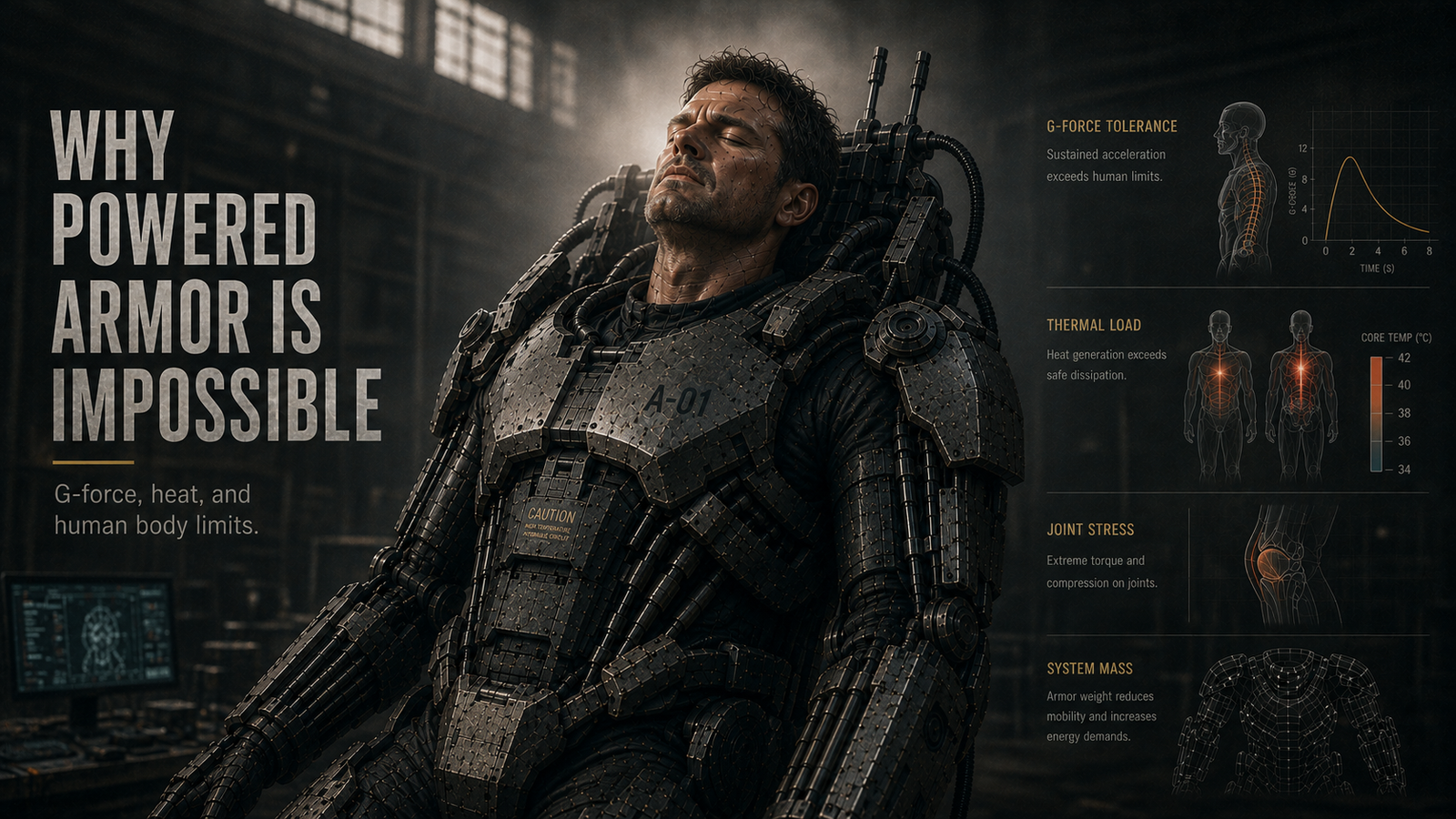
People usually judge the suit by how fast it flies. The harder question is what happens when that speed changes in a fraction of a second. He shoots upward, stops in mid-air, turns sharply, gets thrown backward, and launches again. Those movements would create G-force, and the person inside would feel it.
Even trained fighter pilots need special gear for high-G flight because the body can lose normal blood flow, vision and consciousness. Blood flow could shift, vision could narrow, and the neck and spine would take far more load than normal movement allows.
A Flying Metal Suit Would Still Have Weight
The films make the armour feel almost weightless. A real one would feel less like clothing and more like being strapped into a machine. Even advanced materials still have mass. When the suit turns, stops or lands, that mass still has to be controlled. Much of that stress would pass through the shoulders, spine, hips, knees, elbows and neck.
A normal human skeleton is not built to behave like the frame of a jet-powered vehicle. If the armour moves beyond what the body can tolerate, the protection itself can injure the wearer. Armour can block outside damage while still passing dangerous force into the wearer.
The Joints Would Take the Punishment
Human joints are not machine hinges. Knees can twist. Shoulders can dislocate. Ligaments can tear. The spine can only absorb so much pressure. Iron Man’s suit moves with perfect timing because the film needs it to.
In a real suit, even a small delay or mismatch would matter. If the suit bends before the body is ready, the body resists. If it turns too sharply, the knee or hip takes the load. If an arm thruster pulls too hard, the shoulder could be injured. Making the suit stronger does not solve this by itself.
A stronger suit may protect the machine better than the person wearing it.
Heat Would Be Hard to Control
A suit with engines, weapons and electronics would produce serious heat. The wearer would be trapped inside the same closed shell that is producing and holding that heat. The body is producing heat too, and it still needs air, cooling and a stable temperature. A sealed metal suit makes those basic needs harder to maintain.
The suit cannot just generate power. It has to get rid of heat. More power would make cooling harder, not easier. The films let the suit fly, fire weapons, take damage, and rarely show that problem.
The Force From a Crash Still Has to Go Somewhere
Metal armour can reduce damage, but it cannot make impact vanish. If Iron Man slams into the ground, the suit may spread some force and keep debris away from his body. But the body still has to slow down inside the suit.
People can be injured in crashes even when the vehicle is not completely destroyed. The sudden slowdown still reaches the body. A hard landing does not become safe just because the armour is strong. The force still has to go somewhere. If too much of that force reaches the person inside, bones, organs and the brain are still at risk.
Real Technology Is Not There Yet
Real exoskeletons exist, but they are mostly built for assistance, rehabilitation or carrying loads.
Jet suits exist too, but they are controlled flight devices, not flying combat armour. They are not built for missile hits, violent turns, hard landings or weapon fire. A real exoskeleton mainly assists the body. Iron Man’s suit asks the body to survive inside a weaponised flying machine.
The Body Is the Limit
Engineering can improve, but that is not the main issue here. The human body does not improve like metal, motors or software. Bones still break. Blood still has to reach the brain. Joints still have limits. The brain cannot keep taking violent motion and remain normal. That is why the movie version needs fiction, not just technology. The body inside still has the same limits as the rest of us.
Final Takeaway
Iron Man’s suit is impossible in real life because it treats the human body as if it can survive anything. It cannot.
The metal can improve. Engines, sensors and software can improve too. But the body inside still has the same old limits.
Tony Stark survives because cinema protects him. Physics would not.
Related Reads
Why Shrinking Humans Like Ant-Man Is Impossible
Why Teleportation Is Impossible
Why Sci-Fi Holograms Still Don’t Exist in Real Life
Frequently Asked Questions
Can an Iron Man suit exist in real life?
A limited powered suit can exist. Exoskeletons and jet suits already exist in controlled forms.
But a movie-style Iron Man suit is a different case. It would have to fly, land, turn, fight and protect the wearer all at once.
Why would the suit hurt the wearer?
Because the suit cannot erase force. Acceleration, impact, heat and hard landings would still reach the wearer’s body.
Could future technology solve the G-force problem?
It could reduce some risk. Better padding, pressure systems and smarter controls could help.
But movie-style sudden stops, turns and crashes would still be dangerous for a human body.
What is the biggest problem with Iron Man’s suit?
Keeping the person inside alive.