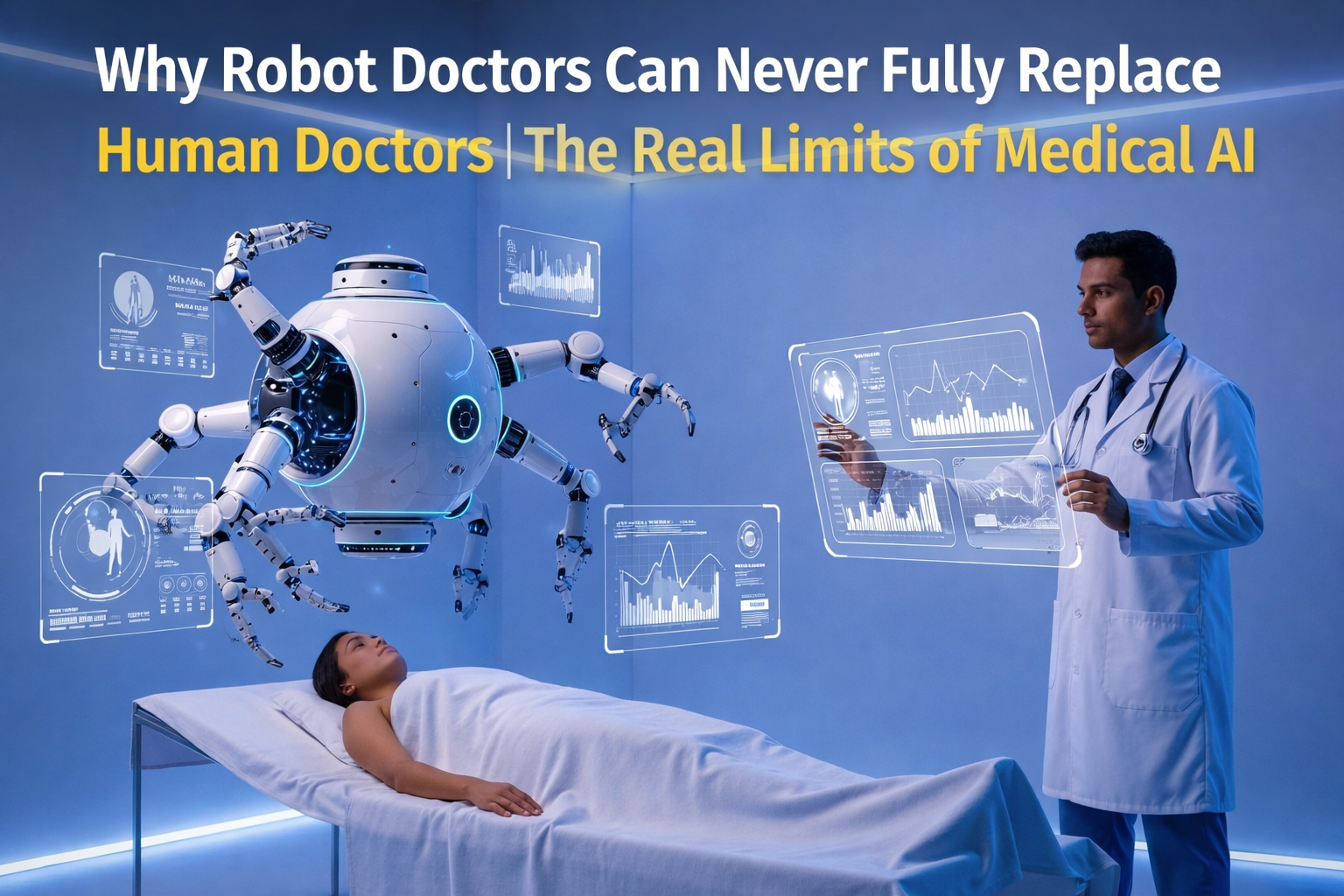
Why Robot Doctors Can Never Fully Replace Human Doctors
For decades, science fiction has imagined robot doctors that can diagnose disease, assist surgery, and avoid the fatigue that affects human doctors. That idea no longer feels distant. AI can already read medical scans, compare reports, predict risks, assist surgeons, and sort through patient data quickly. But medicine is not only a data problem.
If healthcare were only about pattern matching, human doctors would already be easy to replace. The real difficulty is that patients are not clean data points. They come with fear, pain, family pressure, money problems, unclear symptoms, and questions they may be afraid to ask.
A machine can process a case. A doctor has to understand the person behind it.
Patients Are Not Clean Cases
AI works best when the information is clean. Real patients rarely are. One person may downplay serious chest pain because they are scared of the hospital bill. Another may focus on a minor symptom and forget to mention family history. A family may push for aggressive treatment, while the patient quietly wants comfort and less suffering.
An algorithm can read the file. A doctor has to notice what is missing, unclear, or left unsaid.
The Hard Part Is Judgement
Medical diagnosis does not always move neatly from symptom to answer. Two patients can have the same disease and still need different care. Age, earlier illness, side effects, family support, and personal choice can all change the decision.
AI can suggest possible diagnoses, and that is useful. But when test results conflict, symptoms do not fit neatly, or every treatment option carries risk, someone still has to make a judgement call. A doctor is not only choosing the most likely answer. They are also weighing what could go wrong if that answer is wrong.
Empathy Is Part of Care
Empathy in medicine is not a soft extra. It affects care. When someone hears bad news — cancer, organ failure, a risky surgery, or a long-term condition — facts alone are not enough. The patient may need time. The family may need the same thing explained twice. Sometimes silence matters as much as explanation.
AI can generate comforting words. It can explain a disease clearly. But comfort is not only language. A doctor sitting in front of the patient carries a different responsibility. The patient knows there is a person listening, responding, and staying with the decision.
Ethics Cannot Be Left to Software
Doctors do not only solve technical problems. They face ethical decisions too.
Should an elderly patient go through a risky surgery?
Should life support continue?
Should painful treatment continue when recovery is unlikely?
These questions involve consent, dignity, family pressure, and the patient’s wishes. They cannot be reduced to a clean output from a system.
An algorithm can suggest options. It cannot carry responsibility like a doctor.
Robotic Surgery Still Needs Surgeons
The word “robotic” can mislead people. In most robotic surgeries, the machine is not operating independently. A trained surgeon is controlling the tool. During surgery, anything can change: bleeding can start, anatomy may be unusual, or a complication may appear suddenly. The surgeon has to adjust in real time.
Robotic systems can improve precision, but they cannot replace every judgement inside an operating room.
Trust Needs Accountability
Patients need to know who is responsible when something goes wrong. If an AI gives a wrong diagnosis, who answers for it: the hospital, the software company, or the doctor who used the result?
This is not like a software bug. In healthcare, one wrong decision can change a life.
Patients do not only want a fast answer. They want someone who can explain the decision and stand by it.
AI Works Best Beside Doctors
AI will keep improving medicine. It can help doctors read scans, reduce paperwork, notice patterns, and plan treatment. But support is not the same as replacement. The doctor still has to decide when the AI is useful, when it may be wrong, and when the patient does not fit its pattern.
Final Takeaway
Robot doctors will make medicine faster and more accurate in many areas. But fully replacing human doctors is different. Medicine is not only about reports, scans, and predictions. It is also about fear, pain, trust, judgement, and responsibility.
Robot doctors can become powerful assistants. They cannot become the human doctor.
Related Reads
Why Self-Driving Cars Can’t Be 100% Perfect