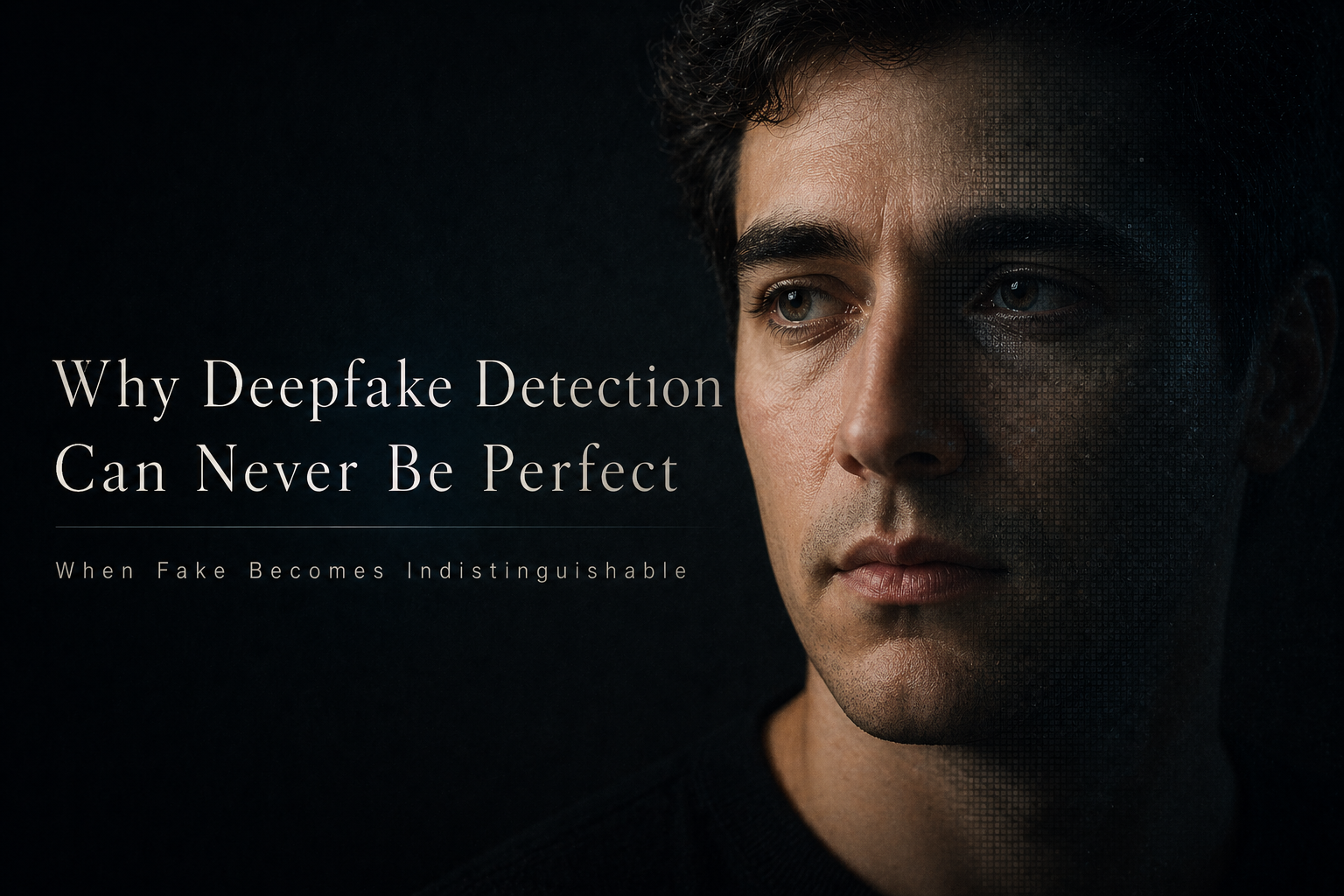
Why Deepfake Detection Can Never Be Perfect
Most deepfakes do not reach a forensic lab first. They reach a feed. A fake clip of a leader, celebrity, or witness can be forwarded on WhatsApp, reposted on X, argued over, and shared again before anyone checks the original file. By the time experts inspect it, the damage may already be done. That is the first reason perfect deepfake detection breaks down. It is always late.
Many fake videos can be caught, but not all of them. There may be no original file to compare against. The video may already be too compressed to inspect properly. Or the fake may simply avoid the old mistakes detectors were built to catch.
Detection Is Always Chasing
Deepfakes are built with AI systems that study real videos and learn how faces, voices and movement behave. When a detector catches one weakness, the people making the fakes change the method. Detectors improve after that, but the fake makers have already moved on. That is why detection is usually catching up to the newest fakes, not stopping them in advance.
The problem gets worse as deepfake tools spread. A fake might be made in a paid app, modified with an open-source model, and cleaned up with another tool before upload. A detector trained on one style of fake may miss another completely.
A Clean Fake Gives Less Away
Early deepfakes were easier to catch because they often had blurry edges, weak lip-sync, or lighting that felt wrong. Modern systems are getting better at removing those clues. The harder problem is a fake where those mistakes are gone. If the real clip and the fake clip look the same in every detail available to the detector, there may be nothing clear to catch. At that point, the system is no longer proving manipulation. It is estimating probability.
We Often Do Not Have the Original
Detection is strongest when there is something trusted to compare against: the original file, the camera source, reliable metadata, or a verified chain of custody. But online videos rarely arrive like that. They are reposted, downloaded, cropped, compressed and stripped of context.
The original file can be missing, the source unclear, and the metadata already gone. In that situation, the detector is not reading a clean original. It is reading whatever is left after uploads, downloads, cropping, compression and reposting.
When the Human Clues Disappear
Modern deepfake systems are trained on huge amounts of real video and audio. They learn faces, expressions, eye movement, skin texture, voice patterns and tiny timing details that make the clip feel normal. When those details are copied well, humans struggle. Detectors also struggle if they were trained mainly to catch the older, visible mistakes.
Real-World Videos Break Clean Detection
A detector is still a model. It does not know truth directly; it reads patterns in a file. A tiny change the viewer cannot see can still push it toward the wrong answer. The mistake can go both ways: a fake slips through, or a real clip gets flagged.
Think about a video forwarded through WhatsApp or reposted from one platform to another. It may be resized, compressed, downloaded, re-uploaded, or screen-recorded before anyone tries to inspect it. Each step can erase small forensic clues. The more a video is shared, the less clean evidence remains.
Internet Scale Changes Everything
A detector can look strong in a controlled test and still struggle online. Platforms deal with huge volumes of video, different languages, different formats, low-quality uploads and live sharing. Even very high accuracy can be misleading here. If millions of videos are moving through platforms, a one-percent failure rate can still mean thousands of wrong calls.
False Positives Damage Trust
There is another risk: real videos can also be wrongly flagged. If that happens often, people start doubting genuine evidence too. That gives bad actors an easy escape. A real video can be dismissed with one line: “That is a deepfake.” This is the liar’s dividend. The fake does not even have to win. It only has to make truth easier to deny.
Fake videos do not just fool people. They can also make people doubt real videos. That is the danger: even real evidence can be waved away.
The Hard Limit
Here is the hard limit. A detector can only read what is still inside the file. If the file no longer contains a reliable difference between real and fake, there is no perfect test. The system can estimate risk, compare sources and look for patterns. But it cannot prove something when the evidence is no longer there.
Why Perfect Detection Is Not Possible
Deepfake detection will get better. It will catch more fakes and reduce damage. But it will not catch everything. Original files will sometimes be missing. Some videos will be too compressed to inspect cleanly. Newer models will learn how to avoid the signs detectors look for. A few fakes may leave no clear trace at all. That is why perfect deepfake detection is not possible. Better software matters, but it is not enough.
Verification matters too. You need the original source when possible, platform checks, watermarking, context, and human judgment. Provenance tools can help show where a file came from, but they cannot prove that everything inside it is true. When almost anything can be faked, the hardest job is not just catching lies. It is keeping real evidence believable.
Related Reads
Why Online Scams Can Never Be Fully Eliminated