Why Movie-Style Teleportation Is Impossible
The Person Who Arrives May Not Be You
Step into a machine in Delhi. A second later, someone walks out in London with your face, your voice and every memory you had before the machine was switched on. Everyone calls it teleportation. But nothing may have travelled.
A movie-style teleporter would have to scan your body, send the information to another location and rebuild you there. In most versions, the original body is destroyed so that two identical people do not remain alive. That may look like instant travel from the outside. For the person who entered the machine, it could be something very different.
A Body Cannot Simply Be Scanned and Rebuilt
A transporter would need more than a record of your body’s shape. It would have to capture a living moment—blood moving, cells reacting and signals passing through the brain. The body is not a statue that can be measured once and assembled somewhere else. It changes continuously.
The brain makes the problem much harder. Its cells, connections, chemicals and electrical activity are all involved in memory, behaviour and awareness. Recording the structure alone would not be enough. The machine would also need to preserve the activity taking place inside it.
Even a small mistake could alter a memory, change someone’s behaviour or damage a vital brain function. By the time a machine had recorded one moment perfectly, the living body would already have moved on to the next. Nothing we can build today comes close to handling that problem.
The Mind Is Not a File
Movie teleportation treats the mind like a file. Copy it into another body, and the same person is supposed to come back. But a brain is not a hard drive. A memory is not one file sitting in one place. It depends on activity spread across different parts of the brain. The way you think and feel is also affected by chemicals, hormones, sleep, pain and the condition of the rest of your body.
We do not know how much of this would have to be copied before the rebuilt person could truly be called the same person. Recreating every brain cell might still miss the exact activity happening between them. Rebuilding the body would be only half the job. The machine would also have to restart the mind exactly where it stopped.
Quantum Teleportation Is Not the Movie Version
The word teleportation is used in real physics, but it describes something far more limited.
Quantum teleportation transfers information about the state of a quantum system. Matter itself does not disappear from one place and reappear in another. The process also needs ordinary communication, so it cannot be used to send information instantly across space.
An unknown quantum state cannot be copied perfectly while leaving the original untouched. This is known as the no-cloning theorem. None of this tells us how to transport a human body or continue a person’s conscious experience somewhere else. Quantum teleportation is real. Human teleportation is still science fiction.
The Copy Would Believe It Was You
The person in London would remember entering the machine in Delhi. Your childhood, your family and private moments from your life would all feel like their own. Naturally, they would believe the journey had worked. That is exactly what a perfect copy would say. Those memories would make the person in London feel completely genuine. But the memories alone would not prove that the person who entered the machine had travelled.
If the original brain was destroyed in Delhi, its activity ended there. We know of no process that allows awareness to leave one brain and begin again inside another. Nobody watching would notice the difference. But the original traveller may never have experienced an arrival.
What If the Original Body Survived?
Suppose the machine fails to destroy the body in Delhi. One version remains there while another wakes up in London. They share the same memories and recognise the same family, yet they are now two people whose lives will immediately move in different directions. One might go home in Delhi. The other might leave the machine in London. From that point onwards, they would have different experiences and form different memories.
The transporter would not have moved one person between two places. It would have created a second person with the same past. Destroying the original afterwards would not change what happened. It would only leave the copy as the sole survivor.
Would a Wormhole Count as Real Teleportation?
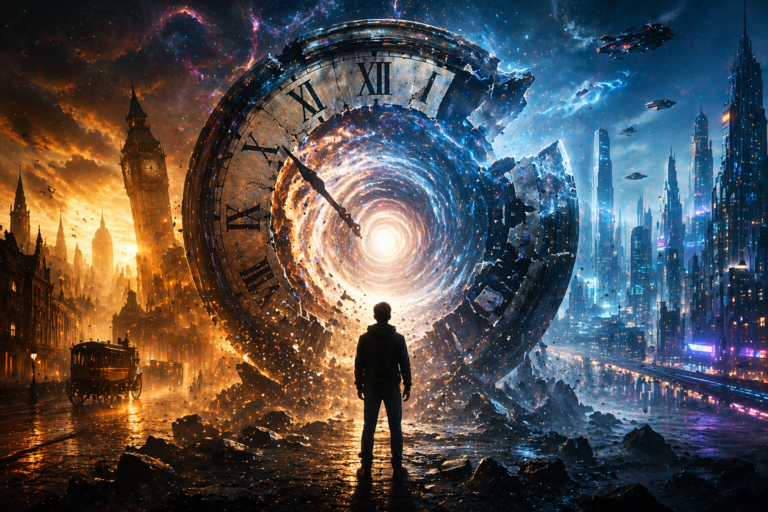
A wormhole would avoid this identity problem because your actual body would pass through it.
Instead of scanning and rebuilding you, a wormhole would act as a shortcut between distant points in space. You would enter one side and leave through the other. There would still be a physical journey, even if it covered a huge distance in very little time. The problem is that usable wormholes exist only in theory.
Some solutions to Einstein’s equations allow wormhole-like structures, but keeping one open may require exotic forms of energy that we do not know how to produce or control. No stable wormhole large enough for a person has ever been found. Even if one existed, keeping it open and passing through it safely would be another matter entirely.
Why the Movie Version Fails
Movie teleportation tries to solve distance by turning a human being into information. Perhaps a future machine could create a copy so accurate that nobody could tell the difference. It might reproduce your face, your memories and every detail of your behaviour.
The person at the destination would believe the journey worked. Your family might believe it too. But the machine could not prove that your own experience continued after the original brain was destroyed. It may create another version of you somewhere else. That does not mean the first one travelled.
Related Reads
Why Iron Man’s Suit Is Impossible in Real Life