Why Sci-Fi Holograms Still Don’t Exist in Real Life
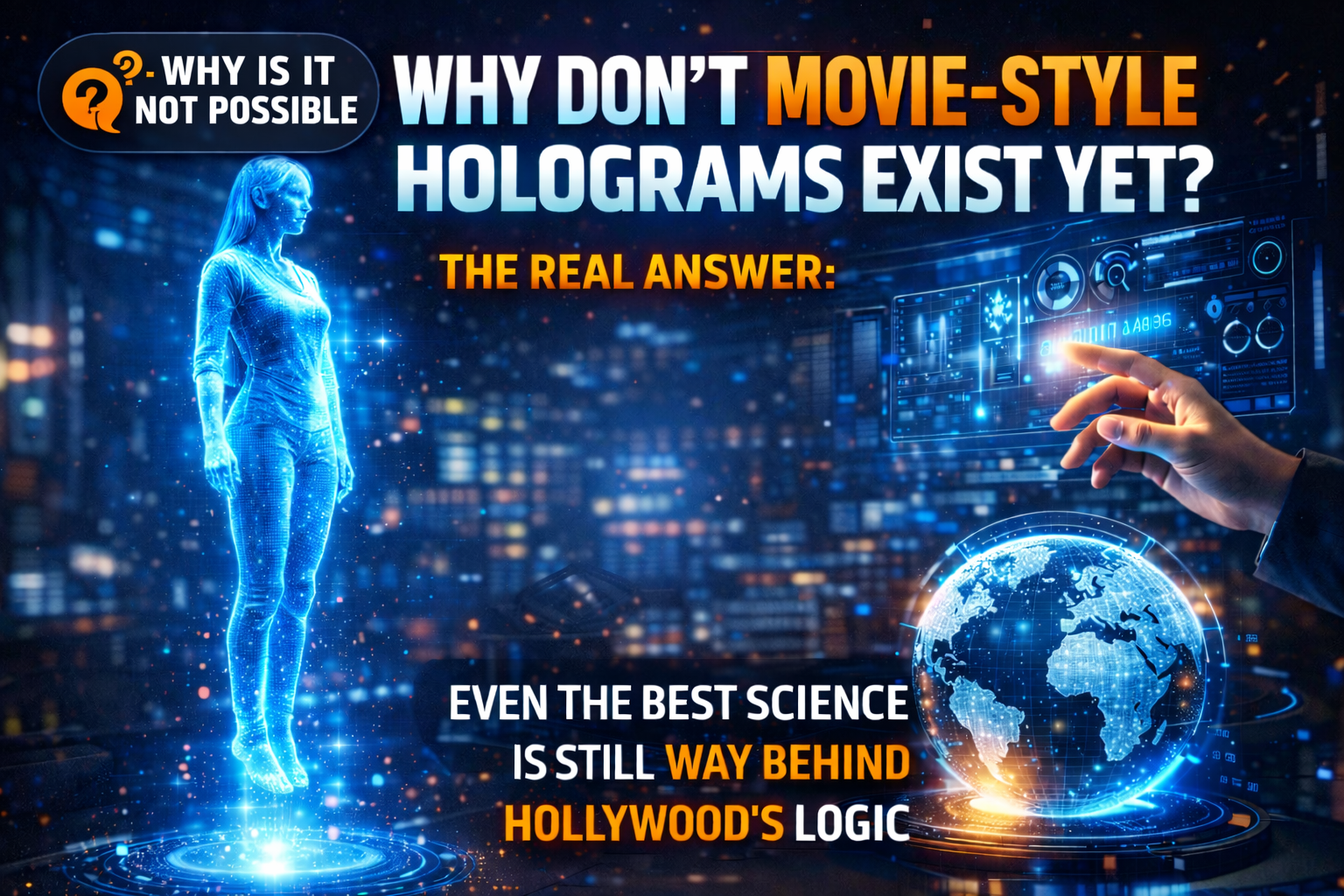
Sci-fi holograms look effortless in films. A person or machine appears in the middle of the room. You can walk around it, look at it from any side and sometimes even touch it. No screen or headset is visible.
Real displays can do some of this, but no system can do all of it at once. Some need glasses. Others use transparent screens, mirrors, mist or a dark room. Laboratory systems can create points of light in open air, but only on a very small scale. The main problem is that light does not stop at a chosen point in empty space.
Light Needs Something to Hit
A cinema projector works because its light hits a screen and is reflected towards the audience.
Without the screen, the beam simply travels through the air. Dust, smoke or mist may make the beam visible, but they do not leave a clear image floating in one place. To make a dot appear in mid-air, something at that spot has to emit or scatter light.
One method uses lasers to ionise tiny spots in the air, producing glowing plasma. Another moves a tiny particle around and lights it so quickly that the eye sees a complete shape. In both cases, the light comes from a real position in the room.
So far, the images are tiny. One optical-trap prototype produced images inside a volume of roughly one cubic centimetre. Laser-plasma systems can also draw shapes in the air. A life-sized figure would need vastly more points every second. Producing them brightly and safely around people is another problem.
A True Hologram Rebuilds the Light, Not the Object
A hologram does not fill the room with glowing points. It shapes light so that your eyes receive the same depth cues they would get from a real object. Move your head and the view should change with you.
Many experimental displays use a spatial light modulator, a panel that changes the phase or intensity of light pixel by pixel. A computer works out the pattern needed for each image. The depth can look real, but the image still depends on a carefully arranged set of optics. The viewer usually has to remain inside a limited viewing zone, and the projectors, lenses or waveguides still have to sit somewhere.
Seeing It From Every Side Is Much Harder
Film characters can circle a hologram and see the correct side of it from every position. Every viewing position needs a slightly different image. A person on the left must see the left side of the object, while someone on the right must see the other side. The more angles the display covers, the more image information it has to produce.
With current spatial light modulators, you cannot have a large image, high resolution and a wide viewing angle at the same time. Push one too far and another usually suffers. Widening the view may reduce sharpness, while enlarging the image may leave only a narrow area from which it can be seen properly. Researchers have widened the viewing angle, but only with extra optics, precise calibration and specialised hardware.
Bright Rooms Wash the Image Out
A faint image can look impressive in a dark demonstration room. Put the same image beside a window or under strong indoor lighting and much of it disappears. The image has to compete with the light already in the room and whatever is visible behind it.
Colour creates another problem. Red, green and blue light do not pass through diffractive optics in exactly the same way, so they must be lined up precisely. Lasers can also produce a grainy effect called speckle.
Researchers have produced full-colour holographic images in compact AR systems, but the display sits close to the eye and uses specially designed waveguides. That is very different from making a life-sized figure appear in the middle of a bright room.
Every Frame Has to Be Calculated
A flat screen only has to set the colour and brightness of its pixels. A holographic display has to calculate how light from the whole scene should interfere. Move the object or the viewer and the calculation changes. A still image is one thing. A moving, life-sized figure seen from several angles is far more demanding.
The hardware must generate new holograms fast enough to keep the movement smooth. It also has to correct small errors in the lasers, lenses and spatial light modulator, which can otherwise blur or distort the image. Faster processors and machine learning have helped, but the best results still need laboratory equipment. We are nowhere near getting the same result from a small projector on a table.
Touching the Image Is a Separate Problem
Seeing a 3D image does not mean you can touch it. Your hand would normally pass straight through the light. To make the image respond, cameras or sensors must track the position of your fingers. The computer must then update the picture with almost no delay.
The display must also hide the parts of the image blocked by your hand. If the picture keeps shining through your fingers, the illusion breaks. Making it feel solid is even harder. Ultrasound, air jets and laser effects can create small sensations on the skin, but they cannot reproduce the feeling of touching a solid person or machine. Films treat the image, tracking and touch response as one feature. In reality, they are separate systems.
Most “Holograms” Are Something Else
Many so-called holograms used at concerts and product launches are versions of an old stage illusion. A bright image reflects from an angled transparent surface and appears to float on the stage. Other products use transparent screens, spinning LED blades or AR headsets.
Light-field displays work differently by sending separate views in different directions. These effects can look convincing from the right position, but they are not free-floating objects that everyone in the room can see from any angle.
Why Sci-Fi Holograms Remain Out of Reach
Some parts of the movie version already exist. One system can create depth, while another can place tiny points of light in open air. Cameras can also track a viewer’s hands and eyes. What we do not have is one practical device that can do all of it.
A movie-style hologram would have to remain bright and sharp at life size. It would need to look correct from every side, react immediately when someone moved and work safely without a room full of equipment. These limits are connected. A wider viewing angle creates more data to process, while a brighter or larger image puts more pressure on the optics and hardware.
What we still cannot produce is a bright, life-sized image that floats in an ordinary room, looks correct from every side and reacts when someone moves or reaches towards it. Making a 3D image is no longer the main problem. Making it behave like a real object in a normal room is, and current hardware cannot do that.
Related Reads
Why Iron Man’s Suit Is Impossible in Real Life