Why Movie-Style Energy Weapons Cannot Work in Real Life
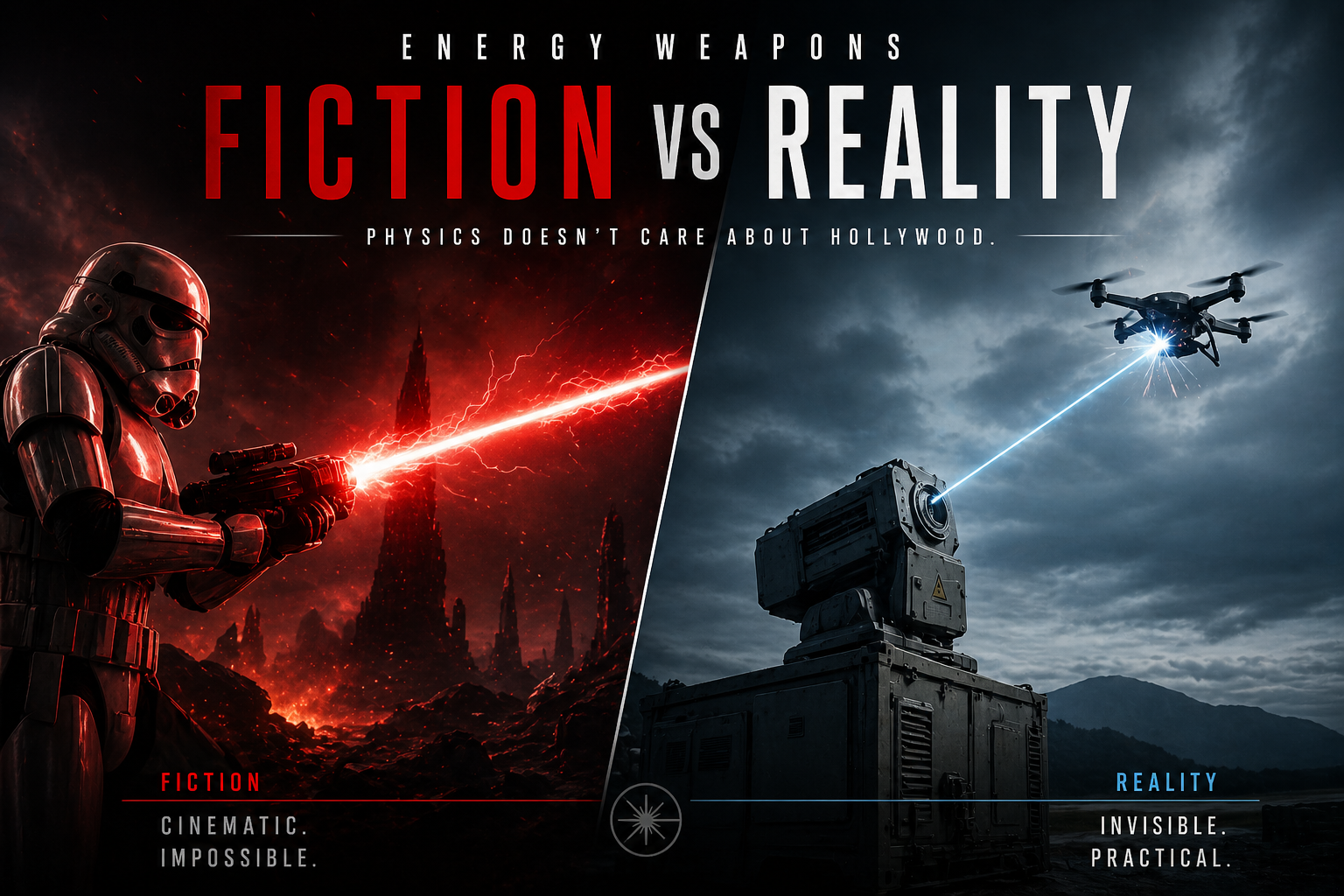
Energy weapons look simple in movies. A Star Wars blaster fires a bright bolt across the room, and the target is gone. Iron Man’s repulsors do even more. They fit inside his palms, fire again and again and never seem to overheat or run out of power.
Films can ignore where that energy comes from and what happens to all the heat. A real weapon cannot. Military lasers already exist, but they are nothing like movie blasters. They are large, power-hungry machines built mainly to damage drones, sensors and other vulnerable equipment.
A Blaster Needs an Enormous Burst of Power
The real challenge is delivering that energy quickly enough to cause serious damage. A bullet carries its energy in a small, solid projectile. An explosive releases its energy almost at once. A beam would have to put a similar amount of energy onto one small spot before the target moved or the beam began to spread.
Burning paper with a laser is easy. Cutting through armour in a fraction of a second is not. That would need far more power than a handheld weapon could supply.
Where Would the Power Come From?
Movie blasters can fire shot after shot without any visible battery or fuel supply. A real one would need a small power source that could store a huge amount of energy and release it almost instantly.
Today’s batteries cannot deliver that kind of burst from something small enough to hold. A battery large enough for repeated shots would be heavy. Pulling the energy out too quickly could also overheat or damage it.
The Weapon Would Overheat
Only part of the stored energy would reach the target. The rest would stay inside the weapon as heat. Large laser systems use pumps, cooling loops and other heavy equipment to remove that heat. A pistol-sized weapon has no room for most of it. Without enough cooling, the optics and electronics would quickly fail. A few powerful shots could be enough to overheat the weapon.
The Beam Would Spread
A laser beam widens as it travels. At longer distances, the same energy covers a larger area and does less damage. Dust, smoke, fog and moving air can weaken or distort it further. A laser that works in clear air may struggle in bad weather. Movie bolts keep the same shape and power all the way to the target. Real beams do not.
A Laser Would Not Cause an Instant Explosion
Real lasers usually damage a target by heating it. The beam may need to stay on one spot long enough to burn, melt or weaken the material. If the target moves or the beam slips across a wider area, the heating drops. Reflective or heat-resistant surfaces may also absorb less of the beam.
A laser may burn through a vulnerable part of a drone. It is much less likely to throw the whole machine backwards in a fireball unless something inside it explodes.
The Beam Would Barely Be Visible
Most laser beams would be difficult to see from the side. The bright line appears only when some of the light scatters from smoke, dust or mist. Light scattered towards the viewer is no longer travelling towards the target. That is why a real laser would not produce the bright line seen in films. A laser pulse would also reach the target almost instantly. It would not crawl through the air like a Star Wars bolt.
Plasma Does Not Solve the Problem
Some films describe these bolts as plasma, but that creates another problem. Plasma is extremely hot ionised gas. Once released into the air, it expands and cools quickly instead of staying together as a neat glowing bolt.
Magnetic fields can hold plasma inside specialised machines, but those machines need large magnets and a great deal of power. A handheld weapon would then have to keep the plasma together even after it had left the barrel. There is no known practical way to do that through open air with a pistol-sized weapon.
What Real Laser Weapons Actually Do
Real military lasers are usually mounted on ships, vehicles or fixed platforms because their power and cooling equipment take up space. They are mainly used against targets such as drones, sensors and other vulnerable equipment. The beam is usually invisible, and it may need to stay on the target briefly before causing serious damage.
The United Kingdom’s DragonFire proves that laser weapons can work. But it is a large military system, not a blaster someone can carry in one hand.
The Real Limit
The main problem is not the laser itself. It is fitting the power source, cooling system and focusing equipment into something small enough to hold. More power means more heat. More cooling means more weight.
A bright beam loses energy in the air, while plasma would spread soon after leaving the weapon. By the time all of that equipment is added, the blaster is no longer a handheld weapon. It becomes the kind of large system already mounted on ships and military vehicles.
Real energy weapons can damage drones and sensors from a distance. But a pistol that fires glowing, explosive bolts belongs in movies, not in the real world.
Frequently Asked Questions
Can laser weapons exist in real life?
Yes. Military lasers can damage drones, sensors and other vulnerable equipment. But they are large systems and do not fire glowing, explosive bolts like movie weapons.
Why can we see energy beams in movies?
A laser becomes visible from the side only when some of its light scatters from smoke, dust or mist. In clear air, the beam would usually be difficult to see.
Could a handheld plasma weapon ever work?
There is no known practical way to build one. Plasma spreads and cools quickly after leaving the weapon, and keeping it together would require powerful magnetic equipment.
Why would an energy weapon overheat?
Only part of its stored energy would reach the target. The rest would remain inside the weapon as heat, so a powerful system would need heavy cooling equipment.
Related Reads
Why Iron Man’s Suit Is Impossible in Real Life