Why Humans Can’t Survive on Mars Without Domes
From far away, Mars looks like the next world humans might try to reach. It is close, rocky, and familiar enough to tempt us. Up close, though, it is not a waiting home. The reason humans cannot survive on Mars without domes is simple: Mars does not give the human body the conditions it needs.
Mars is not an empty desert waiting for people. It is a low-pressure, high-radiation world with almost no breathable air, severe cold, and dust storms that can block sunlight for days. Humans cannot just step outside and live there. Any real colony would need sealed habitats, buried shelters, or domes. The reason is not design. It is biology: the human body is built for Earth.
Mars Has No Breathable Air
Mars does not have air humans can breathe. Its atmosphere is mostly carbon dioxide, with only tiny traces of oxygen. The Martian atmosphere is useless to human lungs.
An oxygen tank alone is not enough. The body also needs the right pressure around it. Astronauts need pressurized suits outside; a settlement would need pressurized rooms inside.
A dome or habitat would have to hold its own breathable atmosphere. Without that, people cannot breathe, crops cannot grow, and a settlement cannot function.
Radiation Makes the Surface Dangerous
Earth protects life with a thick atmosphere and a global magnetic field. Mars does not offer the same protection. Solar and cosmic radiation reach the surface much more easily.
A short visit can be managed with suits and shielding. A permanent colony is different. Exposure would build up over years, raising the risk of cancer, cell damage, and other long-term health problems.
A Mars city cannot be a simple glass bubble on the surface. It would need serious shielding, using thick materials, Martian soil, or underground construction.
Mars Is Far Too Cold for Normal Life
Mars is freezing. The average temperature is far below what the human body can handle, and nights can be even harsher. The cold also affects the systems a colony would depend on: batteries, pipes, crops, and life-support equipment.
A human settlement would need controlled indoor temperatures all the time. Heat would have to be generated and kept from leaking away. Outside, Mars is not a cold place people can simply “get used to.” It would damage bodies, equipment, and exposed systems quickly.
Dust Storms Can Shut Everything Down
Mars dust storms are easy to underestimate. Some Martian storms can grow across huge regions, and in rare cases, they can affect the entire planet. They can block sunlight, cover solar panels, damage sensors, and interfere with machines that a colony would depend on.
For a colony depending on power, communication, and life-support systems, dust becomes part of the survival problem. A sealed habitat keeps people and key systems protected when the surface becomes dangerous.
Low Pressure Is One of the Biggest Dangers
One of Mars’s most dangerous features is invisible: low pressure. Mars has extremely low atmospheric pressure compared with Earth. The human body cannot function normally in such low-pressure air. You cannot just put on an oxygen mask and walk around.
Low pressure changes how breathing and body fluids behave. Every realistic Mars settlement depends on pressurized spaces. A colony needs air, yes, but it also needs pressure. Without both, Mars is not survivable.
Why Domes Are Not Optional
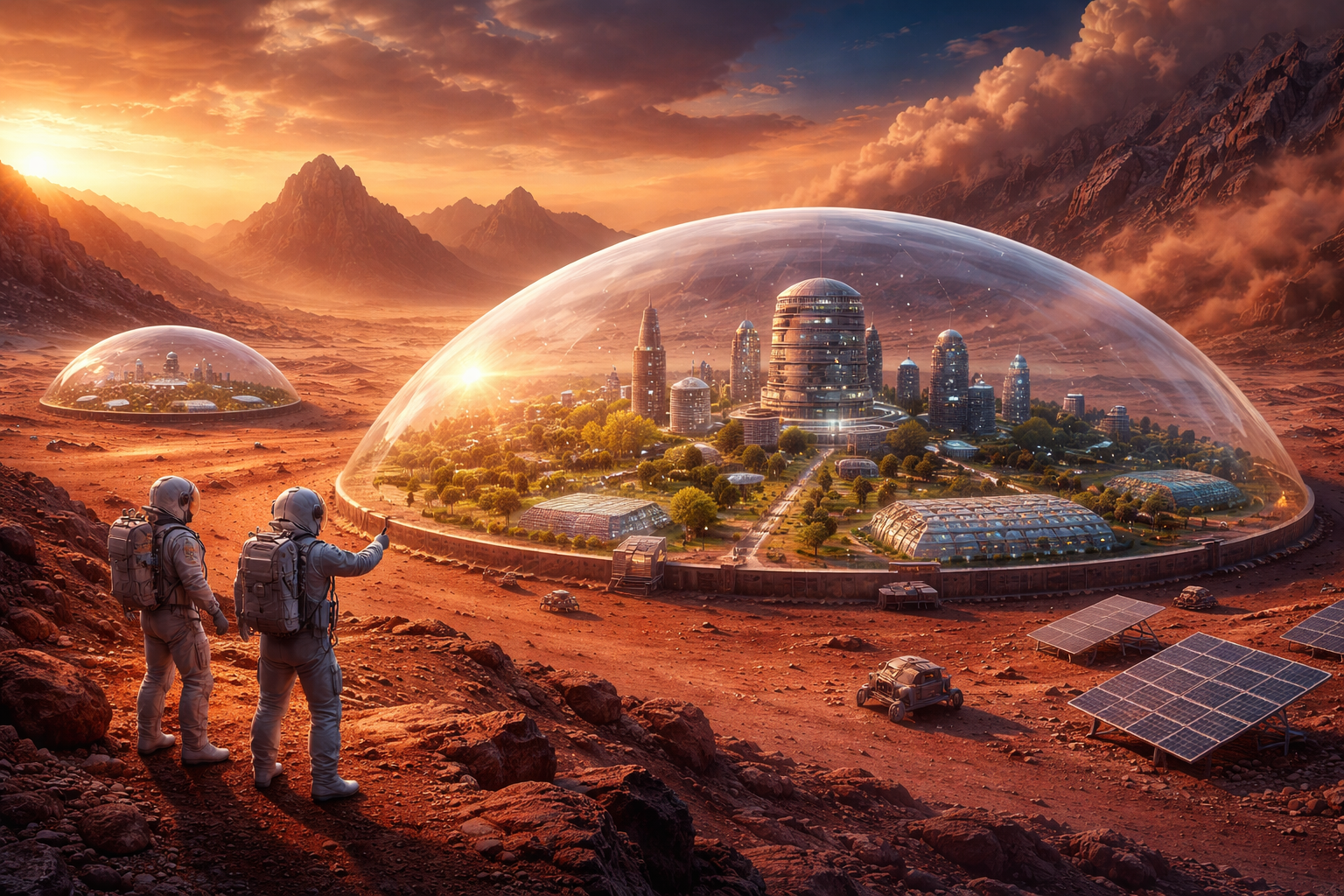
A real Mars colony would have to separate itself from the Martian environment. It would need protected spaces for breathable air, pressure, temperature control, radiation shielding, water recycling, and food production. It may look like a dome, a sealed habitat, or a base built partly underground. Mars does not provide the pressure, warmth, air, and shielding the human body needs.
Final Takeaway
Humans may one day live on Mars. But not in the open. Mars is beautiful from a distance, but the human body has no natural place there.
The air cannot be breathed, the pressure is too low, the radiation is harsh, and the cold can damage both people and equipment. Dust storms add another risk to the systems a colony would depend on. That is why humans can’t survive on Mars without domes or protected habitats.
A dome is not a luxury in a Mars colony. It is the barrier that makes human life possible there.
Related Reads
Why Landing on the Sun Is Impossible – The Physics and Heat Explained
Why Teleportation Is Impossible
Why We Can’t See the Entire Universe – The Science Behind the Observable Universe