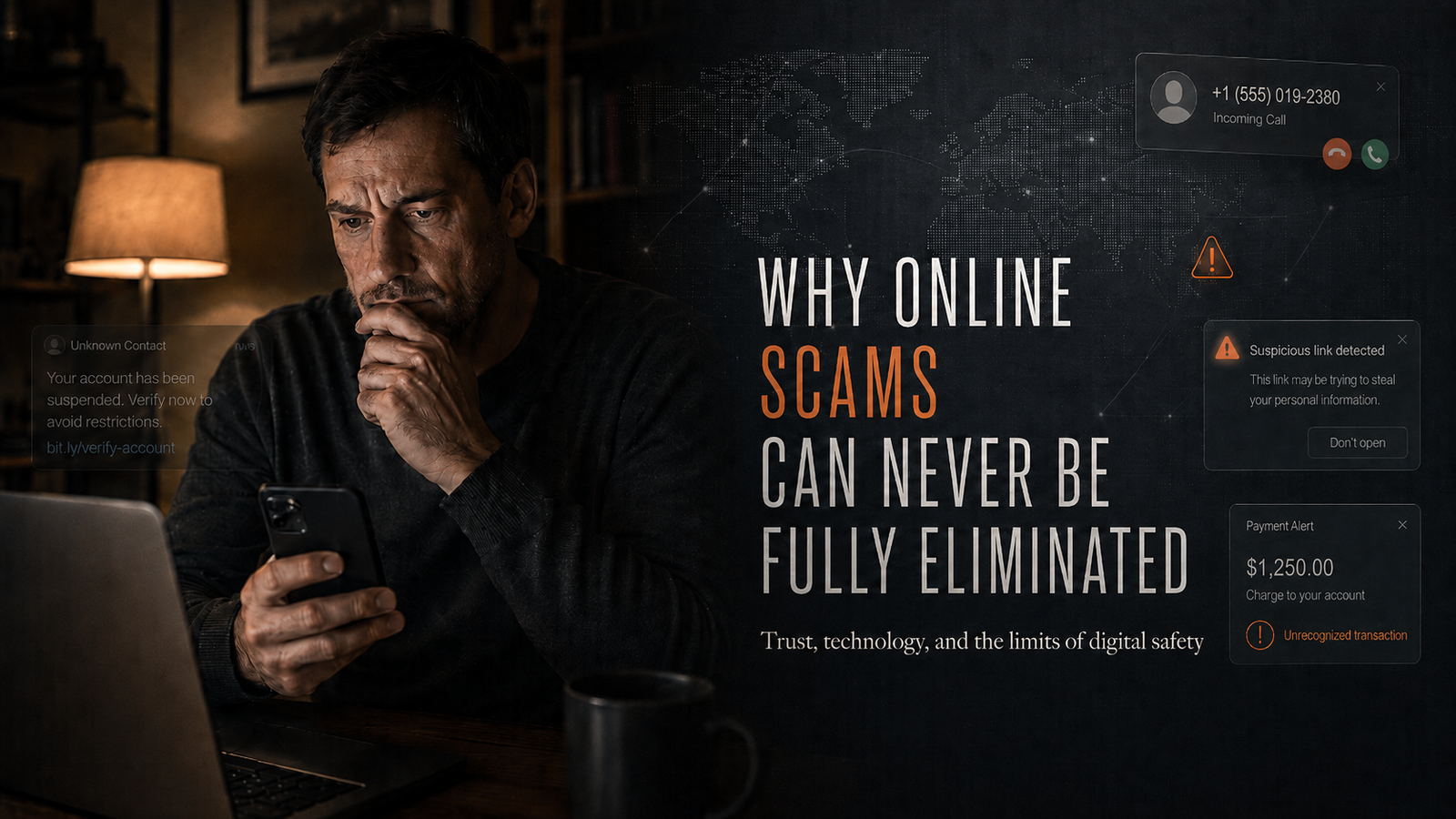
Why Online Scams Can Never Be Fully Eliminated
Online scams survive because they attack trust before they attack technology.
A fake bank message works when it looks official. A fake job offer reaches someone who badly needs income. A fake investment group promises a way out. A fake police call works because fear moves faster than logic. That is why scams are not only a cybersecurity problem. They depend on emotions no software update can remove: fear, hope, greed, loneliness, panic, and trust.
Fake links can be blocked. Suspicious payments can be frozen. Fake accounts can be removed. Cybercrime portals and AI tools can help. But none of them can make human beings impossible to fool. That is why online scams can be reduced, but not fully eliminated.
The Scale Is Already Massive
Online scams are no longer just fake emails sent by one person from a laptop. In many cases, they now operate like an industry.
In its 2025 Internet Crime Report, released in April 2026, the FBI said cyber-enabled crimes caused nearly $21 billion in reported losses in the United States. Its Internet Crime Complaint Center received more than 1 million complaints in 2025.
AI-related complaints appeared in the report for the first time and caused nearly $893 million in reported losses. But those are only reported losses. Many victims never report scams because they feel ashamed, confused, frightened, or convinced that the money cannot be recovered.
So the real scale is almost certainly bigger. That is the deeper problem: the internet gives deception global reach. A scammer does not need a high success rate. With enough reach, even a tiny response rate can pay.
Scams Hit Emotions Before Logic
Most scams are less about advanced hacking and more about pressure. Fear, hope, greed, affection, panic, and urgency are the real entry points. The bank alert, job offer, investment message, romance profile, police call, or customer-care number is only the cover. That is why even educated, careful people can fall for scams.
That does not make every victim careless. Many scams work because they reach people at a vulnerable moment. A student desperate for work may trust a fake work-from-home offer. A parent may panic after a fake emergency call. A small business owner may click a payment link because a customer is waiting.
Scammers understand timing. They know people skip normal checks when they are afraid, rushed, lonely, hopeful, or under pressure. The tools change. The weak point remains human.
The Internet Gives Scammers Unlimited Reach
Before the internet, fraud had physical limits. A scammer had to meet people, call them one by one, or operate inside a local area. Now one person can target thousands of people through email, SMS, WhatsApp, Telegram, Instagram, Facebook, fake websites, fake ads, fake apps, and QR codes.
That scale changes everything. Even if almost everyone ignores the scam, a small number of victims can still make it profitable.
The internet made communication cheap. Unfortunately, it also made deception cheap.
Social Media Makes Fraud More Personal
Social media gives scammers something dangerous: details from real life. A person’s job, location, friends, interests, shopping habits, and public comments can all help a scam look believable.
A random message from a stranger is easy to ignore. But a message that connects to your real life feels different.
The FTC reported that in 2025, nearly 30% of people who reported losing money to a scam said it started on social media. Reported losses from social media scams reached $2.1 billion, eight times higher than in 2020. That is why fake investment groups, shopping ads, giveaways, celebrity pages, and romance profiles still work. They do not feel completely random. They feel familiar enough to lower suspicion.
Social media did not invent fraud. It gave fraud better targeting and wider reach.
AI Has Made Scams More Convincing
Earlier, many scam messages were easier to spot. Bad grammar, poor spelling, strange formatting, and unrealistic promises were common warning signs. That is no longer enough.
AI helps scammers create cleaner messages, professional emails, fake support scripts, job offers, investment pitches, voice clones, deepfake videos, fake IDs, and convincing profiles.
A scam message can look clean, a cloned voice can sound familiar, and a fake video can look real. So spelling mistakes are no longer a reliable warning sign. INTERPOL warned in 2026 that AI-enhanced fraud is becoming far more sophisticated and 4.5 times more profitable than traditional methods.
AI does not create dishonesty. It gives dishonest people better tools, which means scams will keep changing as the tools improve.
Money Moves Faster Than Justice
A scam can be over in minutes. A victim clicks a link. Money leaves the account. It moves through multiple accounts, passes through money mules, gets converted into crypto, or crosses borders before the victim fully understands what happened.
Law enforcement cannot move with the same speed. Police, banks, platforms, investigators, and sometimes even foreign agencies have to follow procedure. Digital money moves instantly. Justice has to move legally. Scammers live in that gap.
India has improved its response through the National Cyber Crime Reporting Portal, the 1930 helpline, and the Citizen Financial Cyber Fraud Reporting and Management System. The Government of India said that, as of January 31, 2026, more than ₹8,690 crore had been saved in more than 24.65 lakh complaints through this system.
Even strong systems mostly reduce damage after the scam has started. They cannot stop every fake message before it reaches someone.
India Shows How Digital Growth Also Creates Risk
India is a clear example of how fast digital growth brings both convenience and risk. UPI, smartphones, WhatsApp, QR payments, and online shopping have made everyday transactions easier. The same habits also give scammers more entry points.
A fake KYC link can create panic. A fake courier message can look real. A fake electricity bill warning can force quick payment. A fake job offer can trap students. A fake “digital arrest” call can frighten families. A fake customer-care number can steal bank details.
The more people come online, the more chances scammers get to test new tricks. Digital growth makes life easier, but it also gives criminals more doors to knock on.
Scammers Keep Changing the Story
Most scams follow a familiar cycle. A scam spreads, people learn about it, banks and police issue warnings, and slowly that version becomes less effective. Then criminals change the story.
Fake lottery scams become fake job scams. Fake job scams become fake task scams. Fake bank calls become fake police calls. Fake shopping sites become fake brand ads. Fake crypto scams become fake recovery-agent scams. Fake romance scams turn into romance-plus-investment scams.
That is why online scams are so difficult to kill off. They are not one fixed trick you can stop once and forget. The story keeps changing. By the time one version is exposed, another is already being tested.
A Scam-Free Internet Would Require Too Much Control
The obvious answer is identity verification. But full verification creates a new problem. If every account, payment, website, group, and message required perfect identity checks, the internet would become less private and less open.
Journalists, whistleblowers, abuse victims, and ordinary users may all need privacy online. Not every online action should be permanently tied to a real identity. So society faces a difficult trade-off.
More verification can reduce scams, but total verification can damage privacy and freedom. That is why the internet cannot remove all anonymity. And as long as some anonymity exists, some criminals will misuse it.
What Can Actually Reduce Online Scams?
Online scams cannot be brought to zero, but the damage can be reduced. The first rule is simple: slow down before acting on urgent messages. Do not trust unknown KYC, courier, job, bank, or payment links immediately.
Take customer-care numbers only from official websites. Treat quick-return investment groups as a warning sign.
Financial cyber fraud should be reported quickly through official cybercrime channels. In many cases, reporting speed decides how much money can be saved.
Final Takeaway
Online scams can never be fully eliminated because the weak point is not only security. It is trust.
The internet connects people instantly. Digital money moves in seconds. AI makes fake content more believable. Social media gives scammers personal details. Privacy limits total identity control. Borders slow down investigations. And human emotion gives criminals openings no machine can fully close.
Better reporting, faster bank action, stronger platform checks, and tougher policing can reduce the damage. But as long as people live, work, shop, invest, and communicate online, criminals will look for moments when trust beats caution.
The goal is not a scam-free internet. The real goal is a scam-resistant internet, because the real fight is not against one scam. It is against the misuse of human trust.
Related Reads
Why Deepfake Detection Can Never Be Perfect