Why Cameras Cannot Capture the World Exactly as Human Eyes See It
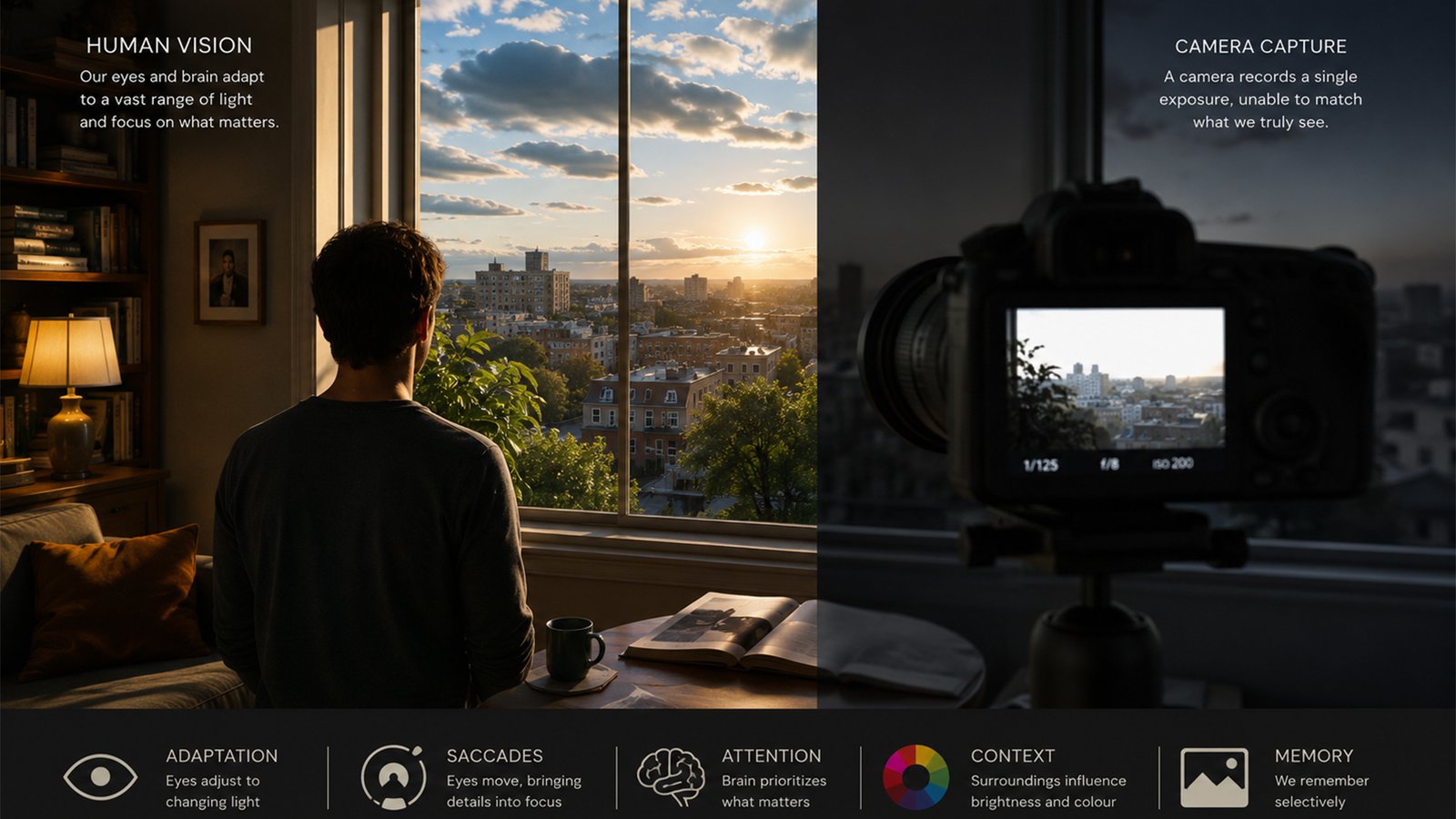
Cameras cannot capture the world exactly as human eyes see it because vision is not a single fixed exposure. Stand inside a dim room on a bright afternoon and look through the window. You can see the furniture around you. You can also see clouds outside, the colour of the buildings across the road and perhaps the leaves moving in direct sunlight.
Now take a photograph from the same position. Expose for the room and the sky may turn white. Expose for the sky and the room may sink into shadow. A modern phone will usually produce a better result by combining several exposures, but the picture can still feel different from what you remember seeing. The usual explanation is that the human eye has a greater dynamic range than a camera. That is only part of the story.
The eye does not take one exposure and stop. It keeps moving, its sensitivity changes with the light, and we pay more attention to some parts of the scene than others. A camera may record details the unaided eye cannot see. That still does not mean the photograph will look exactly as the scene did to the person standing there.
Why Cameras Cannot Capture the World Exactly
A digital sensor measures the light that reaches each part of its surface. Software then adjusts colour, noise, sharpness and contrast before producing the image. The processing may be advanced, but the sensor still does not know what it is looking at. It cannot know that a face in shadow matters more to the photographer than a bright cloud behind it. That judgement must come from software or from the person taking the picture.
The retina does more than detect light. It begins processing contrast, colour and movement before the signals reach the brain.
Human Vision Does Not Have Infinite Dynamic Range
Human vision does not have infinite dynamic range. At any one moment, very bright areas can overwhelm the eye and detail can disappear in deep shadow. Its much larger overall range comes from adaptation as lighting conditions change.
An eye that has adapted to darkness is working differently from one that has just been exposed to bright sunlight. The eye deals with these changes by becoming more or less sensitive to light. It cannot handle the full range at the same moment.
A photograph has to capture the scene in one exposure or combine several exposures afterwards.
The Pupil Is Only the First Adjustment
The pupil narrows in bright light and expands in darkness, but this change accounts for only part of the eye’s adjustment. Much of the adaptation happens in the photoreceptors and retinal circuits. This is why you can barely see when you first walk into a dark cinema from bright sunlight. After a few minutes, shapes and details begin to appear because the visual system has become more sensitive. Rods and cones make this adjustment at different rates.
The Retina Adjusts to Local Contrast
The retina also responds to local contrast. The same amount of light can appear different depending on the brightness around it. That is one reason we can look from a shaded doorway towards a bright wall without the whole view suddenly appearing too dark or too bright.
Glare, backlighting and deep shadow can still hide detail from the eye. Our vision keeps adjusting as we look around. A photograph cannot continue adjusting after it has been taken.
Only a Small Part of Our Vision Is Sharp
Our entire field of view is not equally sharp. Fine detail is concentrated in the fovea, a small area near the centre of vision. Peripheral vision is less detailed but remains good at detecting movement and broad shapes.
Rapid eye movements called saccades bring different parts of the scene into sharp central vision. We do not notice each jump of the eyes. The scene still appears stable.
A high-resolution camera may preserve fine detail across the whole frame. Our eyes inspect only a small area sharply at a time. This is one reason a photograph can feel different from the view we remember.
The Brain Does Not Build a Perfect Internal Photograph
The brain does not keep a complete, high-resolution record of everything we look at. Attention and visual memory are selective, and people can miss even large changes when their attention is elsewhere.
What we notice depends on the task. A driver, a mechanic and a photographer can look at the same street and focus on completely different details. Where the eyes move depends on what the person is trying to do, not only on which object is brightest or most noticeable.
One person may notice a face in the shadows, while another looks at a reflection in the window. Someone who knows the area may recognise a distant building that a visitor overlooks. Two people can stand in the same place and come away remembering different details.
Brightness Depends on What Surrounds It
A surface can appear lighter or darker depending on what surrounds it. A grey object in shadow may still look grey even when it reflects less light than a darker object in direct sunlight.
What surrounds an object affects how bright we think it is. The amount of light reaching the eye is only part of the judgement. Cameras try to produce a similar result using tone curves, local contrast adjustments and scene recognition.
Too much contrast can make the image look harsh, while too little can make it look flat. Raising the shadows too far removes depth, but protecting every highlight may leave a face too dark.
Colour Also Changes with Context
Colour also depends on context. A white sheet of paper reflects different light indoors and outdoors, yet we usually continue to see it as white. This ability, known as colour constancy, helps the brain separate an object’s colour from the lighting around it.
A camera makes a similar estimate through white balance. Different cameras—or different edits of the same raw file—can produce different but believable colours. The result may still differ from the colour the photographer remembers seeing.
Age, surrounding colours and the eye’s current state of adaptation can all affect colour perception. Two people may not see precisely the same colour in the same scene.
What HDR Can and Cannot Do
HDR combines different exposures so that bright skies and dark foregrounds can both retain detail. Phones now do this automatically, often before the photograph appears on the screen.
The result still has to fit within the brightness range of a screen or printed page. Tone mapping decides what happens to the highlights, shadows and contrast.
Poor HDR can leave grey shadows, overworked skies and bright outlines around objects. Better HDR avoids these obvious problems. Even then, the camera or editor must decide how bright the shadows and highlights should appear.
Cameras Can Beat Human Eyes
Cameras already outperform human eyes in many tasks. Long exposures reveal faint stars, high-speed cameras freeze events we cannot follow, and specialised sensors detect infrared or ultraviolet light. In these situations, cameras are simply better tools than human eyes.
Human vision evolved to help us move, recognise objects and react to changing conditions. Cameras were designed to record light. The eye and the camera are doing different jobs.
A camera is far better at recording a faint nebula. But seeing while walking through a forest involves depth, movement and constant changes in attention—things a still photograph does not record.
More Megapixels Will Not Close the Gap
More pixels, better sensors and faster processors allow cameras to record more information. Those improvements still cannot record exactly where the photographer looked or which detail first caught their attention.
When we look around a place, our eyes shift from one detail to another. We also use both eyes and small movements of the head to judge distance and depth. A photograph reduces this changing view to one frame.
Final Takeaway
Cameras can already record faint details, extremely fast events and wavelengths that human eyes cannot detect. The eye is not better at everything, and its dynamic range is not infinite.
Once a photograph has been taken, it no longer changes. Our vision continues to adjust as the eyes move and our attention shifts around the scene.
A camera may capture more detail than the eye, but it cannot record exactly what mattered to the person who was standing there. That is why even an excellent photograph may not match the scene as we remember seeing it.
Related Reads
Why Can’t Humans See Infrared or Ultraviolet?