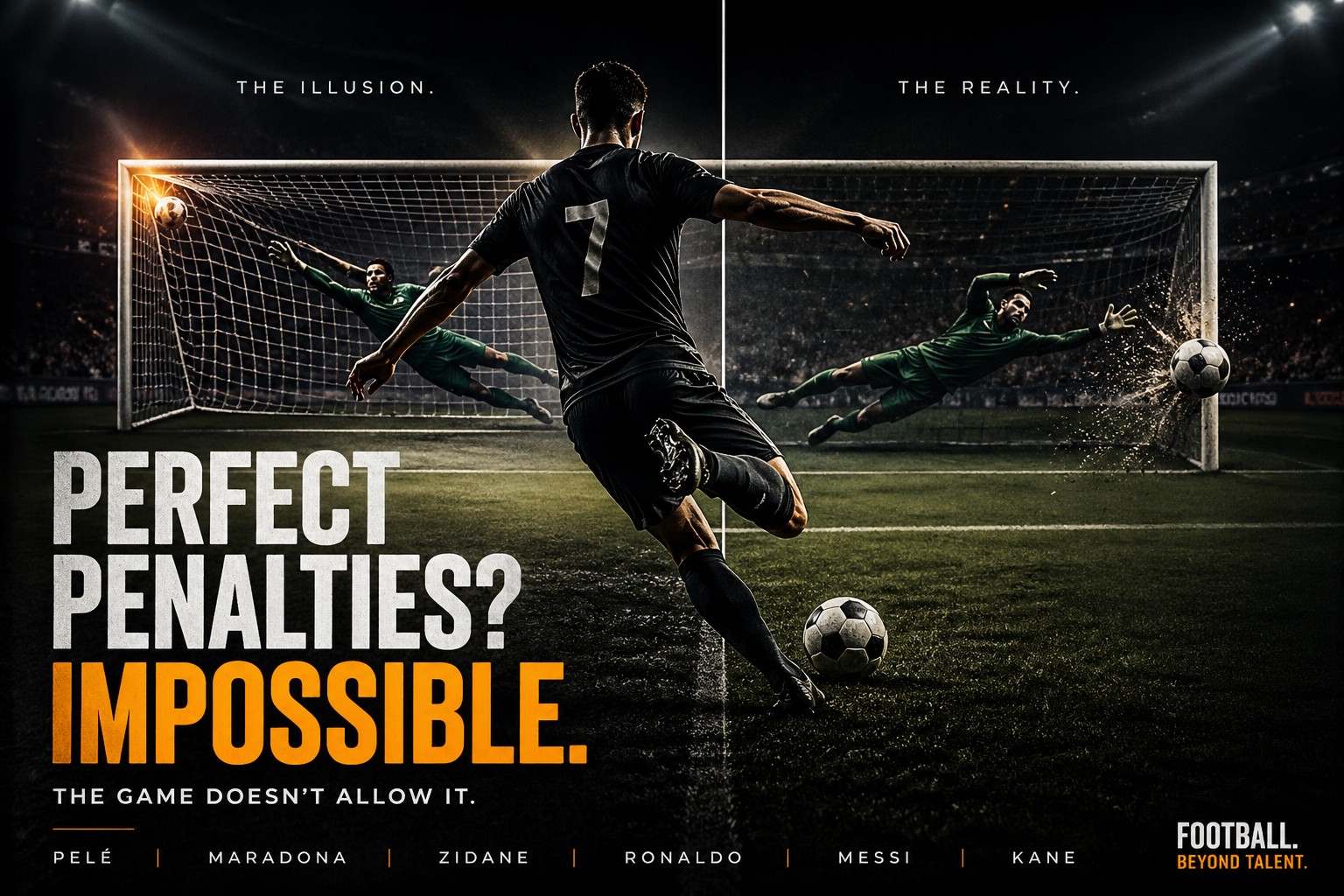
Why 100 Percent Penalty Conversion Is Impossible in Football
A penalty looks easy only until someone has to take it. The ball is still. The goal is big. The goalkeeper is alone. No defender is sliding in. No one is blocking the shot. From the sofa, it feels simple. Pick a corner and score.
The best players in the world have missed penalties. Not average players. Not nervous kids. Great players. Players who train every day, players who have scored hundreds of goals, players who have taken penalties in finals, derbies, shootouts, and title races.
Still, one goes wide. One hits the post. One is saved. One flies over.
That is why 100 percent penalty conversion sounds fine in theory. Over a real career, it breaks.
A player can be brilliant from the spot. He can be trusted by every manager he plays for. He can score again and again.
But perfect forever?
No. One bad kick is enough.
The Goal is Big, but the Safe Area is Not
Yes, the goal is huge. That is why most penalties are scored. But the taker is not aiming at the whole goal. He is trying to hit a part of the goal the goalkeeper cannot reach. That is a much smaller target.
If the shot is too central, the keeper has a chance. If it is too wide, it misses. If it is too high, it can fly over. If it is too soft, even the right corner may not save it.
A good penalty lives near the edge. Close enough to the corner to beat the keeper. Not so close that it hits the post. People see the ball go in and say, “easy finish.” If the same ball goes two inches wider, they call it a terrible penalty. Two inches change the whole story.
The Goalkeeper is Part of the Kick
A penalty is not just a striker taking a shot. There is another player trying to read him and get into his head. Goalkeepers are not standing there like statues. They study penalty takers. They watch the run-up. They watch the hips. They know who waits. They know who picks a corner early. They know who likes power and who likes placement.
Sometimes the keeper guesses. Sometimes he reads. Sometimes he simply gets lucky. For the taker, it does not matter. If the goalkeeper gets a hand to it, the record is gone. For a perfect record, the reason does not matter.
The More You Take, the More They Know
One penalty can be a surprise. Fifty penalties cannot. The more a player takes, the more everyone studies him. His favourite side. His slow run-up. His body shape. What he does after missing. What he does under pressure.
A great penalty taker has to keep scoring while goalkeepers keep learning his habits. Go to the same corner too often, and keepers wait for it. Change too much, and the taker can start fighting his own rhythm. Try to be clever, and one wrong read makes him look foolish. The spot does not move. The goal does not shrink. The taker just becomes easier to scout. After a while, every goalkeeper has seen the pattern.
The Body Can Let Players Down
A penalty is simple in theory, but the body still has to execute it. One plant foot lands slightly wrong. One strike catches the ball too low. One run-up feels rushed. One boot slips. One tired leg does not hit through the ball properly.
A player can score the same penalty ten times in training and miss it in a match. Not because he forgot the technique. Not because he has no mentality. Sometimes the contact is just wrong.
Football fans love big words after a missed penalty. Bottled it. Choked. Weak mentality. Sometimes, yes. Pressure gets players. But sometimes the miss is smaller than that. A few inches. A bad contact. A keeper moving early. A player changing his mind when he should not.
From 11 metres, even a small error can look huge.
Pressure Changes Everything
A penalty at 4–0 is one thing. A penalty in the 89th minute is another. A penalty in a shootout is another world. The ball may be on the same spot, but the player is not in the same place mentally. The crowd is louder. The wait feels longer. The goalkeeper starts walking around. The referee delays the whistle. Teammates stand near halfway and watch.
Then the player has too much time to think.
Same side as last time?
Will the keeper know?
Power?
Placement?
Wait?
Shoot early?
Sometimes the run-up is already in trouble before it starts. The best players control it better than others. But even the best do not remove pressure. They only manage it better.
Power or Placement?
Hit it hard, and the keeper has less time. Hit it carefully, and the corner becomes harder to reach. But power can send it over. Placement can make it too soft. Aim too far into the corner and the post is waiting. Aim safer and the goalkeeper comes back into the story.
This is why “just smash it” is lazy talk.
Plenty of smashed penalties have gone into the stands. Plenty of careful penalties have been saved. The best takers find a balance. One day, the same choice works. Another day, it looks stupid.
One Miss Ends the Whole Argument
Matt Le Tissier is remembered because his penalty record was ridiculous. He missed once.
Once. Most players would happily take that record. Managers would trust that player every week. Fans would feel safe when he walked to the spot. But even that is not 100 percent.
The debate does not need fifty misses. It does not need a long collapse. It does not need a player losing confidence.
It only needs one.
One save.
One post.
One slip.
One bad touch.
One goalkeeper going the right way.
That is enough to kill 100 percent.
Final Takeaway
A 100 percent penalty record looks possible because penalties look simple. Once the whistle goes, it is different. The taker has the advantage, but the goalkeeper is still there. The target is smaller than it looks. The body is never exactly the same twice. Pressure changes the kick. Power and placement pull in opposite directions.
A great penalty taker can score almost every time, but over a long career, almost is still not perfect.
One kick.
One miss.
That is why 100 percent penalty conversion is almost impossible in football. Not because the best players are weak. Because even from 11 metres, one kick can still go wrong.
Related Reads
Why Scoring in Every Football Match Is Impossible