The Hardest Fielding Records in ODI and Test Cricket
The hardest fielding records in cricket receive far less attention than centuries, wickets and big match-winning spells. Some are also much harder to chase. A batter gets repeated chances to score, and a bowler can attack with every delivery. A fielder may wait for hours before one catch or run-out chance comes his way.
Fielding records therefore depend on more than skill. Position, opportunity and career length matter just as much. This list includes only outfielders. Wicketkeeper catches, stumpings and other keeper dismissals are excluded. Some entries are official records, while Ponting and Rhodes are included for the impact they had on fielding.
1. Mahela Jayawardene – 218 Catches in ODI Cricket
Mahela Jayawardene took 218 catches in ODIs, the most by any non-wicketkeeper in the format. He remains the only outfielder to have crossed 200. Jayawardene built the record across 448 matches and nearly two decades in the Sri Lankan side. He also spent much of that career in catching positions, particularly the slips, where an edge can arrive quickly or stay low.
Very few modern players are likely to reach 400 ODIs. Rest, rotation, format specialisation and franchise cricket all shorten international careers. A future challenger would need Jayawardene’s reliability, but also hundreds of matches in the right fielding positions. Reaching 218 now looks extremely difficult.
2. Joe Root – Most Catches by an Outfielder in Test Cricket
Rahul Dravid’s 210 Test catches once looked extremely difficult to pass. Joe Root equalled the record in June 2025 and went ahead at Lord’s the following month with a one-handed slip catch against India. As Root is still playing, the final number may rise further.
A slip fielder may wait for hours before getting one chance. By then, the ball may be old, the pitch may have slowed down and concentration may have started to fade. The edge still has to be taken cleanly.
Breaking the record would require a long Test career, a regular place in the slips and bowlers who create plenty of edges. Even an excellent catcher cannot build a huge total if the opportunities are not there. By the time Root retires, the record may be much higher than Dravid’s 210.
3. Aiden Markram – 9 Catches in One Test Match
Aiden Markram took nine catches against India in the Guwahati Test in November 2025, breaking Ajinkya Rahane’s record of eight. With only 20 opposition wickets available in a Test, Markram caught almost half of India’s dismissals himself. This is not a record a player can deliberately chase. The bowlers must keep producing chances, those chances must repeatedly travel to the same fielder, and none can be dropped. In another Test, Markram could have fielded just as well and taken only one catch.
To break it, someone would need ten catches. Getting that many chances in one Test may be even harder than holding them.
4. Ricky Ponting – The Direct-Hit Specialist
Ricky Ponting does not hold the biggest fielding record on this list, but few fielders created as much fear inside the circle. He took 160 ODI catches and was also credited with 21 ODI run-outs. But the number tells only part of the story.
Ponting was especially feared for his direct hits from point and cover. He attacked the ball, picked it up cleanly and often hit the stumps without taking time to set himself. Batters knew that a slow start or a badly judged second run could be enough. His direct hits got the attention, but the fear of them stopped plenty of singles too.
5. Mahela Jayawardene – 440 Catches in International Cricket
Jayawardene also holds the overall international record, with 440 catches across Tests, ODIs and T20 internationals. Ricky Ponting is next with 364. Tests demanded patience in the slips, while limited-overs cricket required quicker movement and regular changes of position.
Jayawardene remained in Sri Lanka’s side across all three formats and kept adding to the total.
Today, many players specialise in one or two formats, while others leave international cricket earlier for franchise leagues. A challenger would need a long all-format career as well as a regular place in the main catching positions.
6. Jonty Rhodes – The Fielding Legacy That Changed Cricket
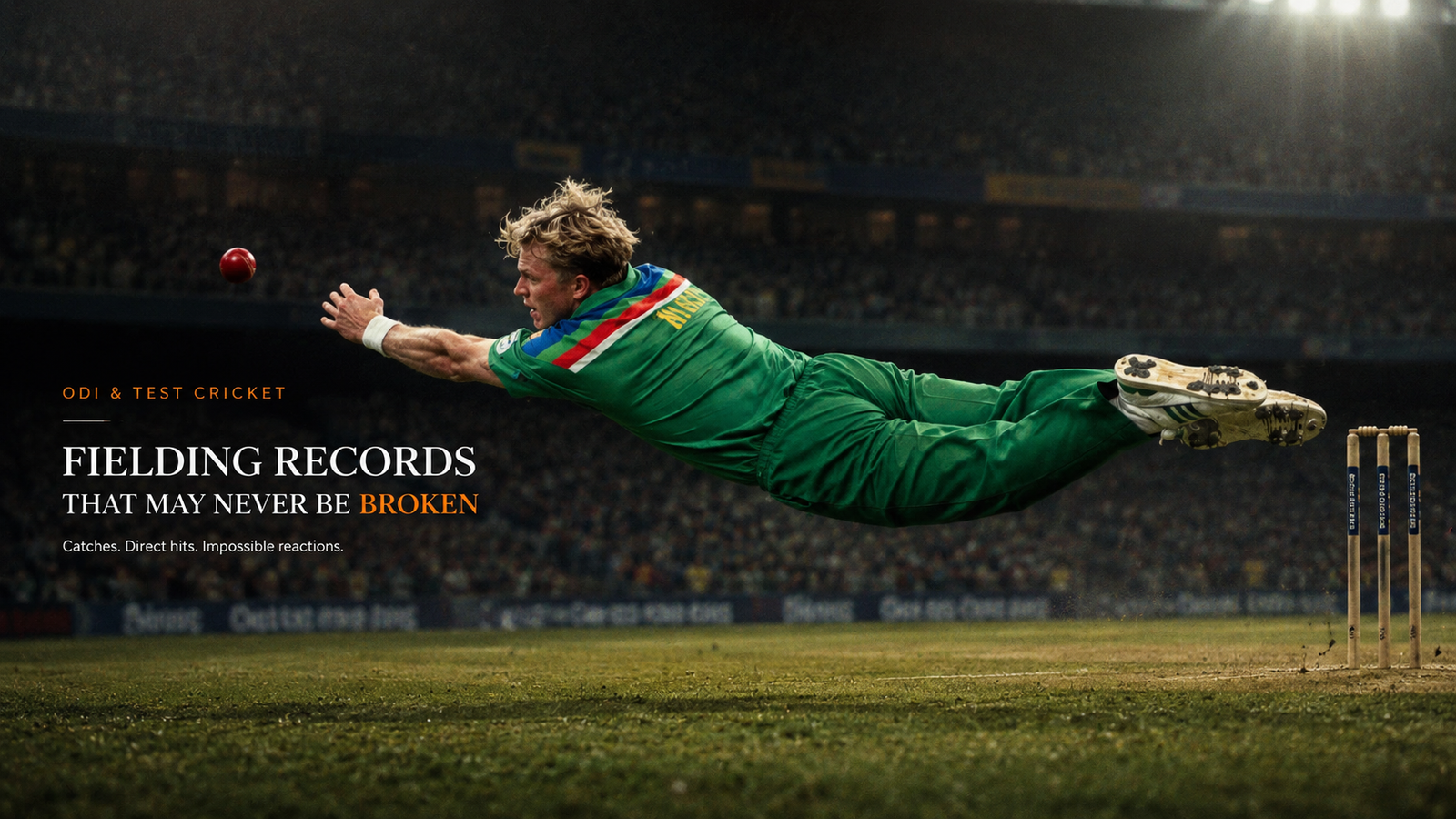
Jonty Rhodes did not build the largest catching or run-out total, but he changed how fielding was viewed. His airborne run-out of Inzamam-ul-Haq at the 1992 World Cup became one of cricket’s most recognisable fielding moments. Rhodes raced in from backward point and dived into the stumps with the ball in his hand.
At the time, players were still selected mainly for batting or bowling. Rhodes showed that fielding itself could change a match. He stopped singles other players could not reach, attacked the ball and turned routine moments into run-out chances. Other teams soon placed more value on speed and throwing, while younger players copied his dives and movement.
Someone may pass his career numbers, but nobody can have the same impact Rhodes had when fielding standards were still changing. Modern cricket already expects every player to field well, and Rhodes was one of the main reasons for that shift.
Why These Fielding Records May Never Be Broken
Modern fielders are fitter and more athletic, but fielding records do not depend on athleticism alone. Career totals require hundreds of matches and regular positions in the slips or close-catching areas. A brilliant boundary fielder may save plenty of runs but receive far fewer catches.
One-match records rely even more on opportunity. Markram could not control how many edges came his way, and Ponting could not make batters attempt a risky run every time the ball went near him.
Jayawardene and Root needed long careers in catching positions. Ponting and Rhodes affected matches differently, with batters becoming more cautious whenever the ball went near them.
Future players may be better athletes, but they still cannot control how many chances come their way or how long they remain in the same role. Better fitness cannot solve that problem.
Join the Conversation
Which one would be hardest to repeat: Jayawardene’s catching records, Root’s Test record, Markram’s nine catches, Ponting’s direct-hit threat or Jonty Rhodes’ fielding legacy?
Related Reads
Top 10 Hardest Bowling Records in Cricket History
Top 10 Hardest Wicket-Keeper Records in ODI & Test Cricket That May Never Be Broken