Why Offside Decisions Can Never Be Perfect in Football
The striker times his run, the pass comes through, and the ball is in the net. Then everyone waits.
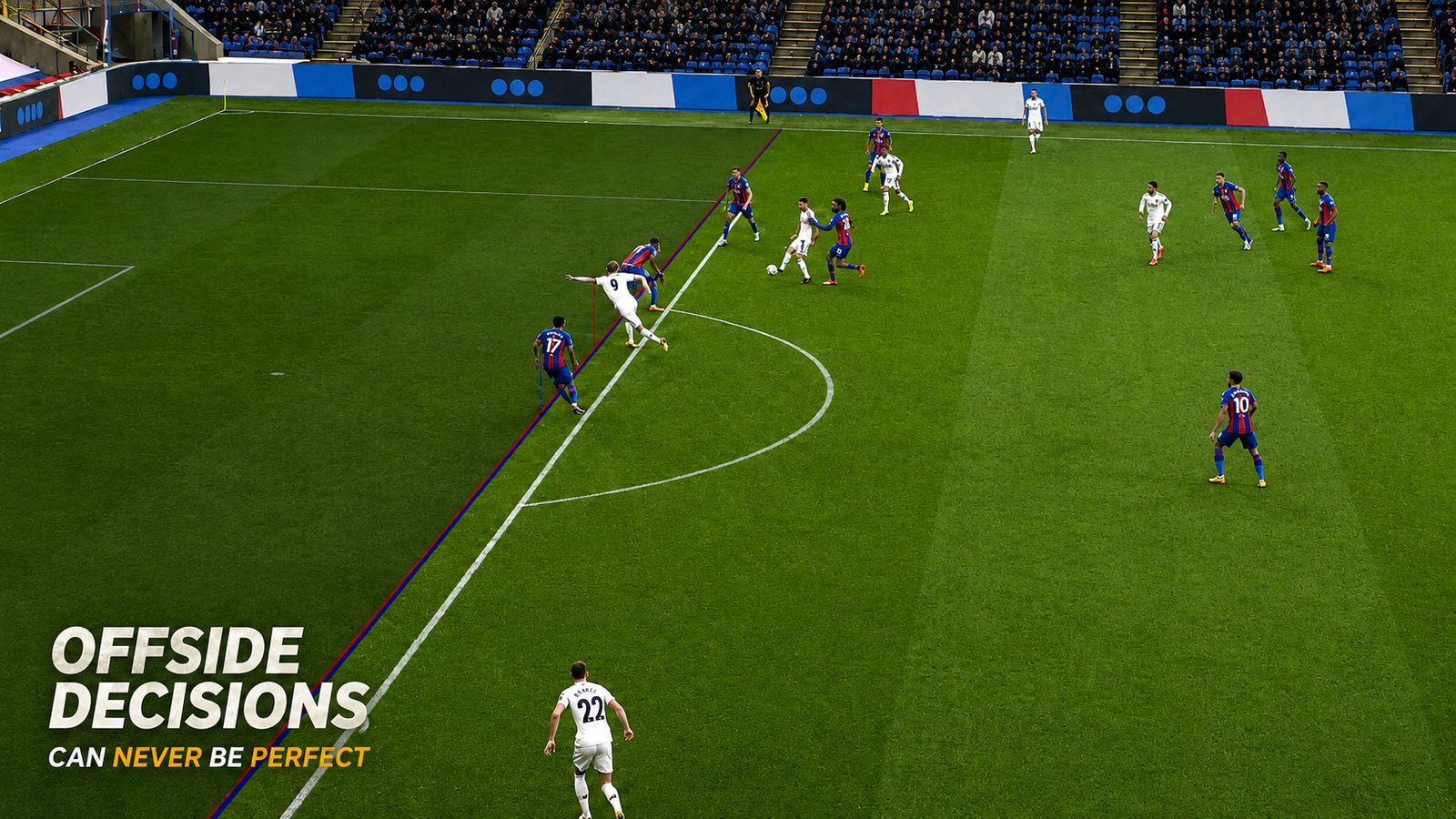
A digital line appears on the screen. A shoulder, knee, or boot may be ahead of the defender by a few millimetres. After several replays, the goal is either allowed or ruled out.
If football has VAR, cameras, sensors, and semi-automated technology, why can’t offside decisions be perfect?
Because the line is only one part of the decision. Officials must also identify the exact moment the ball was played, judge moving body parts and decide whether the player became involved in the action. Technology can make offside decisions more accurate, but it cannot remove every grey area.
What the Offside Rule Actually Requires
A player is not penalised simply for being beyond the second-last opponent.
According to Law 11, a player is only penalised if he is in an offside position when the ball is played or touched by a teammate and then becomes involved in active play. Hands and arms are not counted for offside, and only playable body parts matter.
On paper, the rule looks straightforward. During a match, it rarely is.
Exactly when was the ball played?
Which body part counts?
Was the attacker interfering with play?
Did he affect the defender?
Did the goalkeeper’s view become blocked?
Was it a deliberate play, a deflection or a save?
The Exact Passing Moment Is Not Always Clear
Offside depends entirely on the instant the ball is played. A kick does not happen inside one clean freeze-frame. When a player kicks the ball, the foot stays in contact with it for a tiny fraction of time while both attackers and defenders continue moving at high speed.
Modern systems use high-frame-rate cameras, but they still have to identify the exact instant the ball was played. In a very tight call, one frame may be enough to change the outcome.
A difference of only a few milliseconds may turn an onside run into an offside one. The problem is that continuous movement has to be reduced to one official instant.
Human Bodies Do Not Move Like Straight Lines
The graphic may look precise, but the players inside it are leaning, twisting and stretching as they run. A shoulder may lean ahead, a knee may extend beyond the defender, or a boot may be hidden behind another player.
FIFA’s semi-automated offside system used 12 dedicated tracking cameras and tracked up to 29 data points on each player 50 times per second during the 2022 World Cup technology setup.
The system is highly accurate, but it is still reconstructing bodies in motion from tracking data.
Camera Views Are Not Always Clear
On a crowded pitch, players overlap, block camera views and move in different directions at the same time. Even with many cameras around the stadium, some body parts may briefly disappear behind another player or fall outside the clearest angle.
The reconstruction still depends on camera position, tracking quality and a clear view of each relevant body part.
The Closest Offside Decisions Cannot Be Judged by the Naked Eye
Most controversial offsides are not obvious. They are decided by centimetres or millimetres. To the human eye, both players often look level.
The frustration is simple: a run can look level at full speed and still be ruled offside by a fraction.
Interference Still Requires a Referee’s Judgement
Not every offside decision is about touching the ball.
Sometimes officials must decide whether an offside player:
blocked the goalkeeper’s vision
distracted a defender
challenged for the ball
affected the opponent’s ability to react
Position can be tracked. Whether the player blocked an opponent’s view, challenged for the ball or clearly affected the action still has to be interpreted by the officials.
Semi-Automated Offside Technology Is Not Fully Automatic
The Premier League describes the system as a support tool for VAR, not a replacement for officials. It can identify a possible offside position and generate the visual quickly, but officials still decide whether the player became involved in active play.
A New Rule Would Only Move the Argument
Thicker lines, more protection for attackers or a “clear daylight” rule may change which goals are allowed. None of them removes the boundary between onside and offside. The argument simply moves somewhere else.
Final Takeaway
VAR will keep improving, and the worst offside mistakes should become rarer. But offside decisions will never become completely free of judgement calls. Some calls depend on movements too small to see in real time. Others still depend on how officials interpret interference, obstruction or a defender’s action. Technology can narrow the argument. It cannot remove it.
What Do You Think?
Would you keep the current system, or give the attacker the benefit of the doubt on the closest calls?
Related Reads
Why Football Matches Cannot Be Completely Fair
Why Scoring in Every Football Match Is Impossible
Why 1000 International Goals Is Nearly Impossible in Football