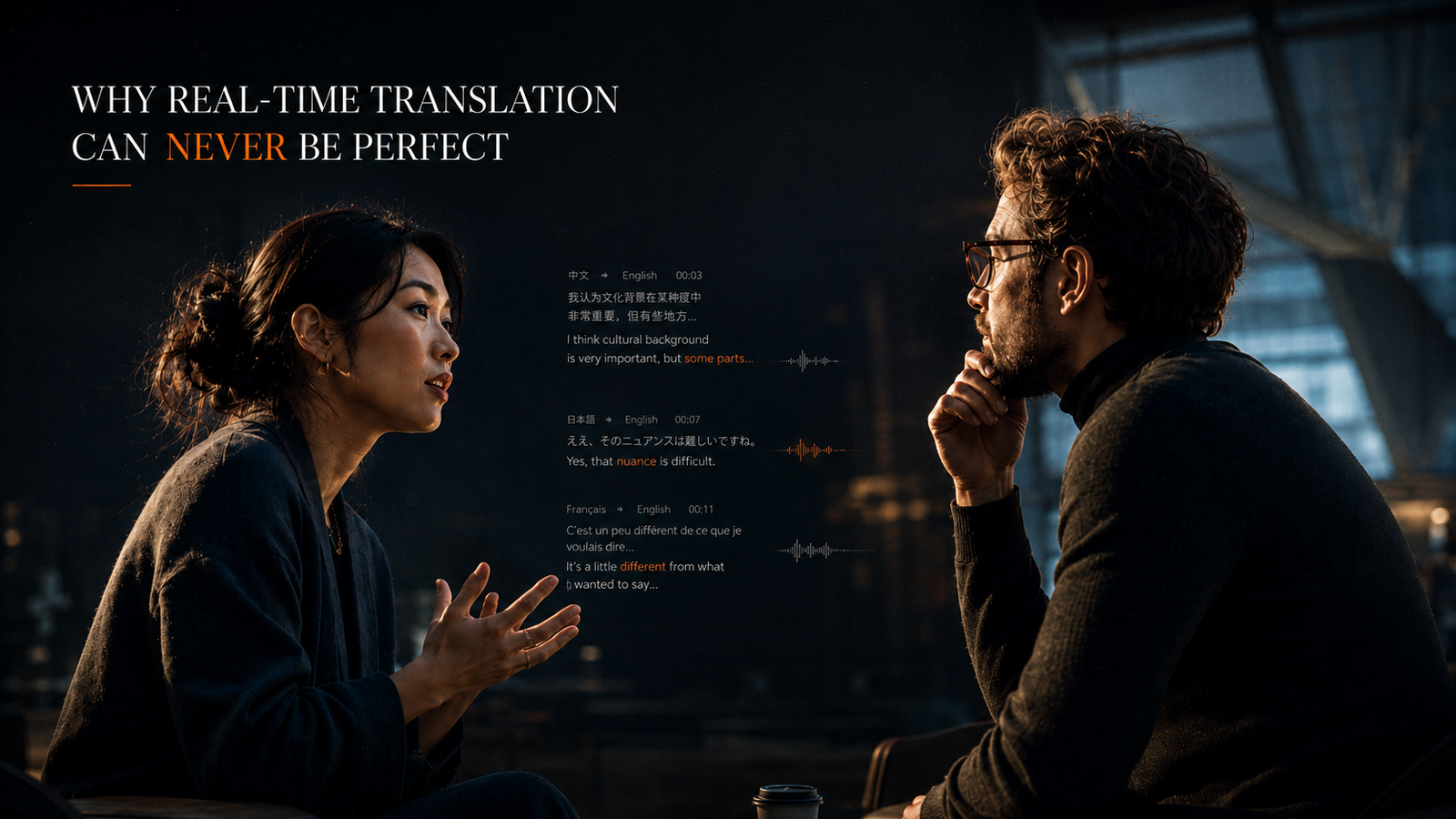
Why Real-Time Translation Can Never Be Perfect
Real-time translation no longer feels futuristic. A tourist points a phone at a stranger and gets help. A student follows a lecture in another language. A business call continues without waiting for a human interpreter.
Google says people use its translation tools more than a billion times a month, with around a trillion words translated monthly across its products. Google Translate now covers almost 250 languages.
Meta has also shown live speech translation with very low delay through its Seamless Streaming research. The tools are strong now. The hard part is human language itself.
People do not speak in clean, finished units. They pause, imply, joke, soften, exaggerate, hide emotion and change direction midway through a sentence. A live translator has to handle all of that while the conversation keeps moving.
Real-time translation may get the words right and still miss what the speaker meant.
Live Translation Has to Guess Too Early
A human interpreter can wait for the full sentence. A real-time system often cannot. It has to make decisions while the speaker is still talking.
In many languages, the final word can change the whole sentence. A late phrase can change tense, politeness, emotion or intention. Even a pause can turn a plain sentence into sarcasm, anger or hesitation.
Translate too early, and the system guesses. Wait too long, and the conversation becomes awkward. Better AI can reduce that trade-off, not erase it. Live translation often begins before the sentence is fully clear.
First, the Machine Has to Hear Correctly
Before translation starts, the machine has to hear the sentence correctly. Real speech is messy. Real speech comes through traffic, fans, classrooms, meetings, airports and hospital rooms. They mumble. They interrupt each other. They mix languages. They use slang. They speak fast when emotional and blur words when nervous. One mistake here can damage the whole translation.
A name may become a normal word. A number may be misheard. A medical term may be heard as the wrong word. A local phrase may disappear because the system treats it as noise.
Live translation depends heavily on speech recognition. If the machine hears the wrong sentence, even the best translation model starts from the wrong place.
Intention Is Harder Than Grammar
Some sentences are easy to translate on paper and difficult to read in real life. “I’m fine” looks simple. In real life, it may mean anger, sadness, distance, politeness, embarrassment or genuine comfort.
The words do not decide the meaning. The situation does. Who said it, to whom, in what tone, and after what?
A human listener reads those clues without thinking. A machine may catch the sentence and miss the pressure behind it. At that point, translation becomes judgment. The system may not have enough to judge.
Languages Do Not Stay Still
A language is not one thing. English changes from country to country. Hindi changes across regions. Arabic can change sharply between communities. Telugu, Tamil, Bengali, Spanish, French and Portuguese all have local versions, shortcuts and everyday habits.
Even inside one city, speech changes with age, class, profession, education and family background.
More data helps, but no dataset can cover every accent, street phrase, joke, slang shift and pronunciation habit.
Adding more languages expands access, but it is not the same as mastering every living form of a language. Languages move faster than any training set.
Culture Is Where Translation Gets Hard
“Where is the station?”
“What time is the meeting?”
“I need help.”
AI usually handles lines like these well. The hard part begins when culture enters the conversation. Jokes, blessings, insults, proverbs, film references, sports metaphors, religious sensitivity, political emotion and family expressions do not move neatly from one language to another.
A literal translation may keep the words and lose the point. A natural translation may keep the effect but change the sentence. A full explanation may save the cultural meaning but ruin the speed. So what should the translation protect: the exact sentence, the emotion, the culture, or the version that sounds normal to the listener? Translation often means choosing what to lose.
Smooth Errors Are More Dangerous Than Broken Errors
Older machine translation mistakes were obvious. They sounded strange, so people stayed alert.
Modern AI mistakes can be harder to catch. Now a sentence can sound clean and still carry the wrong meaning. That is more dangerous because fluency lowers suspicion.
A broken sentence warns you. A smooth wrong sentence can quietly mislead you. This matters most in medicine, law, finance, diplomacy, emergency response and mental health support. In those places, “close enough” can be dangerous.
A mistranslated symptom, warning, legal condition or emotional phrase can change the outcome.
Real-time translation is useful, but it should not be treated as final authority in high-stakes situations.
Some Meanings Have No Perfect Equivalent
Not every word has a clean twin in another language. Some words carry history, religion, class, caste, politics, humour, cinema, sport or family emotion. A phrase that sounds respectful in one culture may sound weak in another. A silence that feels polite in one place may feel suspicious somewhere else.
Real-time translation has no time to explain every hidden layer, so it compresses. That shortcut keeps the conversation moving, but something can get flattened. The problem is not just computing power. It is meaning.
Even Human Translators Disagree
Human translators show the limit clearly. Give the same sentence to four expert translators and they may return four different versions. One may protect the exact wording. Another may protect the tone. A third may make it sound natural for the audience. A fourth may explain the cultural reference instead of translating it directly. All four may be valid. So there may be no single perfect version. It is often a choice between accuracy, speed, tone, culture, clarity and naturalness.
AI can improve its choices. It cannot remove ambiguity from language. If human experts do not always agree, AI cannot guarantee one universal version either.
Bigger Models Cannot Remove the Core Limit
Better models will reduce mistakes, handle more accents, understand more slang and respond faster. But the limit remains.
A live translator must work with incomplete speech, imperfect audio, missing context and cultural signals that may never appear in the words.
No model can always recover what was implied, hidden, joked, softened or left unsaid. The machine can become excellent. It still cannot know what was never made clear.
Final Takeaway
Real-time translation is useful. It makes travel, study, work and emergency communication easier. But it will never be perfect in every real conversation.
A flawless live translator would need clean audio, complete context, cultural judgment, emotional judgment and perfect prediction of unfinished speech. Real life does not provide that.
People do not speak like code. They speak with memory, emotion, fear, humour, background, relationships and silence. The words may cross the language barrier. The hidden meaning may not. That is why real-time translation can help — but never become perfect.
Related Reads
Why Artificial Intelligence Cannot Become Fully Human
Why Internet Privacy Can Never Be Absolute
Why Deepfake Detection Can Never Be Perfect
FAQ
- Is real-time translation accurate?
It can be accurate for simple conversations, travel phrases and basic instructions. Accuracy drops with noise, slang, emotion, technical language or cultural meaning. - Will AI translation become perfect in the future?
No. It will improve, but perfection is impossible because language depends on timing, context, culture, tone and intention. - Why does AI translation sometimes sound correct but still become wrong?
Because fluency is not the same as meaning. AI can produce a smooth sentence while missing the speaker’s real intention. - Where is real-time translation most risky?
It is most risky in medicine, law, emergency response, diplomacy, finance and mental health support, where one wrong phrase can matter. - What is the main reason real-time translation can never be perfect?
The main reason is incomplete context. Real-time systems often translate before the full sentence, emotion and situation are completely clear.