10 Men’s Olympic Athletics Records That May Never Be Broken
A world record can be attempted several times in one season. In Olympic athletics, an athlete gets one chance every four years, often after qualifying rounds and in conditions nobody has chosen. These Olympic athletics records are harder to break than the numbers alone suggest.
Age alone does not decide the order. I have also considered how close each mark is to the event’s limit, how difficult the event is to control at the Olympics, and whether today’s athletes are getting any closer.
10. Men’s Marathon — 2:06:26
Tamirat Tola, Ethiopia — Paris 2024
Paris was hilly and never looked like a course for fast times, yet Tamirat Tola ran 2:06:26. A flatter route and cooler weather could put the record in danger. That keeps it at number ten. Olympic marathons, however, are usually raced for medals rather than records.
9. Men’s 10,000m — 26:43.14
Joshua Cheptegei, Uganda — Paris 2024
Most Olympic 10,000m finals spend several laps going nowhere. The favourites watch one another, nobody wants to waste energy at the front, and the real race begins late. Paris 2024 was different. The pace stayed high, Joshua Cheptegei won in 26:43.14, and the first 13 finishers all went inside the previous Olympic record. The time is beatable, but only if another Olympic final is fast from the early laps. Most are not.
8. Men’s 110m Hurdles — 12.91
Liu Xiang, China — Athens 2004
Liu Xiang’s 12.91 is slower than the world record of 12.80, so the mark is clearly beatable. The hard part is clearing all ten hurdles cleanly in an Olympic final. One touch can disturb the rhythm and end the attempt. No finalist since Athens 2004 has run faster.
7. Men’s Triple Jump — 18.09m
Kenny Harrison, USA — Atlanta 1996
One poor hop or step can ruin the whole jump. Kenny Harrison put all three phases together in Atlanta and reached 18.09m, only 20 centimetres short of Jonathan Edwards’ world record. Jumps beyond 18 metres are rare, and the event is punishing on the ankles, knees and hips.
Few athletes can reach that distance at all. Staying healthy long enough to do it at the Olympics is another problem.
6. Men’s Shot Put — 23.30m
Ryan Crouser, USA — Tokyo 2021
Ryan Crouser’s 23.30m is only 26 centimetres short of his world record. His size and strength matter, but so do the speed and balance he carries through the circle. Very few men have reached 23 metres at all. None has matched Crouser’s combination.
5. Men’s 400m Hurdles — 45.94
Karsten Warholm, Norway — Tokyo 2021
Karsten Warholm’s 45.94 in Tokyo remains both the Olympic record and the world record. Rai Benjamin finished in 46.17, also inside the previous world record, while Alison dos Santos belongs to the same outstanding generation. That is the only reason the record is not higher on this list.
Anyone chasing 45.94 must still reach the final straight with both speed and rhythm intact. That is where most challengers lose one or both.
4. Men’s 4x100m Relay — 36.84
Jamaica — London 2012
Jamaica had Usain Bolt, Yohan Blake, Nesta Carter and Michael Frater on the same team, then completed three clean exchanges. A relay can be lost through a cautious pass, a dropped baton or a disqualification, so four quick individual times are not enough.
Another country must find four sprinters of that level in the same era and get the baton around without a serious mistake.
3. Men’s 400m — 43.03
Wayde van Niekerk, South Africa — Rio 2016
Wayde van Niekerk ran 43.03 from lane eight, where he could not see the main contenders outside him. He went out hard and still held his form on the home straight. The next challenger will need near-200m speed without falling apart over the final 100 metres.
Nobody since Rio has put those two qualities together at the same level.
2. Men’s 800m — 1:40.91
David Rudisha, Kenya — London 2012
David Rudisha led almost from the start and stayed there. With no pacemaker in an Olympic final, he judged the pace himself and finished in 1:40.91. Most Olympic 800m finals are tactical, with the serious racing left until the final lap.
Repeating it would mean finding another runner with Rudisha’s speed and endurance—and one willing to risk an Olympic medal by leading from the front.
1. Men’s Long Jump — 8.90m
Bob Beamon, USA — Mexico City 1968
Bob Beamon took off in Mexico City in 1968 and landed so far away that the measuring equipment could not immediately handle the distance. The final mark was 8.90m.
Fourteen Olympic Games have been held since then, and the record is still his. Mike Powell’s world record stands at 8.95m. An athlete would therefore need to jump 8.91m—only four centimetres short of the best legal jump ever recorded—to remove Beamon from the Olympic record book.
Mexico City’s altitude and a 2.0m/s tailwind helped, but they do not explain the whole jump. Beamon still had to reach the board at speed, take off legally and land without throwing away distance. A small error costs centimetres; a foul erases the attempt. No Olympic jumper since 1968 has matched that combination.
The Final Ranking
| Rank | Event | Athlete/Team | Olympic Record | Year |
| 1 | Long Jump | Bob Beamon | 8.90 m | 1968 |
| 2 | 800m | David Rudisha | 1:40.91 | 2012 |
| 3 | 400m | Wayde van Niekerk | 43.03 | 2016 |
| 4 | 4x100m Relay | Jamaica | 36.84 | 2012 |
| 5 | 400m Hurdles | Karsten Warholm | 45.94 | 2021 |
| 6 | Shot Put | Ryan Crouser | 23.30 m | 2021 |
| 7 | Triple Jump | Kenny Harrison | 18.09 m | 1996 |
| 8 | 110m Hurdles | Liu Xiang | 12.91 | 2004 |
| 9 | 10,000m | Joshua Cheptegei | 26:43.14 | 2024 |
| 10 | Marathon | Tamirat Tola | 2:06:26 | 2024 |
Why Usain Bolt’s 100m Record Misses the List
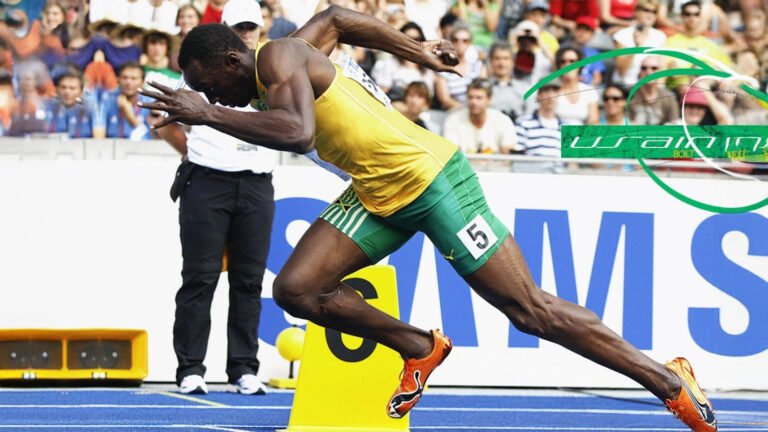
Usain Bolt’s 9.63 from London 2012 remains the Olympic 100m record. Only Bolt himself has run faster, with his 9.58 world record in Berlin. Bolt narrowly misses the list because recent sprinters have continued to run in the 9.7s and 9.8s. That leaves Bolt’s record looking a little less secure than Beamon’s long jump or Rudisha’s 800m. It is a close judgment, not a claim that 9.63 will fall soon.
The two Paris records could fall at the next Games. Beamon’s may still be there in 2068. A faster or stronger athlete will not always be enough. The conditions must help, and the Olympic final must unfold in the right way. That rarely happens.
Related Reads
Why Usain Bolt’s 9.58 Seconds May Never Be Broken
Why a 300 km/h Tennis Serve Is Almost Impossible in Real Life
Why Can’t Humans Run 100 km/h? The Biological and Physics Limits Explained