Why 1000 International Goals Is Nearly Impossible in Football
1000 international goals sounds possible only until you count the matches. Even the greatest finisher would run out of international appearances long before reaching it.
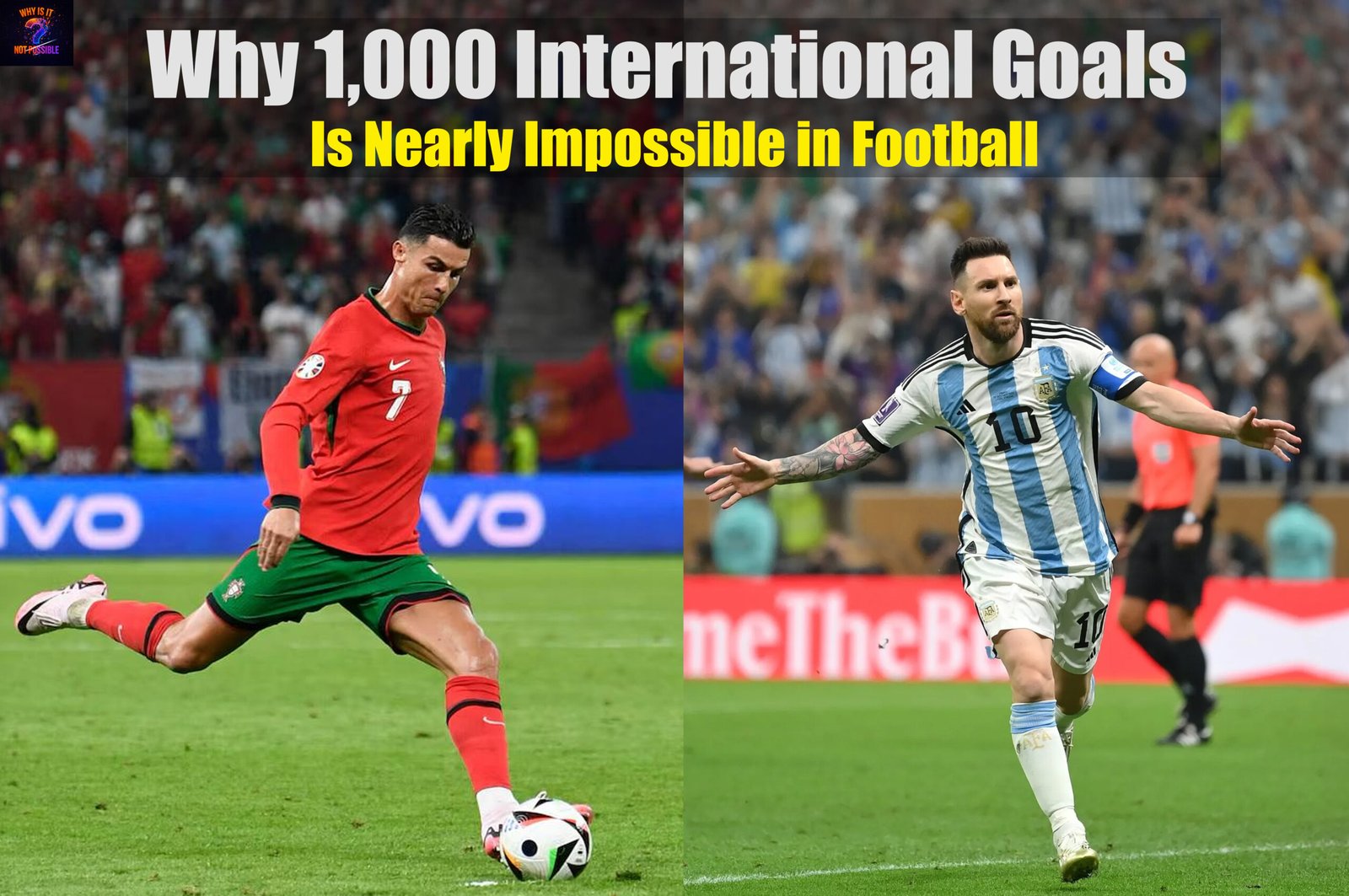
Cristiano Ronaldo holds the men’s record with 143 goals in 228 appearances. Christine Sinclair holds the overall record with 190. Even that total is 810 short of 1,000.
The challenge with 1,000 international goals is not just talent, but the structure of international football itself.
The Match Count Behind 1000 International Goals
Give a player an unprecedented 300-cap career. He would still need 3.33 goals per match. Reduce the number of appearances, and the required scoring rate becomes even higher:
300 matches, he would still need 3.33 goals per match.
250 matches, he would need 4 goals per match.
200 matches, he would need 5 goals per match.
Across 300 appearances, the player would have to average more than a hat-trick per game for an entire international career. Ronaldo’s average is roughly 0.63; at that rate, reaching 1,000 would take about 1,600 appearances.
The Calendar Is the First Barrier
Club football gives strikers a steady run of league, cup and continental fixtures. International football is squeezed into a handful of windows, qualifiers, friendlies and tournaments.
Major tournaments do not add many opportunities. A team can be eliminated after only a few games, while even the eventual champions play a limited number of matches. There is little room for the repeated hat-tricks a 1,000-goal chase would demand.
A player cannot create extra international dates. And one extraordinary season would mean very little. He would need three or four goals almost every time he pulled on the national shirt, year after year. A serious injury, two average seasons or one missed tournament could end the chase.
The Peak Never Lasts Long Enough
An international career can last 15 or 20 years. A forward’s peak does not. Pace fades, recovery slows, injuries build and roles change. A striker who once led the line may later drop deeper, start fewer matches or come from the bench.
That normal career decline is enough to make 1,000 unreachable. The player would have to debut early, remain first choice and keep scoring into his late thirties without losing significant time.
The Game Keeps Changing Around the Scorer
The better a scorer becomes, the more opponents plan for him. They track his runs, block the passes into him and defend deeper—particularly in major tournaments, where space and clear chances are already limited.
His own team changes too. Managers leave, creators retire and formations shift. A striker can remain world-class while the supply around him weakens. Reaching 1,000 would require both the player and his national team to remain unusually productive across several generations.
Ronaldo Shows How Far Away 1,000 Really Is
Ronaldo is almost the ideal case: an early debut, extraordinary longevity, elite fitness, penalty duty and more than two decades of international football.
After 228 appearances, he has 143 goals. He would need another 857 goals—more than four times Sinclair’s entire international total.
Final Takeaway
International football has never produced a 200-goal scorer. Reaching 1,000 would require far more matches than the calendar offers, along with a scoring rate no career has come close to sustaining.
The number simply does not fit international football.
Related Reads
Why Scoring in Every Football Match Is Impossible