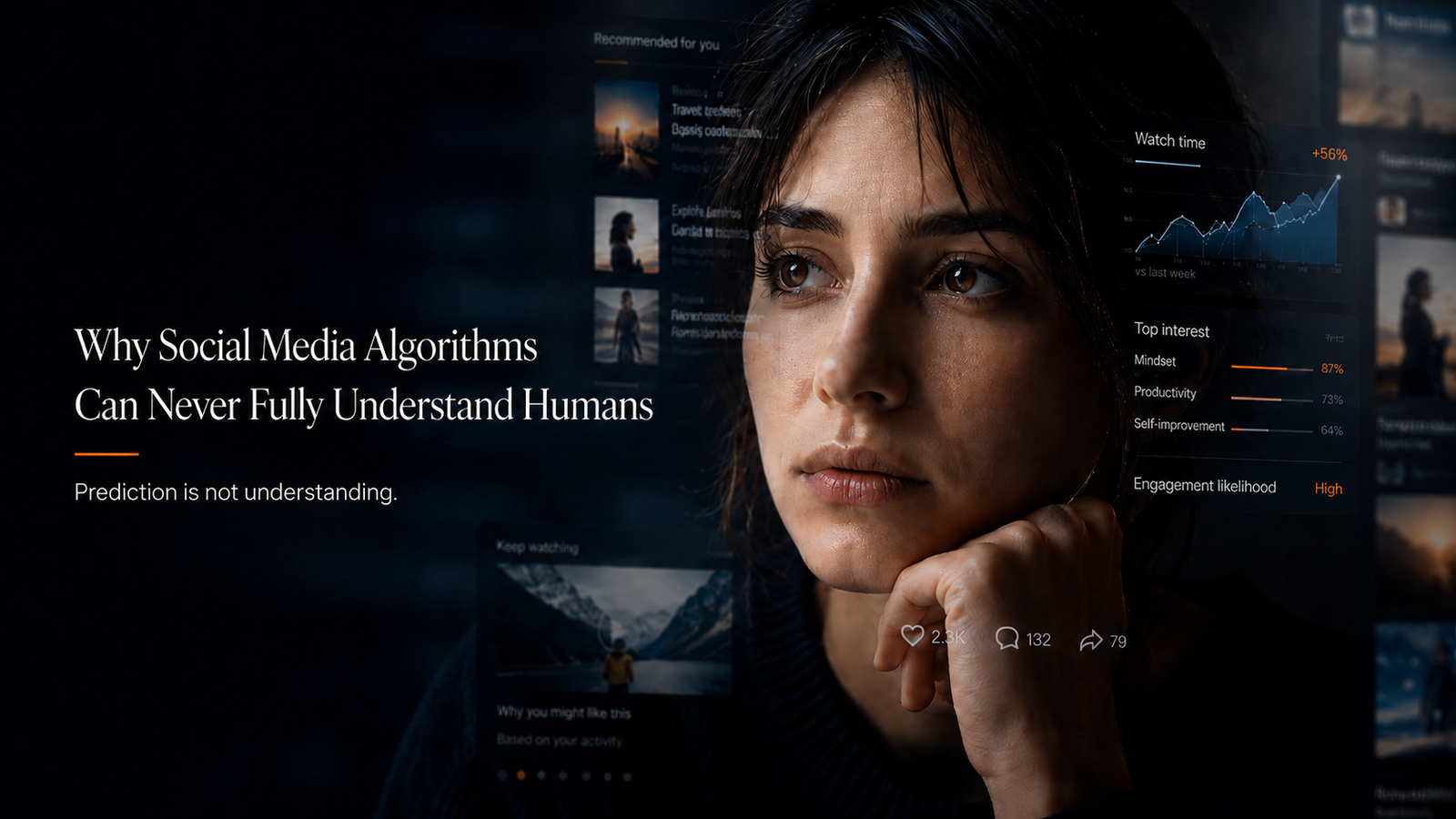
Why Social Media Algorithms Can Never Fully Understand Humans
Social media apps look smarter than they really are. They can track your pauses, replays, comments, saves, and longer stops. That can feel personal, sometimes even uncomfortable. But the app is not reading your mind. It is reading your behaviour.
A recommendation system may know what kept you scrolling. It still does not know why you stayed.
Algorithms Read Signals, Not Intent
Platforms mostly work with visible signals: watch time, likes, saves, shares, comments, skips and searches. If you watch a few cricket videos, the app may assume you want more cricket. If you pause on emotional content, it may send more similar posts into your feed. But the same signal can mean different things.
A long watch can mean interest, anger, shock, confusion, or just tired scrolling. The system can measure the pause, not the reason behind it.
A Click Is Not a Confession
A click can be accidental. A search can be temporary. A comment can come from irritation, not real interest. The algorithm only gets the action, not the background story. One random click can mess up your feed for days. The system may think you want more of that topic, even if you were only curious for a moment.
People Change Faster Than Feeds
Most recommendation systems are built from past behaviour. Your feed often follows an older version of you. Today your mood may be different. The topic may already feel boring, or you may not want more content at all. The algorithm follows the old trail, even after you have moved on.
Humans Are Not One Category
Algorithms sort people into boxes. Real people are not that simple. The same person may watch a physics explanation, a cricket highlight, a movie clip, a food reel and a serious news video in one evening. That does not mean the person is confused. People are like that. A feed goes wrong when it treats one interest as your main identity.
Context Changes Everything
Data often misses context. Two people may watch the same sad video for completely different reasons. One may be moved by it. Another may be studying it. Someone else may just be half-awake with the phone in hand.
The platform sees the same action in all three cases. It can guess from time, location, device and past activity. The same behaviour can still lead to the wrong recommendation.
Engagement Can Mislead the Algorithm
Engagement is easy to count. Emotion is not. A post that makes people angry can perform as well as one that makes them happy. Sometimes it performs better. Both can create comments, shares and long watch time.
The danger is that the system may treat any strong reaction as value. A share is not always approval. A comment is not always interest. A long watch is not always enjoyment. That is one reason outrage travels so easily online. It produces strong signals, even when people are not asking for more of it.
Some Preferences Stay Hidden
Some preferences never show up clearly. People may read without liking, care without commenting, or enjoy something without sharing it. Sometimes they avoid reacting publicly because they do not want attention. The algorithm only learns from what people leave behind.
The Feed Changes the User Too
Another problem is that the algorithm is not just watching users. It can change them too. If the feed keeps showing one topic, people may start spending more time with it. If it keeps repeating one opinion, that opinion may start to feel more common. If outrage gets rewarded, creators learn to produce more outrage. So the platform is not studying people in a neutral space.
It is studying people inside a feed the platform itself shaped. The system is measuring behaviour that it is also helping to create.
Final Takeaway
Social media algorithms are extremely good at predicting attention. But attention is not the whole story. A watch-time graph cannot show boredom, pressure, guilt, curiosity, anger, worry, or quiet interest.
The feed may know what made you stop scrolling, what you clicked, skipped, or saved. But it still does not know the full reason behind them.
Algorithms may keep getting better at reading behaviour. People are still more than behaviour.
We change, hide things, and act for reasons the feed cannot always see. The algorithm may understand the scroll. The person behind it is still harder to read.
Related Reads
Why Online Scams Can Never Be Fully Eliminated




Nice article. Any technology can never understand the human behaviour compltely.
Thank you