Why Football Matches Cannot Be Completely Fair
Football matches cannot be completely fair, even when both teams play under the same rules for the same 90 minutes. The sport is not broken. It is simply played at high speed, under pressure and through human judgment.
Rules can guide the game, but they cannot control everything that happens inside it.
Football Moves Faster Than Judgment
Football rarely pauses long enough for anyone to study a decision. A small shirt pull can stop a run. A light push can knock a player off balance. A missed foul can become a counterattack. By the time the whistle comes, the game may already have moved on. The referee has to judge everything instantly.
Most of these decisions are not black and white. They depend on timing, force, position and how the incident affected play. That is why two fans can watch the same tackle and see two different things.
One sees a clear foul. Another sees normal contact. Once interpretation enters the decision, complete consistency is gone.
VAR Removes Errors, Not Arguments
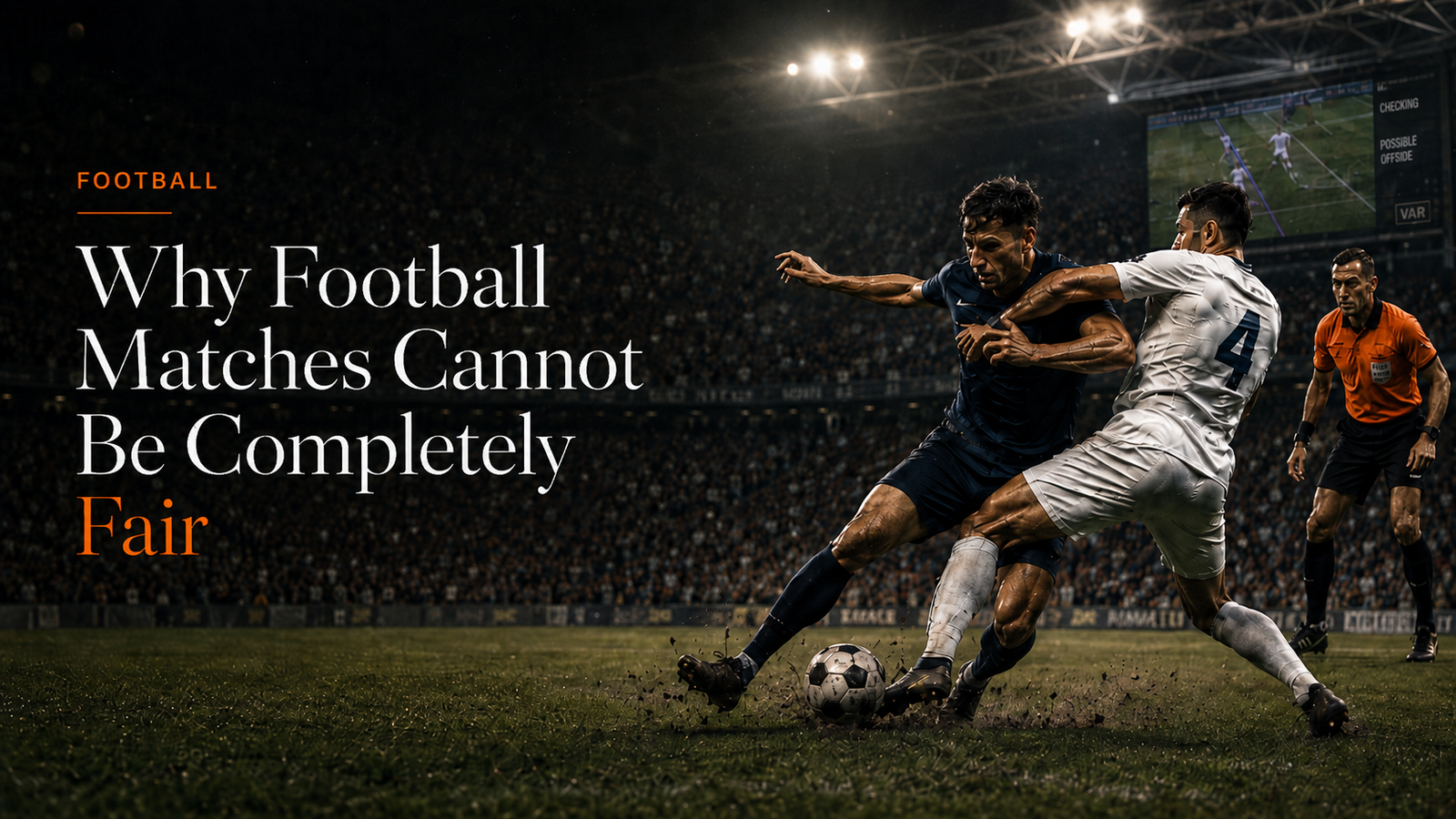
VAR has corrected many decisions referees would once have missed. Under IFAB’s protocol, VAR is limited to goals, penalties, direct red cards and mistaken identity. It intervenes only when there is a clear and obvious error or a serious missed incident. VAR is not there to find the fairest call. It is there to decide whether the referee was clearly wrong.
A player can be offside by a toe. A soft penalty can survive review. Slow motion can make a normal tackle look worse. One angle can miss the contact. Another can make it look obvious.
Technology can catch mistakes, but it cannot settle every argument. VAR has only moved those arguments from the pitch to the replay screen.
Referees Cannot See Everything
With 22 players moving at once, the referee cannot watch every part of the pitch. Away from the ball, players block runs, hold shirts, nudge opponents, delay movement and create space.
Some incidents are hidden behind players. Others are over before the referee gets a clear view.
Even with assistant referees and VAR, some incidents will still be missed.
The Clock Cannot Restore Momentum
A football match lasts 90 minutes, but the ball is in play for far less than that. One team wastes time, the other loses rhythm, and an injury stoppage can kill a spell of pressure.
Added time replaces some of the lost seconds. It cannot bring back the attack that was interrupted or the pressure that had been building.
Correct Can Still Feel Unfair
A decision can be technically correct and still feel unfair.
A tiny offside can cancel a beautiful goal.
A soft penalty can decide a final.
A red card can reshape the whole match.
A deflection can send the better team home.
The call may be right. Its impact can still feel far bigger than the incident itself.
Football promises a result. It does not promise that the result will feel just.
Final Takeaway: Why Football Matches Cannot Be Completely Fair
Football matches cannot be completely fair simply by adding better cameras, quicker reviews or clearer protocols. Those changes can reduce mistakes, but they cannot remove judgment from the game. Every match still depends on what the referee sees, what the cameras miss and how the laws are interpreted.
There will always be fouls open to interpretation, replays without the right angle and moments no referee or camera can judge perfectly.
Football can become fairer. It will never become perfectly fair.
Which change would help most: a stop clock, faster VAR reviews or clearer contact rules?
Related Reads
Why Scoring in Every Football Match Is Impossible