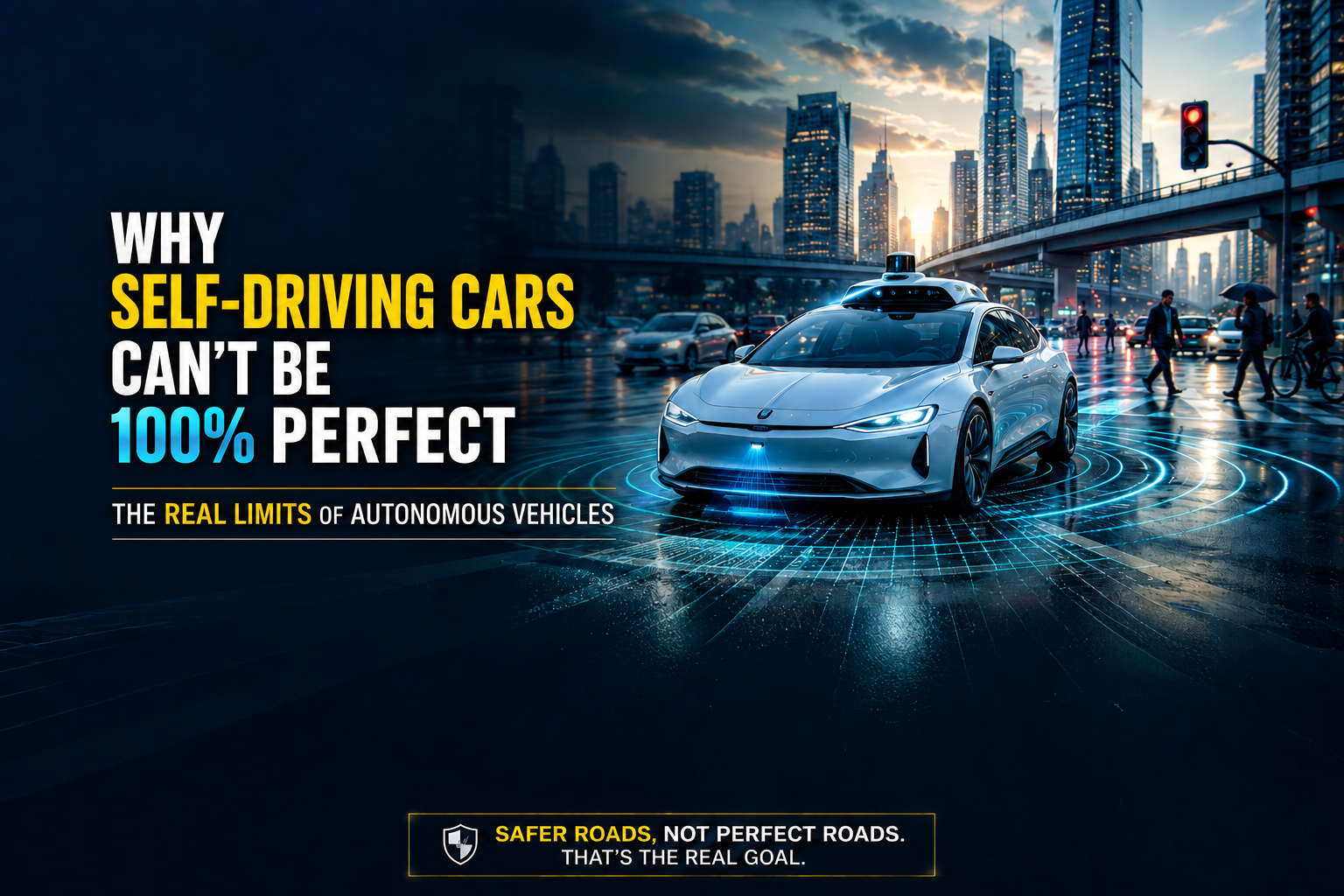
Why Self-Driving Cars Can’t Be 100% Perfect
Self-driving cars are no longer science fiction. They can read lanes, track vehicles, follow maps, and react faster than a tired human driver. In the right conditions, they already look impressive.
But perfect is a much heavier word.
A road is not a test track. It has bad markings, sudden braking, stray animals, confused pedestrians, illegal turns, rain, glare, roadworks, and drivers who do strange things for no clear reason.
Self-driving cars may become safer than many human drivers. But 100% perfect driving is a different claim. The harder part is the road around it.
Driving Is Messier Than Software
On paper, driving looks like a set of rules: stay in the lane, stop at signals, keep distance and avoid obstacles. But real driving is also about reading people. A driver is always reading things that are not written on signboards. A person standing near the road may be waiting, or may suddenly step forward. A biker behind a bus may appear at the last second. A car in the next lane may look normal, then suddenly brake. A pedestrian may wave another vehicle through even when the rule says something else.
A self-driving car can calculate speed, distance and probability. But it still has to guess what people might do next. On a road, people often move before they make sense.
The Strange Moments Never Stop
Most kilometres on the road are ordinary. Then one odd moment changes everything. A dog runs across the street. A truck drops something on the road. A traffic light stops working. A child comes out from between parked cars. A driver comes from the wrong side and expects everyone else to adjust.
A self-driving system may handle thousands of normal situations well. The danger is the one unusual situation it reads wrong. Perfect driving would mean getting those strange moments right every single time. That is the impossible part.
Sensors Can Improve, But They Cannot See Everything
Self-driving cars depend on cameras, radar, LiDAR, GPS, maps and software. These tools help the car understand the road, but they do not see the world perfectly.
Cameras can struggle with glare, darkness, rain, dust, dirty lenses and faded lane markings. Reflections can confuse the system. Radar and LiDAR help, but they also have limits when visibility is poor or objects are partly blocked. Humans struggle in bad conditions too. The road does not give perfect visibility to anyone.
A self-driving car can only decide from the information it receives. If that information is blurred, blocked or incomplete, the decision carries risk. A car cannot make a perfect decision from an imperfect view.
AI Cannot Train for Every Road Surprise
AI learns from data. It can study huge amounts of driving footage and improve over time. But no dataset can contain every possible road event. There will always be a new mix of weather, timing, road damage, human mistake and bad luck. It could be a tree branch on a dark curve, a cyclist hidden behind a van, a half-built diversion in the rain, or a confused pedestrian standing between two lanes. More data helps. But it cannot make every future road predictable.
Weather Changes the Road
A clear road on a sunny day is one thing. The same road during heavy rain is a different problem.
Rain can blur lane markings, hide potholes and change braking distance. Fog can shrink visibility within seconds. Dust can block cameras. Flooded roads can hide depth, damage and open drains.
Weather also changes people. Some drivers slow down too much. Some do not slow down at all. Bikers take sudden turns to avoid water. Pedestrians rush across roads without judging speed properly. The car must know not only where the road is, but whether it is still safe to drive on.
Human Behaviour Is the Hardest Part
Traffic rules are clear. People are not. People jaywalk. Drivers panic. Bikers squeeze into impossible gaps. Pedestrians hesitate, step back, then suddenly cross.
Some drivers follow rules. Others treat rules as suggestions. This is where autonomy struggles most. The car is not moving among objects that follow fixed rules. It is moving among people with habits, fear, impatience and sudden mistakes. In some places, traffic follows lanes. In others, driving works through hand signals, eye contact, slow negotiation and constant adjustment. Machines can estimate people. They cannot make people predictable.
Software Always Carries Some Risk
A self-driving car is also software moving through public roads at speed. Software can improve, but it can still fail. A bug, a wrong sensor reading, an old map, a bad prediction, or a few small mistakes together can create a dangerous moment. Testing reduces the risk. It does not erase it.
This is true even in aviation, banking, hospitals, satellites and power grids. These systems are tested heavily, but they still need updates, backups and monitoring. More reliable does not mean flawless.
When Something Goes Wrong, Blame Is Not Simple
When a human driver makes a mistake, responsibility is usually clear. But when a self-driving car makes a wrong decision, the question becomes harder.
Was it the car company? The software team? The sensor supplier? The map provider? The owner? The regulator? This is not only a legal question. It affects trust.
People understand human error. Machine error feels different, especially when the decision is hidden inside software. “The algorithm decided” is not enough when lives are involved.
Until responsibility is clear, full public trust will remain difficult.
Safer Does Not Mean Perfect
The best argument for self-driving cars is not perfection. It is that they may reduce many human mistakes. Humans get tired. They look at phones. They drive drunk. They speed. They get angry. They take risks because of ego, hurry or carelessness.
A self-driving car does not get drunk, sleepy, angry or distracted like that. But a system can be safer than an average human driver and still not be perfect.
Final Takeaway
Self-driving cars may still change transport. They may reduce accidents, help people who cannot drive, and make roads safer in many situations. But they cannot be 100% perfect. The reason is simple: real roads do not behave perfectly.
Perfect driving would need perfect sensors, perfect data, perfect weather, perfect roads, perfect software and perfectly predictable humans. None of those exist.
The future of self-driving cars is not a perfect robot driver. It is a useful technology working inside the limits of real roads. The perfect driver may never exist.
Related Reads
Why Flying Cars Still Aren’t Practical for Everyday Life