Why AI Cannot Detect Lies Perfectly
Why AI Cannot Detect Lies Perfectly: The Truth About AI Lie Detection
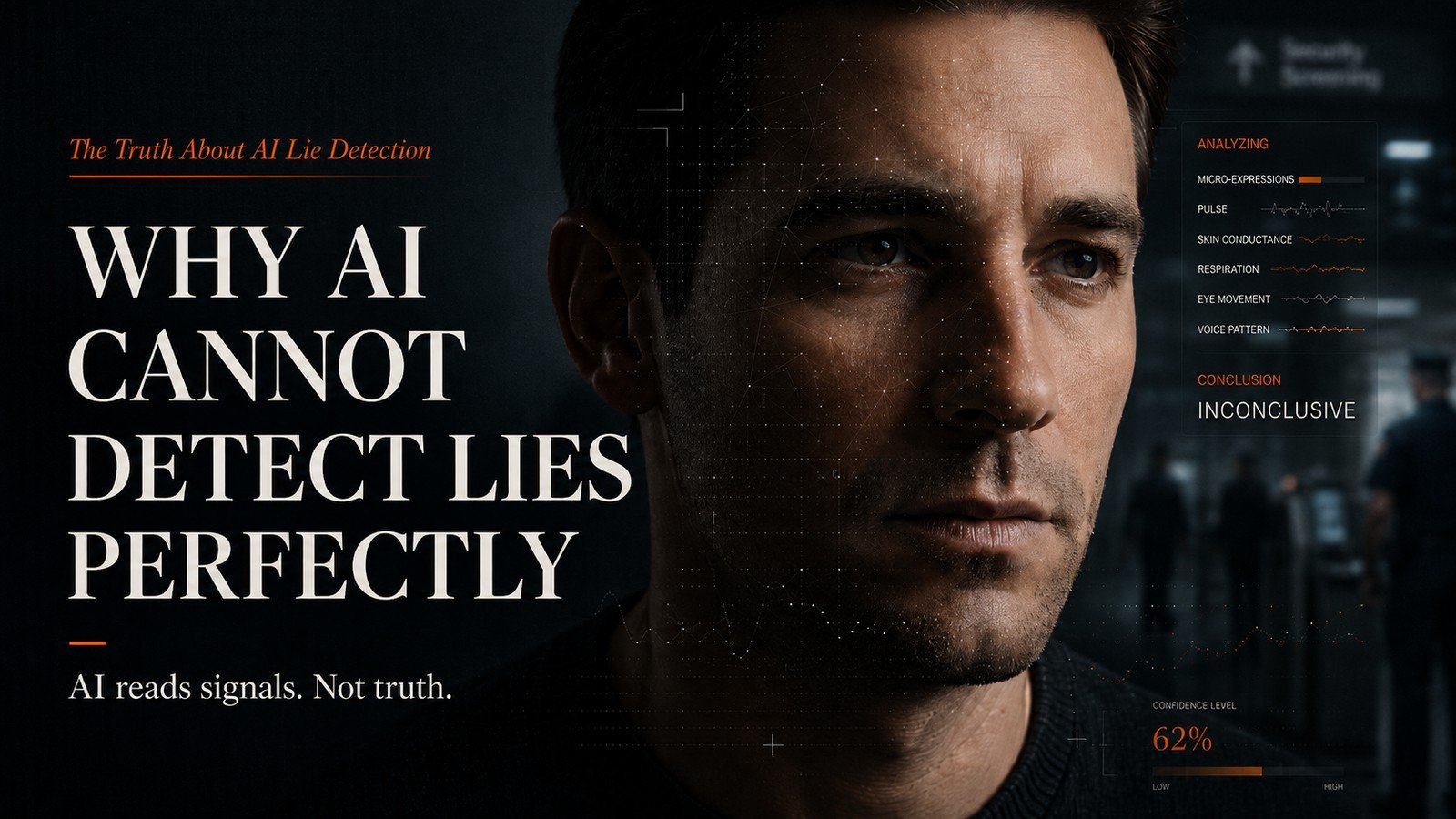
AI lie detection sounds simple until you think about what it is really trying to measure. Put a person in front of a camera. Record the voice. Watch the eyes, face, posture, pauses, and word choice. Then ask a machine learning system to decide whether that person is telling the truth.
It looks like a data problem. But lying is not one clean signal. There is no single mark on the face, no fixed tremor in the voice, and no universal pattern in the body that means deception. Fear, memory, pressure, culture, and intention all get mixed into the same behaviour.
Two people can look almost identical from the outside and still be in completely different mental states. That is why AI can flag suspicious behaviour. It cannot become a perfect truth machine.
There Is No Universal Lie Signal
One person may avoid eye contact while lying. Another may hold eye contact because they know people expect liars to look away. An innocent person may panic under pressure. A liar may stay calm because the story is rehearsed. That makes deception different from a fingerprint. A fingerprint has fixed physical features. A lie changes with the person, the pressure, and the situation.
A machine can detect sweating, blinking, pauses, facial tension, voice changes, or unusual wording. But those signs do not have one fixed meaning. Sweating may come from fear, heat, illness, embarrassment, or stress. A pause may come from lying, but it may also come from trying to remember accurately.
The machine can measure the behaviour. The meaning is still the hard part.
AI Often Detects Stress, Not Lies
Most lie detection systems are closer to stress detection than truth detection. That was the weakness of the polygraph too. A polygraph measures body reactions such as pulse, breathing, blood pressure, and skin response. Those reactions may increase when a person lies, but they may also increase when a person is scared, angry, confused, or wrongly accused.
AI can use more data than a polygraph. It can combine facial expression, voice tone, eye movement, body movement, and language patterns. But more data does not remove the basic problem. If the system is mainly reading stress, then the result is only a warning sign, not a truth test.
An innocent traveller may look nervous at an airport because the setting itself is intimidating. A person in a police interview may hesitate because they are afraid of saying the wrong thing. A job candidate may speak awkwardly because interviews are stressful.
A trained liar may do the opposite: rehearse the answer, control the breathing, and appear natural. Stress can be useful information, but it is not proof of lying.
Honest People Can Look Suspicious
Truth is not always delivered cleanly. Honest people forget details, correct themselves, or explain things badly under pressure. Sometimes they sound defensive simply because they feel accused.
Human memory is not a perfect recording. It is reconstructed each time we recall something. Some details remain strong, some fade, and some change under pressure. That becomes dangerous when AI treats every inconsistency as deception. A small contradiction, nervous tone, or badly explained answer may come from pressure, not dishonesty.
In real life, an honest answer can be nervous, incomplete, and badly explained.
Good Liars Can Look Honest
Some liars do not give the machine much to catch. They prepare, speak calmly, control their body language, and add just enough detail to sound believable. In some situations, they may appear more confident than an innocent person who is under pressure. The hardest lies to detect are often the ones that look ordinary.
A skilled liar may understand exactly what investigators, interviewers, or systems expect to see, and then avoid those signals.
AI can only work with what it can observe. If a liar controls the visible signs, the system has less to read. It may still find contradictions, but that is not the same as detecting deception directly.
AI may catch careless deception. A calm, rehearsed liar is a much harder target.
Face, Voice, and Text Are Not Reliable Proof
The face can show emotion, but it does not explain the reason behind that emotion. Fear, guilt, shame, and stress can look similar from the outside. A falsely accused person may show the same anxiety as someone hiding something.
Voice analysis runs into the same wall. A shaky voice may come from lying, but it may also come from fear, tiredness, illness, language difficulty, or pressure. Some honest people hesitate. Some liars sound fluent.
Text analysis is also limited. AI may look for vague wording, contradictions, over-explaining, or unusual sentence patterns. But writing style is not truth. Some honest people write unclear answers. Some liars write clean ones. A person can also polish a false statement until it sounds calm, direct, and believable.
Face, voice, and text can help raise questions. They cannot settle the truth on their own.
Real Life Is Not Like a Lab Test
AI lie detection usually looks stronger in controlled tests than in real life. A lab test can control the room, the questions, and the stakes. Real life does not give AI that comfort.
A police interview, court case, immigration check, job screening, business negotiation, or personal accusation carries pressure that a lab test cannot fully reproduce. People may be tired, frightened, traumatised, angry, confused, or speaking in a second language. Lighting may be poor. Audio may be unclear. Cultural behaviour may be misunderstood.
A model can perform well on a dataset and still fail outside it. That does not make the model useless; it shows where the limit begins.
Deception is not only a data pattern. It is behaviour shaped by the situation around it.
Bias Can Make AI Lie Detection Dangerous
AI systems learn from the data they are given. If that data is incomplete, narrow, or biased, the system can carry those problems into real decisions. That becomes risky because normal behaviour does not look the same across people.
Eye contact, gestures, accents, facial movement, and nervousness around authority can vary widely between people. If the system treats those differences as suspicious, innocent people can be judged unfairly.
A bad lie-detection result can damage a person’s job, reputation, legal case, travel, or personal life. So AI lie detection is not just a technical question. It is also a fairness question.
AI Cannot Read Intention
The hardest part is intention. A lie is not just a wrong statement; it is a wrong statement told to deceive.
Two people can say the same false thing. One may be lying. The other may simply be mistaken. The words may be the same, but the meaning behind them is completely different.
AI can analyse the statement. It can compare it with other information. It can study the person’s behaviour while they speak. But it cannot directly enter the mind and measure intention.
Without access to intention, AI can only estimate risk. It can say something looks inconsistent or suspicious. It cannot know, with perfect certainty, that the person meant to deceive. That is the wall a perfect lie detector cannot cross.
Final Takeaway: AI Can Detect Clues, Not Perfect Truth
AI can help in investigations. It can compare statements, organise evidence, flag contradictions, and notice patterns that humans may miss. But that is not the same as knowing the truth.
An honest person can look nervous. A liar can look calm. A memory can be wrong without being dishonest. A face can show fear instead of guilt.
The real limit is not the camera, the microphone, or the size of the dataset. The real limit is the nature of lying itself.
A lie is tied to context, pressure, memory, personality, and intention. AI can study the outside signs, but it cannot directly see the reason behind them. That is why AI can support human judgment, evidence, and investigation. It cannot replace them.
Perfect AI lie detection remains impossible because truth is not just a pattern waiting to be measured.
What Do You Think?
Would you trust an AI system to judge truth in an airport check, job interview, or court case?
Or should truth always need evidence, context, and human judgment?
Share your view in the comments.
Related Reads
Why Online Scams Can Never Be Fully Eliminated