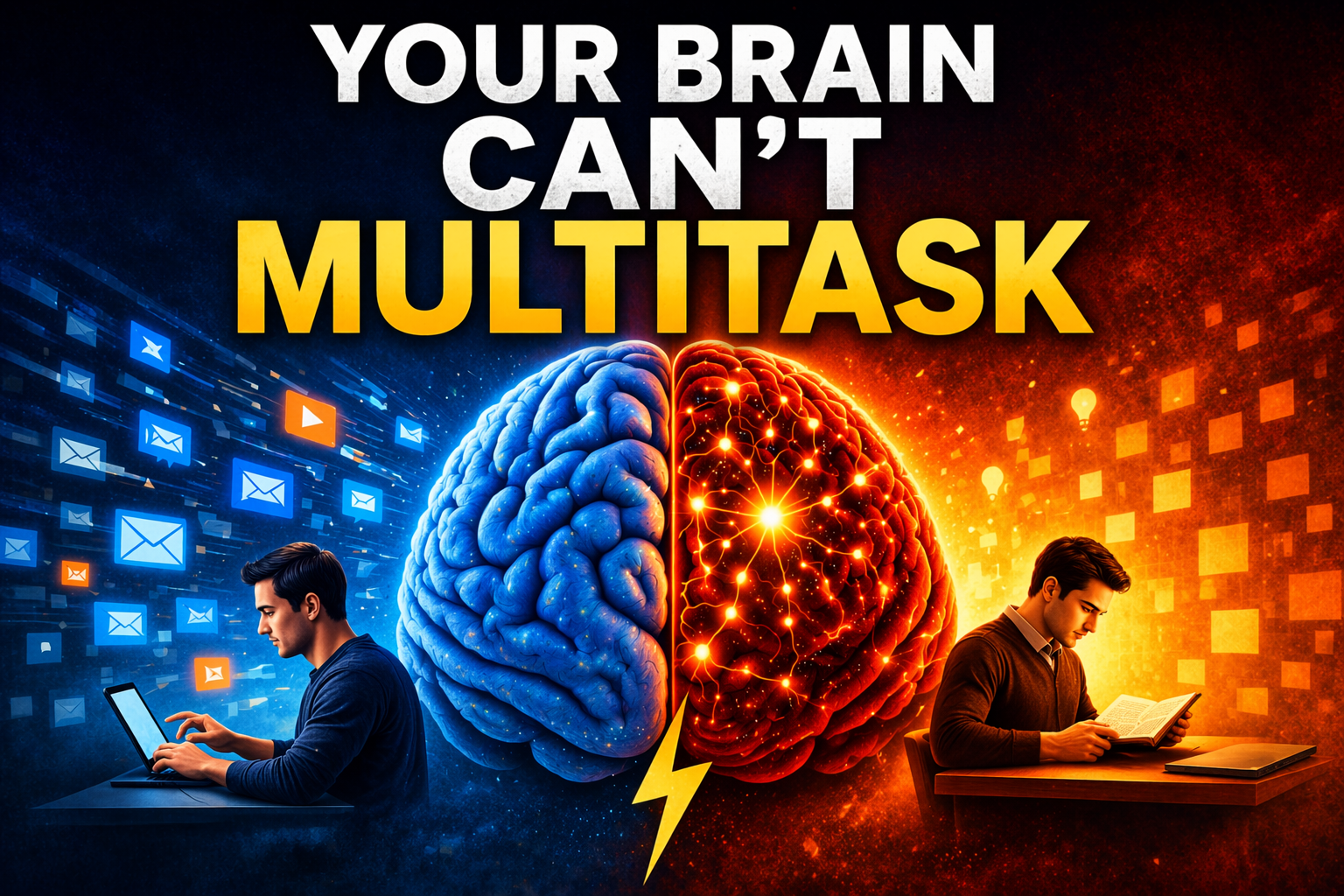
Why True Multitasking Is Not Possible
True multitasking is not possible, but it feels real because we experience it every day. A student listens to a lecture while replying to messages. Someone works with ten browser tabs open. A person studies while checking Instagram every few minutes. It feels like everything is happening at the same time.
The human brain can move between demanding tasks quickly, but it cannot give both tasks full attention at the same moment. What we call multitasking is usually fast task switching.
The brain jumps from one task to another so quickly that the jump feels like multitasking. That is why multitasking can feel productive while quietly lowering the quality of the work.
The Multitasking Myth
The confusion begins because switching is fast. You glance at a notification, return to a paragraph, answer someone, and continue as if the focus was never broken.
Complex work needs steady attention. Reading with understanding, solving a problem, writing, listening carefully or making a decision cannot all share the same full focus.
When two serious tasks compete, attention has to move away from one of them. That is why two hours of “studying” with a phone nearby can leave behind very little memory.
What the Brain Actually Does
Each switch forces a small reset. The mind leaves one thread, picks up another, and then has to find its way back. One switch may not matter much, but repeated switching changes the whole rhythm of work.
Notifications, tab changes and quick replies keep interrupting that rhythm. This is why you sometimes return to your work and need a few seconds to remember where you stopped. The brain was not holding the previous task in perfect condition. It has to rebuild the context before the work feels smooth again.
Why Multitasking Makes Work Slower
You may still finish the task, but the work usually loses depth. Focused work builds momentum. Once the mind settles, details stay longer and ideas connect more naturally. Multitasking breaks that rhythm too early. The real loss is the effort needed to regain the same focus. A five-second phone check can disturb far more than five seconds of work.
Why Mistakes Increase
Mistakes become more likely when attention keeps breaking. A student misses a step in a calculation. A reader passes over an important line without absorbing it. A quick reply goes out before the question is properly understood.
Serious work needs continuity. If that continuity keeps breaking, accuracy naturally falls. The task continues, but the quality drops. That is why multitasking becomes risky in work that needs judgment: driving, medical decisions, complex study or financial details.
Why It Feels So Tiring
Multitasking is tiring because switching is work. The mind is not only handling the task. It is also managing distractions, unfinished thoughts and the constant return to where it stopped. That is why a day full of messages, calls, tabs and half-finished tasks can feel exhausting, even without hard physical work. The tiredness comes from attention being pulled too often. Multitasking keeps forcing attention to start again.
Why the Brain Cannot Truly Multitask
Part of the explanation lies in executive control, the brain’s system for handling goals, distractions and working memory. But that control system has limits. It cannot give every demand the same priority at once.
When two difficult tasks compete, attention has to shift between them. That is the biological reason true multitasking is not really possible. This is not just a discipline problem. It is built into attention itself.
When Doing Two Things Works
Of course, some combinations work. You can walk while talking, listen to music while cleaning a room, or hold a simple conversation while driving on a familiar road. But that is not the same as running two demanding mental tasks at full power. In those cases, one task is mostly automatic.
The brain can pair an automatic action with another activity. It cannot give full attention to two complex tasks at the same time.
Why Modern Life Makes It Worse
Modern life makes this limit harder to notice and harder to avoid. Phones, apps, alerts and open tabs keep pulling attention away before the last thought has settled. The environment changed faster than the brain did.
A notification looks small, but it still breaks concentration. Once attention leaves, focus has to be rebuilt. That is why people can feel busy all day and still finish very little that feels complete. Their attention is split into fragments.
The Better Way to Work
The better answer is not extreme discipline. It is fewer interruptions. This does not mean working for hours without a break. It means giving the mind enough quiet time to settle into one task.
For many people, a focused block of 25 to 50 minutes is more useful than two distracted hours.
Difficult work usually needs that kind of quiet stretch. Understanding, writing and problem-solving all improve when attention is allowed to stay in one place.
Final Takeaway
True multitasking is not a real advantage in demanding work. It is usually fast switching mistaken for doing everything at once.
Simple automatic actions can run beside another task. But when two tasks need real focus, memory, judgment and understanding, full multitasking breaks down. You can switch fast, but switching is not the same as focusing.
Serious work still asks for something old-fashioned: one clear stretch of attention. In a world full of interruptions, that may be the real skill: staying with one thing long enough to do it well.
Related Reads
Why We Can’t Hack the Human Brain Like a Computer
Why Can’t Humans See Infrared or Ultraviolet? The Science Behind Our Vision Limits