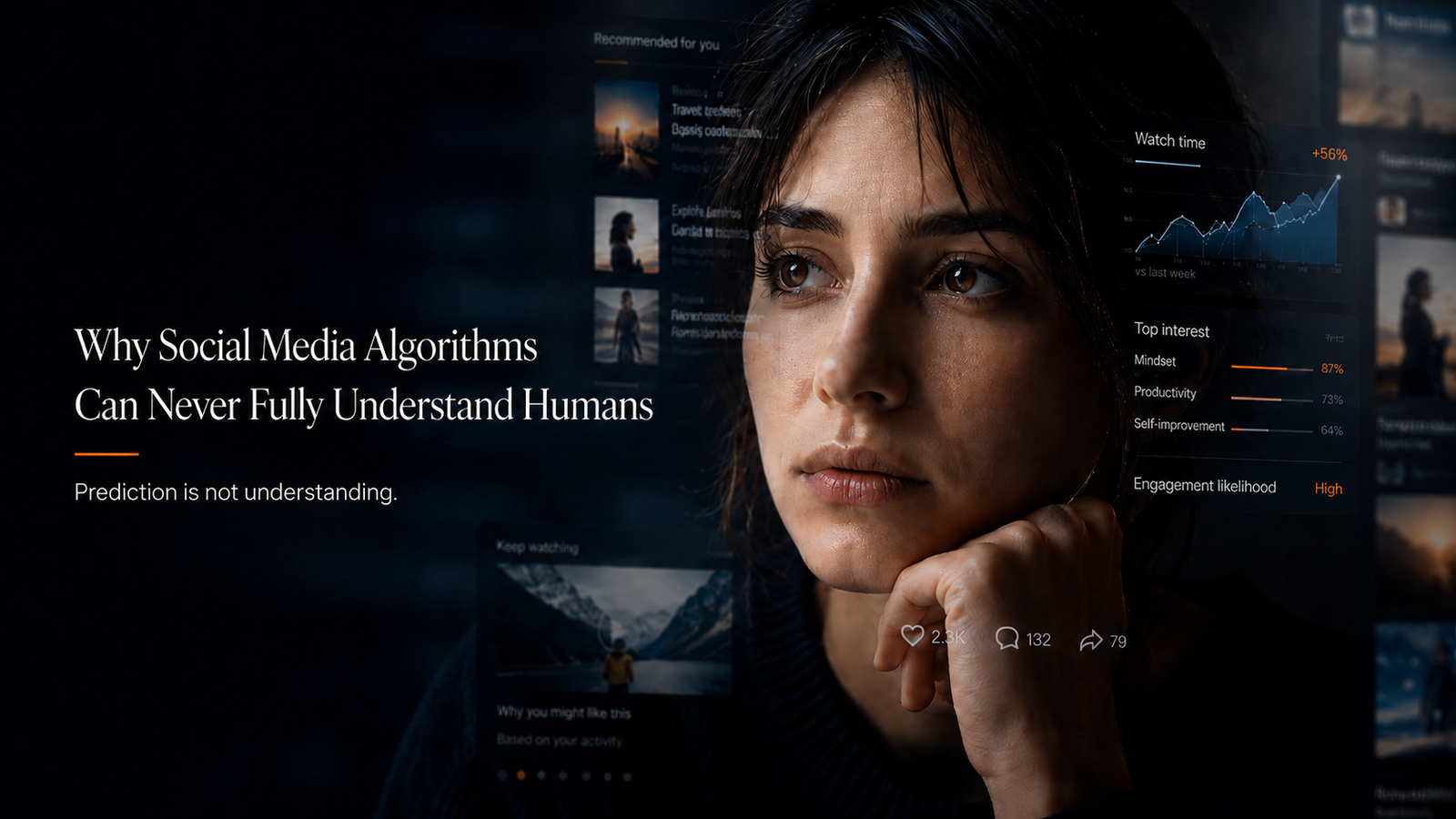
Why Social Media Algorithms Can Never Fully Understand Humans
Social media algorithms can predict what you may watch next — but prediction is not understanding.
Social media algorithms feel almost magical.
They know what video may stop your scrolling.
They know which post may make you react.
They know what topic can keep you watching long after you planned to stop.
Sometimes, it feels like the algorithm understands you better than people around you.
But that feeling is misleading.
The algorithm does not understand you.
It studies your behavior.
It does not read your mind.
It measures your patterns.
And that difference is exactly why social media algorithms can never fully understand humans.
Because a human being is not just data.
A human being is mood, memory, culture, emotion, boredom, curiosity, insecurity, contradiction and silence.
An algorithm can see what you do.
But it can never fully know why you do it.
The Reality: Algorithms See Signals, Not Meaning
Every social media platform depends on signals.
You watch a video.
You like a post.
You share a reel.
You skip something quickly.
You search for a topic.
You comment on a debate.
You follow a creator.
To the algorithm, these actions become data.
If you watch cricket videos, it shows more cricket.
If you save fitness posts, it shows more fitness.
If you watch emotional videos, it may show more emotional content.
That sounds intelligent.
But the problem is simple:
The same action can mean different things.
You may watch a video because you love it.
You may watch it because you hate it.
You may watch it because you are shocked.
You may watch it because you are studying it.
You may watch it only because you were too tired to scroll away.
The algorithm sees watch time.
It does not fully understand the emotion behind it.
That is the real danger.
When an algorithm predicts us correctly a few times, we start believing it understands us completely.
But accuracy is not wisdom.
A system can guess what keeps you watching without understanding what you are feeling.
It can recommend content without knowing whether that content helps you, harms you, comforts you, or traps you.
That is why this problem is not just about technology.
It is about the gap between human behavior and human meaning.
Humans Do Not Always Mean What They Click
A click looks simple.
But human intention is messy.
You may click a celebrity headline not because you care, but because it is outrageous.
You may watch a scam video not because you like scams, but because you want to understand the danger.
You may search for a health issue not because you have it, but because someone you know mentioned it.
The algorithm does not know the full story.
It only sees the action.
This is why one accidental click can change your feed. One emotional moment can become a recommendation pattern. One angry comment can make the system think you want more of that topic.
But a click is not a confession.
A view is not a personality.
A reaction is not the full human truth.
Humans Change Faster Than Algorithms Can Follow
People are not the same every day.
Your mood changes.
Your goals change.
Your stress changes.
Your interests change.
Your attention changes.
One day you want motivation.
Another day you want comedy.
Another day you want silence.
Another day you want deep information.
But algorithms mostly learn from past behavior.
They build a version of you based on what you already did.
That means the algorithm is often recommending content to yesterday’s version of you.
This is a major reason social media algorithms can never fully understand humans.
The algorithm follows the trail.
But the human keeps moving.
Humans Are Contradictory
Humans are not clean categories.
A person can love fitness and still watch food videos.
A person can hate drama and still watch dramatic clips.
A person can enjoy science, football, cricket, movies, memes and philosophy in the same day.
Algorithms prefer categories.
Sports fan.
Tech lover.
Comedy viewer.
Fitness audience.
Political user.
But real humans are not one niche.
We are many moods inside one mind.
That is why your feed sometimes feels strangely accurate and completely wrong at the same time.
The algorithm may understand one part of you.
But it mistakes that part for the whole person.
Context Changes Everything
Context is the part algorithms struggle with the most.
A person watching a sad video may be heartbroken.
Or writing a story.
Or helping a friend.
Or simply pausing while doing something else.
The video is the same.
The human context is different.
An algorithm can use time, device, language and past activity to make guesses.
But it cannot fully know your private situation.
It does not know if you are tired.
It does not know if you are pretending to be okay.
It does not know if you saved something because you agreed with it or because you wanted to criticize it later.
Human meaning depends on context.
And context is never fully visible from data.
Engagement Is Not Emotion
Social media platforms measure engagement.
But engagement is not the same as understanding emotion.
Anger creates engagement.
Fear creates engagement.
Curiosity creates engagement.
Joy creates engagement.
Outrage creates engagement.
To an algorithm, these can look similar because they all produce action.
A user watched.
A user reacted.
A user commented.
A user shared.
But emotionally, those actions are not the same.
A person may share a post because it inspired them.
Another may share it because it disturbed them.
Another may share it to warn others.
Another may share it to disagree.
The algorithm can count the share.
But it cannot fully understand the heart behind the share.
That is why emotionally intense content spreads so easily online.
The system sees reaction.
But reaction is not always truth.
Humans Hide Their Real Preferences
Not everything we care about becomes visible.
People do not always like posts they enjoy.
They do not always comment on what moves them.
They do not always share what they truly believe.
They do not always follow creators they secretly admire.
Many preferences stay private.
A user may watch educational content without liking it.
A user may care deeply about a topic but never comment.
A user may avoid serious posts publicly but read them quietly.
The algorithm can only learn from what becomes measurable.
But some of the most important parts of a human being are not measurable.
That is the permanent blind spot.
Algorithms Can Influence the Human They Study
This is the deepest problem.
The algorithm is not only observing your behavior.
It is also shaping it.
If it shows you more of one topic, you may watch more of it.
If it repeats one belief, that belief may feel more common.
If it rewards outrage, creators may produce more outrage.
If it pushes emotional content, your mood may shift.
So the algorithm is not studying a neutral human.
It is studying a human inside a system the algorithm helped create.
That makes full understanding impossible.
It is like measuring a river while also changing its direction.
The Core Truth
Social media algorithms can become extremely powerful.
They can predict attention.
They can recommend content.
They can detect patterns.
They can personalize feeds.
They can guess what may keep you watching.
But they cannot fully understand humans.
Because humans are not just patterns.
A person is not fully explained by watch time.
A person is not fully captured by likes and shares.
A person is not only a profile, a category or a prediction.
Humans click without caring.
They watch without agreeing.
They share without believing.
They search without confessing.
They stay silent while feeling deeply.
That is the limit.
The algorithm may know what you watch.
It may know what you skip.
It may know what keeps your thumb from moving.
But it does not know the full story behind your attention.
It does not know your private context.
So yes, social media algorithms will become more accurate.
But they will never become complete.
They may understand your scrolling.
But they will never fully understand you.
And that is the line no algorithm can cross.