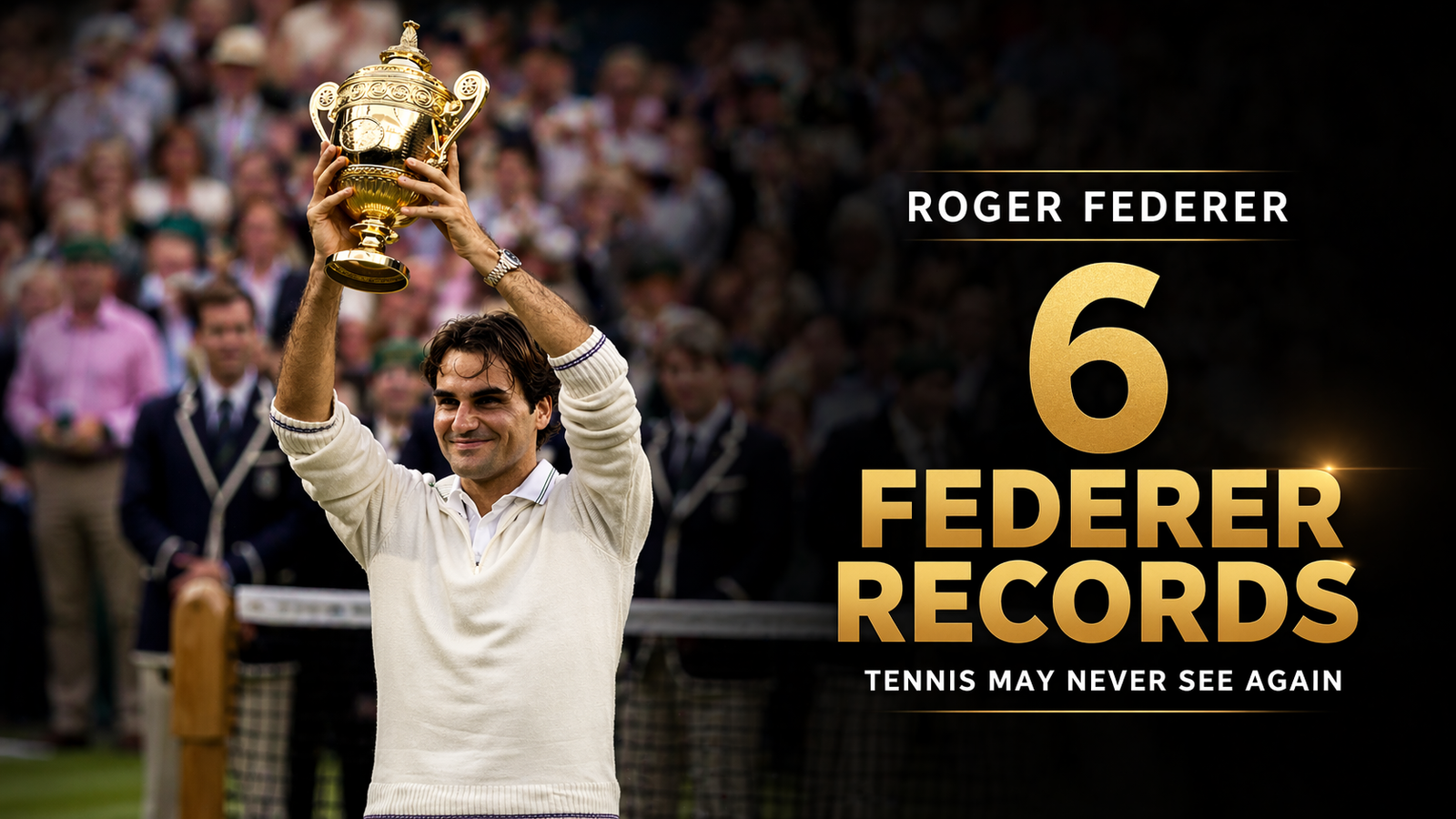
Roger Federer Records That May Never Be Broken
Roger Federer records are not what they looked like ten years ago. Djokovic has moved past him in many of the biggest totals. Nadal’s clay records are a separate case. But a few Federer numbers are still hard to ignore. These are the ones that still look hardest to chase.
1. 237 Consecutive Weeks as World No. 1
Federer first became World No. 1 in February 2004 and stayed there until August 2008. That is 237 weeks in a row. More than four and a half years at the top, without one break. A streak like that leaves almost no room for a bad month.
Federer held it through hard courts, clay, grass, indoor events, and the pressure that follows every No. 1 player. One bad Slam or a few missed months would have been enough. None of it happened.
2. 8 Wimbledon Men’s Singles Titles
Federer’s eight Wimbledon titles still stand as the men’s record. Grass does not give players much time. One bad service game can swing a set. One poor tiebreak can change the tournament. His titles came in 2003, 2004, 2005, 2006, 2007, 2009, 2012, and 2017. The 2017 title is the important one. It came fourteen years after the first.
To match eight, a player cannot just have one great grass-court spell. He has to keep coming back to Wimbledon with a real chance for more than a decade.
3. 23 Consecutive Grand Slam Semifinals
Twenty-three straight Grand Slam semifinals is a ridiculous tennis number — not twenty-three in total, twenty-three in a row. For nearly six years, Federer entered every major and reached at least the final four. Australian Open, Roland Garros, Wimbledon, US Open — different balls, weather, surfaces, and matchups.
He avoided the early upset, the five-set mess, the bad physical week, and the flat afternoon that can end everything.
4. 36 Consecutive Grand Slam Quarterfinals
The quarterfinal streak says something simpler: Federer almost never had a bad Slam. From Wimbledon 2004 to Roland Garros 2013, he reached at least the quarterfinal of every Grand Slam he played. That is nine years without falling before the last eight at a major. This is where Federer’s normal level shows. Even when he was not winning the title, even when Nadal, Djokovic, Murray, Del Potro, Berdych, Tsonga, and others were making life harder, he was still there deep in the draw.
Most great players have messy Slams: a flat first week, a five-set trap, a bad matchup, or a physical issue. Federer avoided that early exit for almost a decade. That is the part that looks hardest to repeat now.
5. 14 Years, 142 Days Between First and Last Day as World No. 1
Federer first reached No. 1 on 2 February 2004. His last day there came on 24 June 2018. The gap was 14 years and 142 days. This record is easier to miss than the Wimbledon titles or Slam streaks, but it may say just as much.
By 2018, Federer was not the young player taking over tennis anymore. He had years of mileage in his legs, knee issues behind him, and Djokovic and Nadal still in the way. Still, he got back to No. 1. Many players get one peak. Federer found another one.
6. 5 Consecutive US Open Titles
Federer won the US Open every year from 2004 to 2008. Five straight titles in New York. This record looks better the longer tennis moves away from it. The US Open comes late in the season, when players are already carrying months of matches. New York can be hot, loud, and awkward at night. The draw rarely gives anyone a soft road.
Since Federer’s run ended, the men’s title has kept moving. Nobody has come close to five straight. For five years, Federer made New York look calmer than it really is.
Final Takeaway: Why Roger Federer Records Still Matter
Federer is remembered for the beautiful stuff — the forehand, the serve, the footwork. But these records are not about style. They are about how rarely he let tournaments get rid of him early.
Some of his records have already broken. These ones may last longer because they needed years of form, health, and week-after-week control.
Related Reads
Rafael Nadal Records That May Never Be Broken
Novak Djokovic Records That May Never Be Broken in Tennis History
Why a 300 km/h Tennis Serve Is Almost Impossible in Real Life