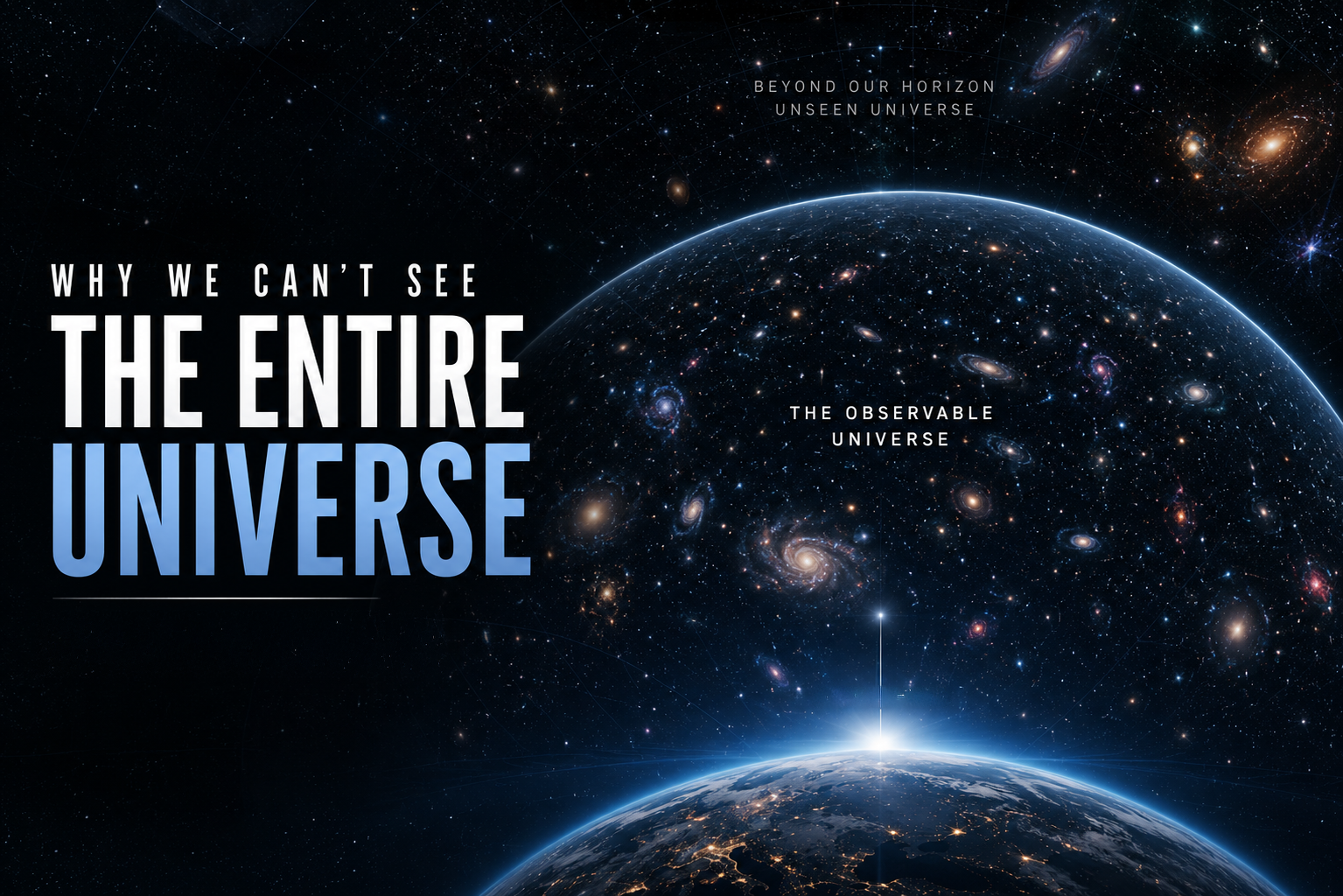
Why We Can’t See the Entire Universe
We can’t see the entire universe because there is a limit to how far any telescope can see. A bigger mirror or a better camera can only help so much. To see something, its light must first reach us. The region we can see is called the observable universe. The universe may continue far beyond it, but light from those regions has not reached us.
Looking Farther Means Looking Back in Time
Light takes time to travel. Sunlight takes about eight minutes to reach Earth. When we look at the Sun, we see it as it was eight minutes ago. A star 1,000 light-years away appears as it was 1,000 years ago.
The farther away a galaxy is, the farther back in its history we see it. The universe is about 13.8 billion years old. Light from some regions has not had enough time to reach us, so those regions remain unseen.
Why the Observable Universe Is About 92 Billion Light-Years Wide
If the universe is 13.8 billion years old, why can we see about 46 billion light-years in every direction? Space kept expanding while the light travelled towards us. During that time, the distance between us and its source continued to grow.
Some of the regions whose ancient light reaches us today are now roughly 46 billion light-years away. That gives the observable universe a diameter of about 92 billion light-years.
There Is No Wall at the Edge
The edge of the observable universe is not a wall or the end of space. It is simply the farthest distance from which light has reached us. Earth is not at the centre of the whole universe. We are only at the centre of our own observable region. An observer in another galaxy would see a different region, including places we cannot see.
We do not know how large the whole universe is. It may be finite and much larger than the part we see, or it may be infinite.
Faster Than Light Does Not Always Mean Invisible
Very distant galaxies can move away from us faster than light because space itself is expanding. They are not travelling through nearby space faster than light. We can still see some of these galaxies because their light began travelling towards us billions of years ago.
The Hubble sphere, where recession reaches the speed of light, is therefore not the edge of the observable universe. What we see is old light. Events happening in that galaxy now may never become visible to us.
The Event Horizon Sets Another Limit
The expansion of the universe is accelerating. Because of this, light emitted today from some distant regions will never reach us. This boundary is called the cosmic event horizon. We may still see ancient light from galaxies beyond this boundary, but new light leaving them may never arrive.
A Better Telescope Cannot Fix This
The James Webb Space Telescope can detect faint infrared light from galaxies that formed early in the universe, but it still cannot see beyond the observable universe. Larger mirrors and better detectors can reveal fainter objects.
No telescope can detect light that never reaches Earth. Better instruments can only improve what we see inside the observable universe.
Waiting Will Not Reveal the Whole Universe
More distant light will reach us in the future, so the observable region is not completely fixed.
That does not mean the whole universe will eventually become visible. Because expansion is accelerating, light from many events happening now will never reach Earth. Some galaxies visible today will also fade as their light is stretched to longer wavelengths.
Why We Will Never See Everything
The universe has a finite age, light has a finite speed, and space is still expanding. Better telescopes will reveal fainter galaxies and older light inside the observable universe.
The universe may extend far beyond what we can see, but some of it will always remain outside our reach.
Related Reads
Why Solar Panels Can Never Convert 100% of Sunlight into Electricity
Why Landing on the Sun Is Impossible – The Physics and Heat Explained