Why Faster-Than-Light Travel Is Probably Impossible
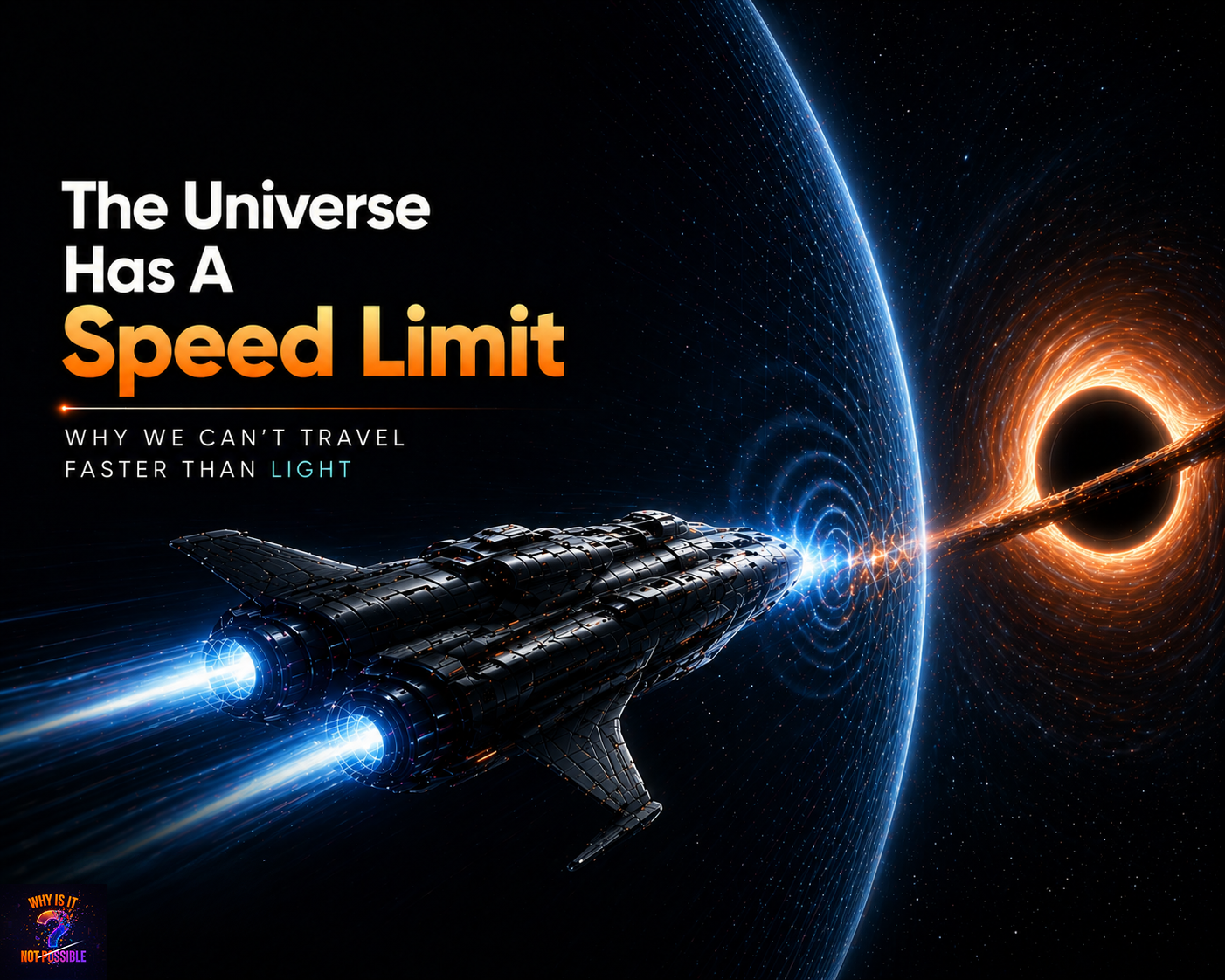
Faster-than-light travel sounds simple in science fiction: build a better engine, find a stronger fuel and keep accelerating. Physics does not work that way. The speed of light is not a limit caused by weak engines or poor technology. It is built into the relationship between space, time, matter and energy.
In a vacuum, light travels at exactly 299,792,458 metres per second. Massless particles move at that speed; objects with mass can only approach it. So a faster engine would not solve the problem. Even a civilisation far more advanced than ours would still face the same laws of relativity.
Light Speed Is Not an Engineering Record
Aircraft broke the sound barrier, rockets escaped Earth’s gravity and spacecraft reached other planets. Those were engineering problems that better materials, fuel and engines could overcome. Light speed is different. It is not like the speed of sound, which depends on the material through which sound is travelling.
Light speed in a vacuum remains the same for every observer, regardless of how fast the observer or the source is moving. This is one of the basic rules of Einstein’s special theory of relativity. A spacecraft can keep accelerating and get closer to light speed. But it can never close the final gap.
The Energy Requirement Keeps Rising
At ordinary speeds, adding more energy makes an object noticeably faster. But as an object with mass approaches light speed, each further increase in speed requires far more energy. Particle accelerators show what happens. Scientists can push tiny particles extremely close to light speed, but adding more energy produces only a tiny increase in speed.
Reaching light speed would require an unlimited amount of energy. Crossing it through ordinary acceleration would require passing through that impossible point first.
Travelling Close to Light Speed Is Still Possible
Relativity still allows a spacecraft to travel extremely close to light speed. For the crew, time would pass more slowly than it does on Earth. This is time dilation, an effect measured in experiments. A journey across many light-years could feel much shorter to them, but the spacecraft would still lose a race against a beam of light. Travelling that fast would also create serious engineering problems.
Even tiny pieces of dust could strike the spacecraft with enormous energy. Radiation would become dangerous, and accelerating a large vehicle to such a speed would require an extraordinary amount of power. Those problems may be difficult rather than impossible. Crossing light speed is a different matter.
Faster-Than-Light Travel Can Reverse Cause and Effect
Energy is not the only problem. Faster-than-light travel would also interfere with causality: the rule that a cause must happen before its effect. Relativity makes time depend on the motion of the observer. Two observers moving differently can disagree about how much time passed between events. They can even disagree about the order of certain distant events. Normally, this does not create a contradiction because neither event can influence the other faster than light.
Allow faster-than-light communication, and that protection disappears. From one observer’s point of view, a signal could arrive before it was sent. With a return signal moving faster than light, a person could theoretically receive a reply before sending the original message. A warning might arrive early enough to stop the event that caused the warning. But if the event never happened, there would have been no reason to send the warning.
Could a Warp Drive Avoid the Limit?
One proposed route to faster-than-light travel is to move space rather than the spacecraft. A warp drive would not accelerate a ship through space beyond light speed. Instead, it would compress spacetime in front of the ship and expand it behind the ship. The spacecraft would sit inside a moving region of spacetime.
General relativity contains mathematical solutions that resemble this idea. The best-known example is the Alcubierre warp metric. But writing down a possible spacetime shape is not the same as building it.
Early warp-drive models required negative energy. Newer models have explored positive-energy versions, but they still demand extreme conditions and leave major problems with stability, acceleration and control. No one knows how to create such a bubble, steer it or stop it at a destination, and causality problems may remain even if the engineering could be solved.
Wormholes Have Similar Problems
Wormholes offer another possible shortcut. Instead of travelling across the full distance between two places, a spacecraft could pass through a tunnel connecting them. General relativity allows wormhole-like solutions, but no traversable wormhole has ever been observed.
A traversable wormhole would have to stay open, be large enough for a spacecraft and connect to the right destination. Many models require negative energy or exotic matter to keep it stable, and no one knows how to create or control one. Wormholes can also be turned into theoretical time machines under certain conditions. So wormholes run into the same causality problem.
Quantum Entanglement Does Not Provide a Shortcut
Quantum entanglement is often described as an instant connection between distant particles.
Measurements of entangled particles can produce correlations that appear immediately, even when the particles are far apart. But those correlations cannot be used to send a controlled message faster than light.
The result of one measurement cannot be chosen to create a readable signal at the other end. The measurements still have to be compared through ordinary communication, which cannot exceed light speed.
New Physics Would Need Strong Evidence
A future theory could change what we know about faster-than-light travel, but it would still have to explain why relativity has passed every major test so far. It would also need experimental evidence that matter or usable information can travel faster than light.
There have been occasional claims of faster-than-light particles or signals, but none has held up under closer examination. So far, relativity still fits the evidence.
A Better Engine Would Not Be Enough
Near-light-speed travel may be possible one day. Faster-than-light travel is another matter: current physics gives us no way past the energy limit or the causality problem. Unless new evidence changes that, light speed remains the limit.
Related Reads
Why Time Travel to the Past Is Probably Impossible
Why Landing on the Sun Is Impossible – The Physics and Heat Explained
Why We Can’t See the Entire Universe – The Science Behind the Observable Universe