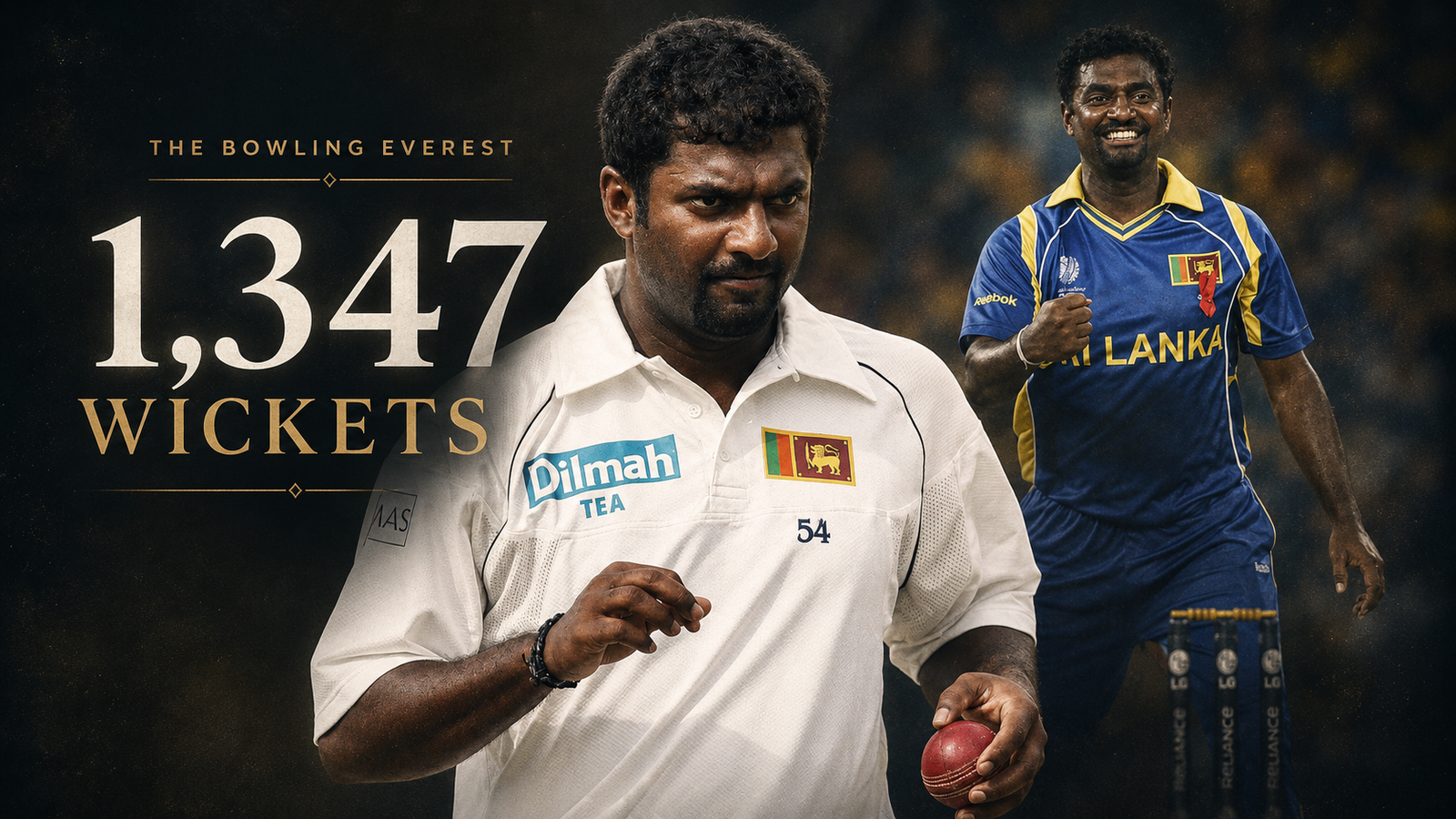
Why Muttiah Muralitharan’s 1,347 Wickets May Never Be Broken
Cricket has had great bowlers of every kind. Wasim Akram had swing. Shane Warne had leg-spin and nerve. Glenn McGrath built pressure with control. James Anderson made fast bowling last longer than it usually does. But when the subject is wickets, the list still starts with Muttiah Muralitharan.
The Muttiah Muralitharan 1347 wickets record is not just a big number. It is almost impossible to rebuild in today’s cricket.
Why the Muttiah Muralitharan 1347 Wickets Record Looks Out of Reach
Murali’s record is 800 wickets in Tests, 534 in ODIs, and 13 in T20 internationals. The Test number alone separates him from almost everyone else. Add the ODI wickets, and the record starts looking out of reach.
Murali took his 800th Test wicket in his final Test. It closed a career built on long spells, heavy workloads, and a bowling style batters spent years trying to read. Batters studied his off-spin, his doosra, his angles and his stamina. They still kept getting out to him.
800 Test Wickets
One great season does not take anyone near 1,347. A bowler has to be picked for years, bowl heavy spells, stay fit, and keep taking wickets after opponents have seen him again and again.
Even the names behind him show how far away the number is. Shane Warne finished with 708 Test wickets. James Anderson finished with 704. Anil Kumble finished with 619. These were giant careers. Murali still finished a long way ahead in Tests, and still had 534 ODI wickets next to that.
Test wickets take time. A bowler has to come back spell after spell, often on flat pitches, often with tired legs, and often against batters who are happy to block for hours. He has to beat players not just once, but across sessions, series, countries, and years. Murali did that for long enough to reach a number nobody else has touched.
The 534 ODI Wickets
A modern bowler might build a huge Test career and still be short in white-ball cricket. Another might play white-ball cricket for years and still have nothing close to 800 Test wickets.
To chase 1,347, one format is not enough. The bowler has to take wickets in both. That is harder now. Bowlers get labelled earlier, protected differently, and pulled into different schedules. Franchise leagues and workload breaks also take away international volume.
He Carried the Attack
For years, he carried Sri Lanka’s attack. Captains went to him when they needed wickets, not just overs. In Tests, he could attack for hours. In ODIs, he could control the middle overs and still take wickets. He was changing games, not filling time.
Longevity explains only part of it. Plenty of players last. Very few keep hurting sides for that long. Batters study a bowler. Analysts pick apart his variations. Conditions change, rules change, bodies slow down, form dips, and selection pressure arrives. Murali kept coming back with wickets anyway.
The Modern Game Has Changed
In international cricket, a few hundred wickets is almost another career. A bowler can be excellent for 15 years and still not come close. A 600-wicket Test career would still need a huge ODI record beside it. A great ODI bowler would still need a mountain of Test wickets too. Too many things have to line up.
Today’s bowlers have better fitness, better analysis, and better medical support. But that does not automatically create another Murali. The game is now split across formats, leagues, rest cycles, and workload plans. That makes a record like this harder, not easier.
Final Takeaway
Some records only need another genius. Murali’s 1,347 may need something else: enough overs, enough years, enough trust, and enough international cricket for one bowler to keep climbing.
Murali did not just finish ahead of everyone. He may have finished in a place the game cannot take another bowler again.
Related Reads
Top 10 Hardest Bowling Records in Cricket History
Sachin Tendulkar Records That May Never Be Broken in Cricket History