Why Time Travel to the Past Is Probably Impossible
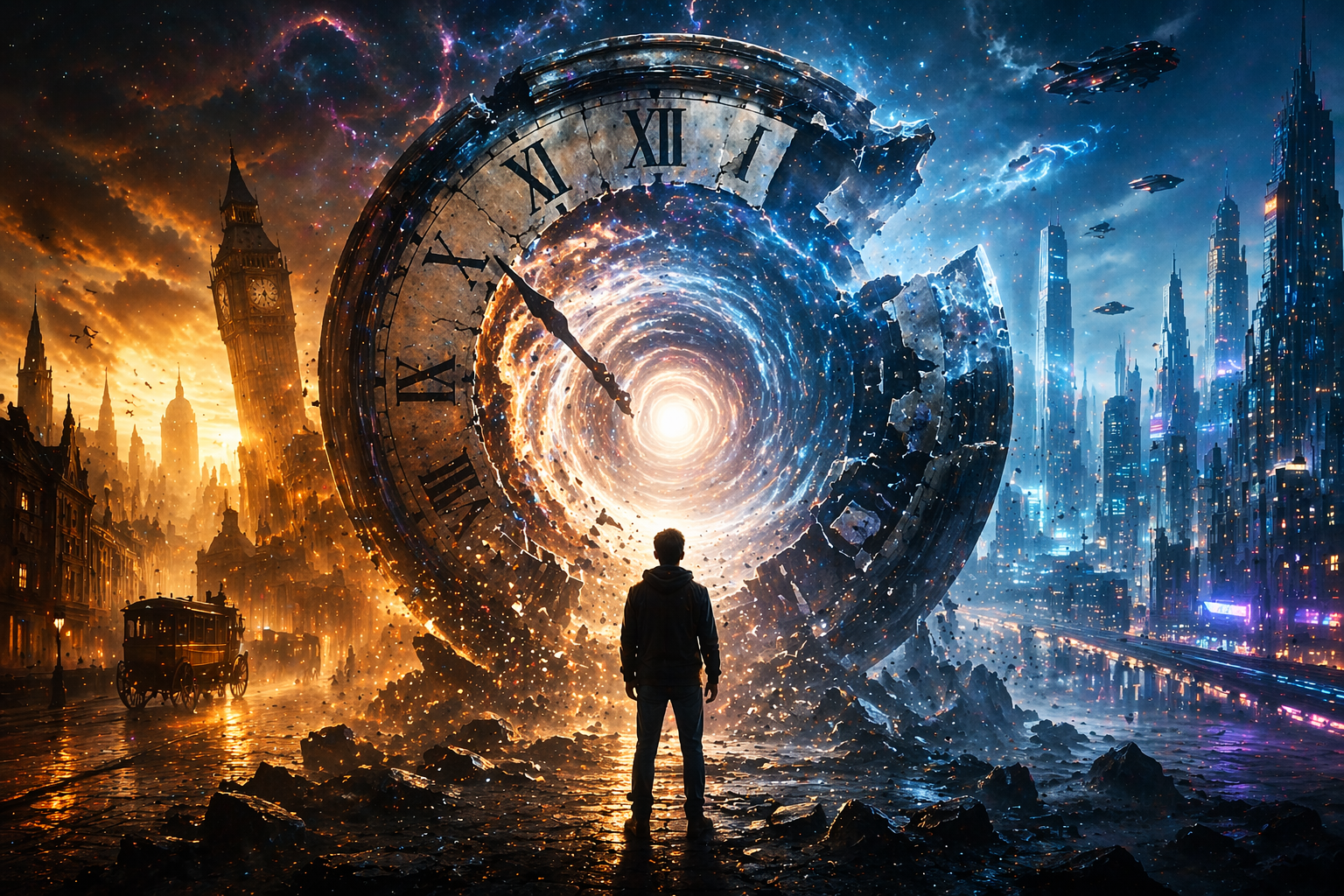
In fiction, time travel to the past looks simple: build a machine, step inside, go back, and one small change rewrites everything that follows. Physics does not give the idea that much room.
Relativity allows a limited version of time travel. Fast motion and strong gravity can make clocks disagree, so one observer can move into the future differently from another. That is not fantasy; it is how relativity works.
The past is where the real trouble starts, because going backward would mean letting cause and effect run in the wrong order. That may not be a gap technology can close. It may be a limit built into nature.
The Core Truth
Future travel is about clocks running at different rates. Past travel is about something much harder: causes appearing after their effects. Once that happens, history is no longer a stable chain. It can contradict itself.
Why Time Travel to the Past Breaks Causality
Causality is the basic order we depend on: causes come first, effects follow. The grandfather paradox is only the simplest version of the problem, but it shows the danger clearly. If you erase the events that produced you, who exactly made the trip?
Physicists have proposed ways around this, including self-consistent timelines, fixed histories, and branching realities. These ideas are interesting, but they do not give us a working time machine. They mostly show the cost of the idea: either history can change, and causality becomes unstable, or history cannot change, and past time travel loses the freedom people imagine.
Wormholes Are Math, Not Machines
Wormholes are usually the first answer people reach for. General relativity does contain strange mathematical paths, including closed timelike curves, but that does not mean nature lets us build or use them.
A traversable wormhole would likely need exotic conditions, including negative energy. We cannot create or control that at the required scale, and we have no real method for keeping such a structure stable. Even if the equations allow the idea, quantum effects may ruin the setup before it becomes useful. On paper, it is a possibility. In the real universe, it is nowhere close to a machine.
Entropy Gives Time Its Everyday Direction
The universe does not behave like a video that can simply be rewound. Ice melts, smoke spreads, bodies age, and broken things do not usually rebuild themselves. That one-way feeling is tied to entropy.
Entropy alone does not prove past time travel impossible, but it explains why the past and future are not equal in everyday reality. Heat spreads, information leaks into the environment, and damage leaves traces. Going backward would mean fighting the direction real processes normally take.
There Is No Evidence Anyone Has Done It
A serious scientific claim needs evidence. For backward time travel, we have no confirmed traveller, no verified message from the future, and no experiment showing controllable travel into the past. A claim this large cannot survive on possibility alone, so past time travel remains theoretical.
The Universe May Protect History
Stephen Hawking called this the chronology protection conjecture: the idea that nature may stop time machines from forming in the first place. It is not proven, but it fits a serious possibility — general relativity may allow strange paths on paper, while the full laws of physics block them in reality.
Closed time loops may become unstable before anyone can use them. That is important because physics is not just about what equations allow in an ideal case; it is also about what can actually survive in the universe.
What Would It Take?
To travel into the past, we would need stable wormholes or closed timelike paths, exotic energy, control over extreme spacetime curvature, and some way around causality paradoxes. We may also need something physics still does not have: a working theory that joins gravity with quantum mechanics. Even then, the biggest missing piece would be evidence. Past time travel is not one clever invention away. It may require physics the universe simply does not permit.
Final Takeaway
The future is reachable. We move into it every second, and relativity shows that different observers can experience that movement differently.
The past is not like that. It is the chain of events that made the present possible. Change the chain, and the present starts losing its own explanation.
That is why time travel to the past may not be a technology problem at all. It may be impossible because cause and effect cannot simply break.
Related Reads
Why Faster-Than-Light Travel Is Probably Impossible
Why We Can’t See the Entire Universe – The Science Behind the Observable Universe
Why Landing on the Sun Is Impossible – The Physics and Heat Explained