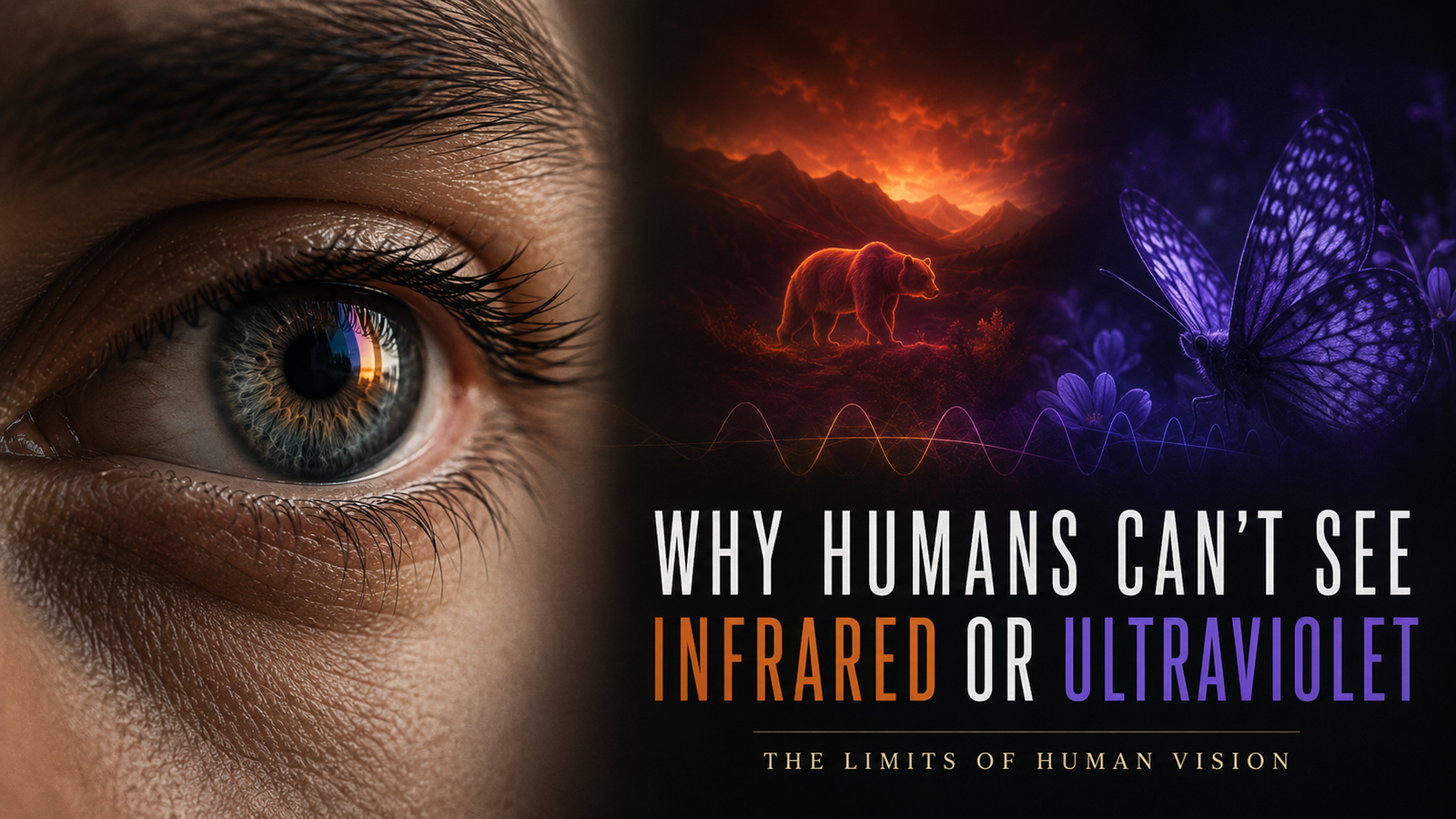
Human eye and infrared ultraviolet light spectrum showing why humans cannot see beyond visible light
|

Why Can’t Humans See Infrared or Ultraviolet? The Science Behind Our Vision Limits

Right now, our room is glowing.
Our phones are radiating heat.
The sun is emitting invisible ultraviolet light.

Every warm object around us is shining in wavelengths our eyes will never detect.
Your phone camera can partially detect infrared light.
Some animals can see ultraviolet patterns invisible to humans.
Reality is far larger than human vision.

We are surrounded by light we cannot see.
Why?
Because human vision is not designed to show us reality in full — only the part evolution decided we needed.

Light exists across a vast electromagnetic spectrum. But human eyes detect only a narrow band:
Approximately 400–700 nanometers (nm)
(With sensitivity extending slightly beyond that range.)
~400 nm → Violet
~700 nm → Red

Anything shorter is ultraviolet (UV).
Anything longer is infrared (IR).

That small strip is what we call “visible light.” Everything else is invisible to us — not because it isn’t there, but because our biology can’t process it.

The full electromagnetic spectrum extends far beyond visible light — from radio waves to gamma rays.

Our Photo receptors Are Chemically Limited

Inside our retinas are rods and cones — cells that convert light into electrical signals.
Cones contain light-sensitive proteins called opsins, which are chemically tuned to respond only to photons within the visible range.

Infrared photons usually lack enough energy to trigger the chemical reaction needed for vision.
Ultraviolet photons have higher energy, but most are blocked before they ever reach the retina.
If the photo pigments don’t activate, no electrical signal is sent to the brain.
No signal. No image.

Our Eyes Actively Block Ultraviolet

The cornea and lens absorb most ultraviolet radiation before it reaches the retina.
This is protective. UV light can damage cells and DNA. Filtering it reduces long-term harm, such as retinal injury.

In rare cases — for example, after cataract surgery when the natural lens is removed — some people report faint perception of near-UV light. But under normal conditions, UV is largely filtered out.

Our eyes are protecting us — even if it means limiting what we see.

Infrared Is Felt as Heat, Not Seen as Light

All objects above absolute zero emit infrared radiation — including us.
Infrared wavelengths are longer and carry less photon energy than visible light.
They are generally insufficient to activate retinal photo pigments.
Instead, specialised nerve endings in our skin detect infrared radiation indirectly as warmth.

We don’t see heat — we feel it.
This is why thermal cameras can reveal heat signatures in complete darkness while human eyes cannot.

Evolution Optimised Efficiency, Not Full Access

Human vision evolved under sunlight.
The Sun’s energy output peaks within the visible spectrum, and Earth’s atmosphere efficiently transmits visible light while filtering much of the harmful ultraviolet radiation.

From an evolutionary perspective:
Visible light detection provided clear survival advantages.
Visual infrared detection offered limited additional benefit.
Ultraviolet exposure increases biological risk.
Natural selection favours efficiency.

Our brains already consume significant energy.
Expanding visual bandwidth without strong survival benefit would not be favoured.
So, evolution built a system that works — not one that sees everything.

Other Animals See What We Can’t

Some species evolved different sensory tools:
Bees detect ultraviolet patterns on flowers.
Many birds possess UV-sensitive photo receptors.
Pit vipers sense infrared radiation using specialised heat-detecting organs.

They don’t see “more” because they are advanced.
They see differently because their survival required it.

Evolution does not aim for maximum perception.
It selects only what improves survival efficiency.

Final Takeaway: Why Human Vision Has Limits

Humans cannot see infrared or ultraviolet because:
Our retinal photoreceptors are chemically tuned to visible wavelengths (~400–700 nm).
The eye blocks most ultraviolet radiation as protection.
Infrared photons generally lack sufficient energy to trigger visual pigments.
Evolution optimised our vision for survival efficiency, not full-spectrum detection.

The universe is not limited to what we see.
We live inside a biologically filtered version of reality.
And science is what allows us to glimpse beyond it.

Infrared and ultraviolet are not hidden because they are rare.
They are hidden because human biology was never designed to see the universe in full.

Related Reads

Why Humans Cannot Survive Without Sleep

Why We Can’t Remember Every Moment of Our Life

Why Can’t Humans Live for 200 Years? (Biological Limits of Lifespan)

Related Reads

Leave a Reply

Your email address will not be published. Required fields are marked *