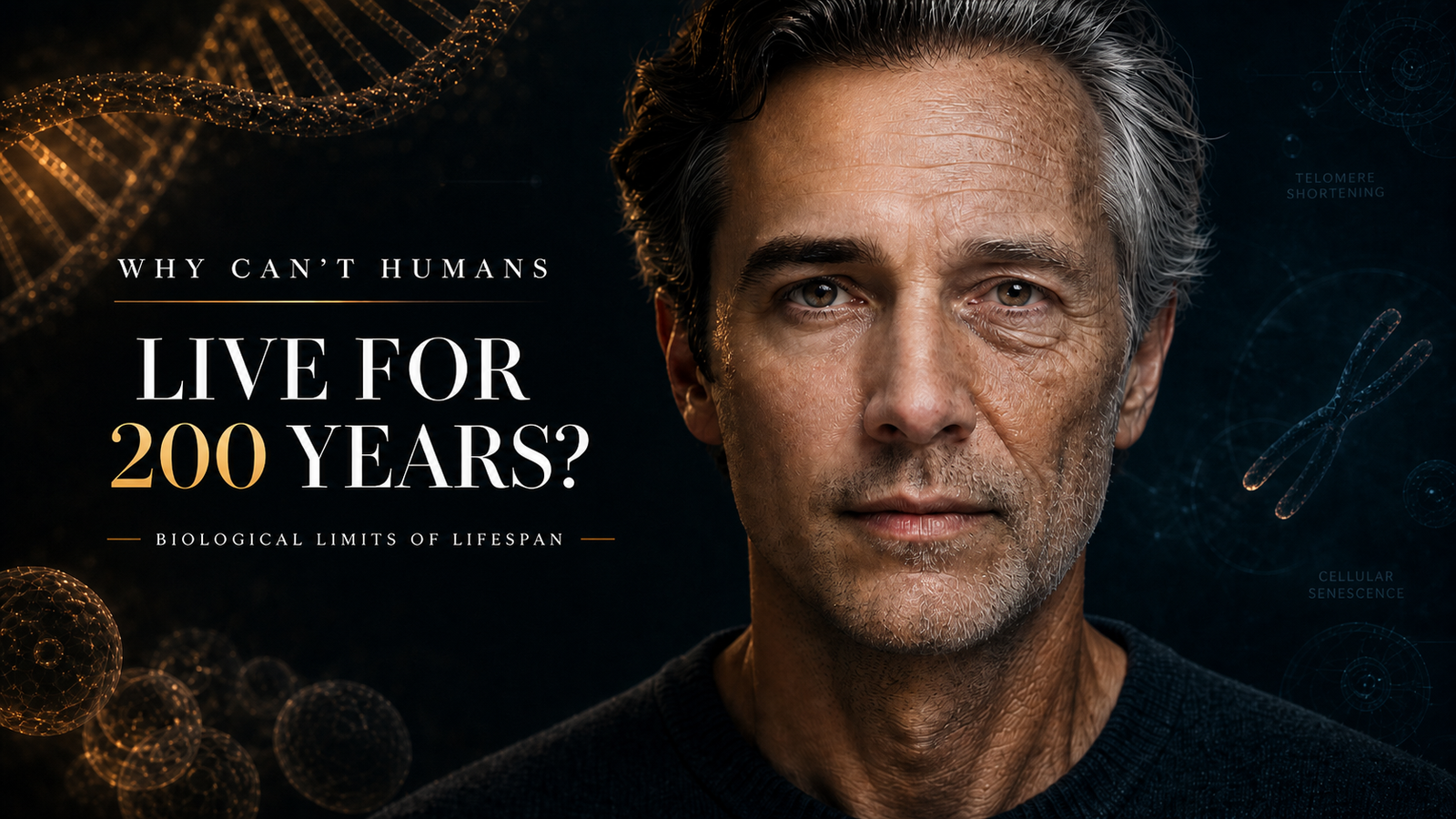
Why Can’t Humans Live for 200 Years?
Imagine this. It is the year 2226. You are 200 years old. You have seen children become grandparents. You remember things that other people now read about as history. It feels almost like immortality. But the body was never built to go that far.
It is easy to think longer life is mostly common sense: eat better, avoid disease, stay active. All of that helps. It just does not solve the real problem. The body repairs damage every day. It just never catches everything. After enough years, the missed damage starts to matter.
A 200-year life is not stopped by one weak organ. Damage builds up everywhere at once, in DNA, cells, organs, blood vessels, immunity, metabolism, and the brain.
Why Can’t Humans Live for 200 Years Naturally?
The body is always repairing itself. It just misses things. Small errors remain. Over decades, they stack up.
Your Cells Cannot Divide Forever
Many cells divide to replace old or damaged tissue. They can do that for a long time, but not forever. Each time a cell divides, the protective ends of its chromosomes — called telomeres — tend to shorten. Once they become too short, the cell may stop dividing or die. That is one reason older tissues do not renew as well.
This limit also protects against cancer. A cell that keeps dividing without control can become dangerous. So the body has to balance renewal and safety. The same protection that helps slow cancer also limits how much the body can rebuild.
Damage Builds Up Every Day
Even a careful life does not stop cellular damage. Sunlight, pollution, metabolic waste, copying errors, misfolded proteins, inflammation — they all leave small marks inside the body. Much of that damage is repaired. Some of it is not.
For decades, the body manages the damage well enough. Later, the damage becomes harder to hide. Past 100, even healthy people are working with systems that are much harder to keep stable. At 200, the danger would not be one sudden failure. Too many systems would be unreliable at once.
Some Parts of the Body Do Not Reset
Medicine can replace or support some parts of the body. Heart valves can be repaired. Kidneys can be transplanted. Artificial joints can restore movement. But the body is not a machine where every part can simply be swapped out.
The brain is the difficult one. Neurons are not replaced like skin cells. Memory, personality, movement, speech, balance, and identity all depend on networks built over a lifetime. Blood vessels, nerves, immunity, and connective tissues also age in ways medicine cannot fully reverse.
Medicine can support an aging body. It cannot erase time from it.
Energy Itself Has a Price
Your cells need energy every second, and much of that work happens inside mitochondria.
But making energy is not a clean process. Over time, it adds stress inside the cell. Mitochondria can also get damaged, making cells less efficient. The process that keeps you alive also contributes to the damage that ages you.
Diet, exercise, sleep, and medical care can reduce some of this damage. They cannot remove it completely.
Cancer Becomes Harder to Avoid
The longer a person lives, the more chances cells have to collect mutations. Most mutations do nothing. Some are repaired. Some damaged cells are destroyed. But the longer life goes on, the harder those odds become. Cancer is not only something that comes from outside. It is also tied to the basic job cells must do: divide, copy DNA, and keep surviving.
To live for 200 years, the body would need strong repair. But repair often means cell division, and cell division creates chances for mistakes. Too little division, and tissues wear out. Too much, and cancer risk rises. The body has to renew tissue without letting dangerous cells run loose.
Why 120 to 150 Years Is Already Extreme
The longest verified human life belongs to Jeanne Calment: 122 years and 164 days. That record shows how rare the far edge of human life really is. Many people reach 80 or 90. Some reach 100. Very few cross 110. But 120 is still almost untouched territory.
Some scientific models put the possible ceiling around 120 to 150 years, mostly because the body slowly loses its ability to recover from stress. The exact number is debated. But the bigger point still holds: going far beyond 120 is not just adding a few healthy years. It means keeping the whole body resilient long after it normally starts losing that resilience.
A 200-year human life would require something far beyond today’s anti-aging medicine.
Evolution Did Not Build Us for 200 Years
Evolution does not aim for immortality. It favors bodies that survive long enough to reproduce, raise offspring, and pass genes forward. After that, there is much less pressure to keep every repair system perfect for another hundred years.
Human biology runs on compromises. Stronger cancer protection can reduce renewal. More renewal can raise cancer risk. Inflammation protects in the short term, but damages in the long run. Energy keeps us alive, but making energy also wears cells down.
What 200 Years Would Actually Require
To reach 200, science would have to keep DNA stable, cells renewable, cancer suppressed, organs working, blood vessels healthy, immunity balanced, metabolism steady, and the brain intact for two full centuries.
A 200-year lifespan would mean keeping the body repairable, stable, and cancer-resistant far beyond any verified human life so far.
Final Takeaway
Humans cannot naturally live for 200 years because aging is not one big failure. It is many small failures piling up together. Cells slowly lose the ability to renew safely. DNA damage builds up. Mitochondria weaken. Organs lose efficiency. Cancer risk rises. The brain and nervous system cannot simply be replaced.
Medicine may help humans live longer and stay healthy for more of those years. But a 200-year life would mean solving several problems that fight against each other. That is why humans cannot live for 200 years — not because one part breaks, but because repair slowly fails everywhere.
Related Reads
Why Can’t Humans See Infrared or Ultraviolet? The Science Behind Our Vision Limits