The Most Unbreakable Men’s Olympic Athletics Records of All Time
Some Olympic records are broken because athletes get faster.
Some survive because sport evolves slowly.
But a few records survive for a deeper reason.
They were not just great performances.
They were perfect collisions of talent, pressure, timing, conditions, and history.
In Olympic athletics, that matters more than anywhere else.
A world record can be chased in a perfect meet, with ideal pacing, weather, and preparation.
But an Olympic record must happen in the most pressurized environment in sport.
One final.
One chance.
The world watching.
No second attempt next week.
That is why some men’s Olympic athletics records feel almost impossible to break.
They are not just numbers on a results sheet.
They are moments where the human body touched the edge.
The Reality
Olympic records are harder to break than ordinary records because the Olympics are not designed for perfect performance.
The athlete must survive qualification rounds, handle medal pressure, adapt to conditions, and peak on one exact day. In some events, weather matters. In others, tactics decide everything. In field events, one centimeter can separate history from failure.
That is why this ranking is not based only on the oldest record or the biggest number.
It is ranked by:
How close the record is to the human limit
How long it has survived
How hard the event is to control at the Olympics
How rare the athlete or team profile was
Whether modern sport makes the record easier or harder to beat
Top 10 Most Unbreakable Men’s Olympic Athletics Records
10. Men’s Marathon — 2:06:26
Tamirat Tola, Ethiopia — Paris 2024
The marathon is improving fast.
That is exactly why this record is placed at number 10, not higher.
Tamirat Tola’s 2:06:26 at Paris 2024 was extraordinary because it came on an Olympic course, not a record-hunting city marathon course. World Athletics reported that Tola set an Olympic record on a Paris course made difficult by hills and heat. The same report noted that the Paris course included difficult climbs and descents, including a severe section late in the race.
That makes the performance historically strong.
But marathon records are also more vulnerable than many others because modern road running is improving through deeper fields, better shoes, advanced nutrition, and faster race strategies.
Why it may survive:
Olympic marathons are rarely built for pure speed. Heat, hills, tactics, and championship pressure make them much harder than flat commercial marathons.
Why it is not ranked higher:
The marathon is still evolving quickly. A flatter, cooler Olympic course could put this record under serious threat.
Impossibility level: 8.4/10
9. Men’s 10,000m — 26:43.14
Joshua Cheptegei, Uganda — Paris 2024
This record deserves a place because it was not just fast.
It changed what an Olympic 10,000m final could look like.
Joshua Cheptegei won the Paris 2024 men’s 10,000m in 26:43.14, breaking the Olympic record. World Athletics reported that the first 13 men finished inside the previous Olympic record, showing how historically fast the race was.
That is important.
The 10,000m at the Olympics is usually tactical. Athletes often wait, conserve energy, and prepare for the final kick. Paris 2024 was different. It became a brutal championship race at near-record pace.
Why it may survive:
To break it, another Olympic final must be both tactical and extremely fast. That requires a rare combination: multiple athletes willing to push, perfect weather, deep competition, and a champion strong enough to close under pressure.
Why it is not ranked higher:
Distance running depth is increasing. If another Olympic final becomes fast from the start, this record can be challenged.
Impossibility level: 8.5/10
8. Men’s 110m Hurdles — 12.91
Liu Xiang, China — Athens 2004
The 110m hurdles is one of the least forgiving events in athletics.
There is no room to recover.
One poor start, one clipped hurdle, one broken rhythm — and the race is gone.
Liu Xiang’s 12.91 from Athens 2004 remains the Olympic record, while the current world record is faster at 12.80. World Athletics lists Olympic records separately from world records in its official records database.
That gap matters.
It proves the mark is physically breakable, but Olympic circumstances make it much harder.
Why it may survive:
The event demands sprint speed, perfect hurdle clearance, exact stride rhythm, and mental calm under pressure. In an Olympic final, even the best hurdlers can lose everything in one mistake.
Impossibility level: 8.7/10
7. Men’s Triple Jump — 18.09m
Kenny Harrison, USA — Atlanta 1996
Triple jump looks like a jump.
It is actually three violent events in one movement.
Hop.
Step.
Jump.
Each phase must be powerful, balanced, and technically connected. If one phase collapses, the entire attempt dies.
Kenny Harrison’s 18.09m Olympic record from Atlanta 1996 remains one of the greatest championship jumps ever. The world record, Jonathan Edwards’ 18.29m, is only 20 centimeters farther, showing how close Harrison’s Olympic mark sits to the absolute top of the event.
Why it may survive:
Triple jump is limited not only by talent but by durability. The stress on the ankles, knees, hips, and back is extreme. To break 18.09m at the Olympics, an athlete needs elite speed, perfect technique, and a body that can survive the force.
Impossibility level: 8.8/10
6. Men’s Shot Put — 23.30m
Ryan Crouser, USA — Tokyo 2020, held in 2021
Ryan Crouser changed the scale of shot put.
His 23.30m Olympic record, achieved at the postponed Tokyo 2020 Games in 2021, sits close to world-record territory. World Athletics lists Olympic Games records and world records separately, and Crouser’s Olympic mark remains one of the strongest men’s field-event records in Olympic history.
Shot put is not just strength.
It is explosive speed, rotation, balance, timing, release angle, and body control — all compressed into less than two seconds.
Crouser’s record is dangerous because it does not feel like a normal Olympic outlier. It feels like the result of a rare athlete built almost perfectly for the event.
Why it may survive:
To beat it, someone needs Crouser-level size, power, technique, and consistency. That profile is extremely rare.
Impossibility level: 8.9/10
5. Men’s 400m Hurdles — 45.94
Karsten Warholm, Norway — Tokyo 2020, held in 2021
This was not just an Olympic record.
It was one of the greatest races in track history.
Karsten Warholm ran 45.94 at the postponed Tokyo 2020 Olympic final in 2021, setting both the Olympic record and the world record. World Athletics lists the 400m hurdles Olympic record and world record at this same historic level.
The 400m hurdles is brutal because it combines two painful worlds.
It has the speed demand of a 400m sprint and the technical demand of hurdling. The athlete must attack ten hurdles while fatigue destroys rhythm in the final straight.
Warholm did not just win.
He dragged the event into a new era.
Why it may survive:
The record requires 400m flat speed, perfect hurdle rhythm, stride control, and extreme pain tolerance. Very few athletes in history can combine all four.
Why it is not top three:
The event has recently improved dramatically. Rai Benjamin and Alison dos Santos have shown that the level is still moving.
Impossibility level: 9.1/10
4. Men’s 4x100m Relay — 36.84
Jamaica — London 2012
A relay record is harder than an individual record because four athletes must be perfect.
Jamaica’s 36.84 at London 2012 was a perfect storm: Usain Bolt, Yohan Blake, Nesta Carter, and Michael Frater, with elite sprint speed and clean baton exchanges. World Athletics lists Jamaica’s 36.84 as both the Olympic record and world record.
This record is not just about running fast.
It is about moving the baton fast.
A team can have four incredible sprinters and still lose everything through one slow exchange. The relay punishes tiny mistakes.
Why it may survive:
To beat 36.84, a nation needs four world-class sprinters in the same era, perfect relay chemistry, and flawless Olympic execution.
That combination is extremely rare.
Impossibility level: 9.2/10
3. Men’s 400m — 43.03
Wayde van Niekerk, South Africa — Rio 2016
This record still feels unreal.
Wayde van Niekerk ran 43.03 in the Rio 2016 Olympic final, setting both the Olympic record and the world record. World Athletics lists the mark as the top global standard in the men’s 400m.
The most shocking part?
He did it from lane 8.
In lane 8, an athlete cannot see the field. There is no one outside to chase. No visual feedback. No tactical rhythm from competitors ahead.
Van Niekerk had to run blind.
And he still produced the fastest 400m ever.
Why it may survive:
The 400m is one of the hardest events in sport because it demands speed, endurance, pacing, and pain resistance. To break 43.03, an athlete needs near-200m speed and the strength to survive a collapsing final 100m.
This is not just sprinting.
It is controlled suffering.
Impossibility level: 9.4/10
2. Men’s 800m — 1:40.91
David Rudisha, Kenya — London 2012
This may be the greatest Olympic middle-distance race ever run.
David Rudisha’s 1:40.91 at London 2012 remains both the Olympic record and the world record. World Athletics lists Rudisha’s mark as the world standard in the men’s 800m.
But the number alone does not explain the greatness.
Rudisha led from the front.
No pacemaker.
No hiding.
No waiting for the final kick.
He turned an Olympic final into a world-record time trial.
That almost never happens.
The 800m is one of the cruelest events in athletics because it sits between sprinting and endurance. It is too fast to relax and too long to sprint fully.
Why it may survive:
Breaking 1:40.91 requires perfect pacing, rare biomechanics, elite speed endurance, and total fearlessness. It also requires an Olympic final that allows a record pace instead of a tactical battle.
That is why Rudisha’s record feels almost impossible.
Impossibility level: 9.7/10
1. Men’s Long Jump — 8.90m
Bob Beamon, USA — Mexico City 1968
This is the ultimate Olympic athletics record.
Bob Beamon’s 8.90m long jump from Mexico City 1968 has survived for more than half a century. World Athletics lists Mike Powell’s world record at 8.95m and Beamon’s Olympic record at 8.90m, meaning the Olympic record is only five centimeters behind the world record.
That is what makes it legendary.
Many Olympic records are difficult because they are fast or powerful.
Beamon’s record is different.
It feels like a moment that escaped time.
Long jump does not improve smoothly. Athletes do not simply add centimeters every generation. The event depends on sprint speed, take-off angle, board accuracy, legal wind, body control, and landing technique.
Everything must happen perfectly.
One slightly early take-off, and the distance is lost.
One slightly late take-off, and it becomes a foul.
One poor landing, and history disappears into the sand.
Why it may survive:
To break 8.90m at the Olympics, an athlete must produce near-world-record speed, hit the board almost perfectly, take off at the perfect angle, land cleanly, and do it under Olympic final pressure.
That is not just difficult.
That is history asking to repeat one of its rarest moments.
Impossibility level: 9.9/10
Final Ranking by Impossibility
| Rank | Event | Athlete/Team | Olympic Record | Year |
| 1 | Long Jump | Bob Beamon | 8.90 m | 1968 |
| 2 | 800m | David Rudisha | 1:40.91 | 2012 |
| 3 | 400m | Wayde van Niekerk | 43.03 | 2016 |
| 4 | 4x100m Relay | Jamaica | 36.84 | 2012 |
| 5 | 400m Hurdles | Karsten Warholm | 45.94 | 2021 |
| 6 | Shot Put | Ryan Crouser | 23.30 m | 2021 |
| 7 | Triple Jump | Kenny Harrison | 18.09 m | 1996 |
| 8 | 110m Hurdles | Liu Xiang | 12.91 | 2004 |
| 9 | 10,000m | Joshua Cheptegei | 26:43.14 | 2024 |
| 10 | Marathon | Tamirat Tola | 2:06:26 | 2024 |
Why Usain Bolt’s 100m Olympic Record Is Not in the Top 10
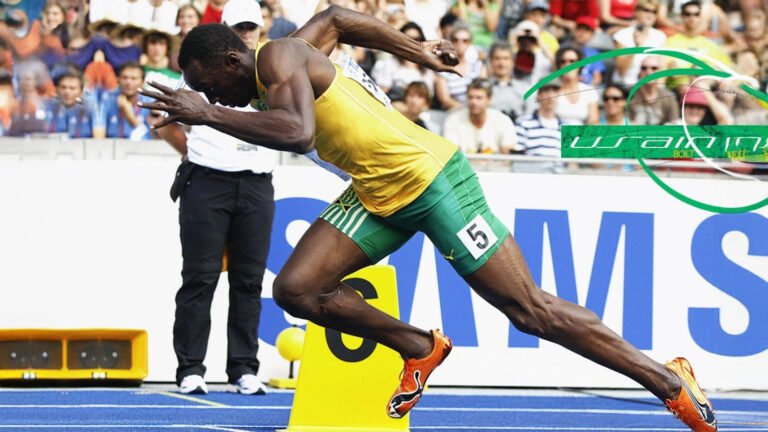
Usain Bolt’s 9.63 Olympic record from London 2012 is one of the most iconic performances in Olympic history. World Athletics lists Bolt’s 9.63 as the men’s Olympic record, while his 9.58 from Berlin 2009 remains the world record.
But this ranking is about the most unbreakable records, not only the most famous.
The 100m record is still extremely difficult, but modern sprinting remains deep.
Athletes continue to run near 9.7–9.8, and advances in track surfaces, shoes, training, and competition depth mean Bolt’s Olympic record is not as untouchable as Beamon’s long jump, Rudisha’s 800m, or Van Niekerk’s 400m.
Bolt’s record is legendary.
But Beamon’s record feels more structurally frozen.
The Core Truth
The hardest Olympic athletics records are not just built on talent.
They are built on timing.
A perfect body.
A perfect day.
A perfect final.
A perfect response to pressure.
That is why these records survive.
They are not just targets for future athletes.
They are reminders that sometimes, even in sport, greatness does not repeat easily.
Some records are meant to be chased.
These feel like they were meant to remain.
Related Reads
Why Usain Bolt’s 9.58 Seconds May Never Be Broken
Why a 300 km/h Tennis Serve Is Almost Impossible in Real Life
Why Can’t Humans Run 100 km/h? The Biological and Physics Limits Explained