Why Can’t Humans Run 100 km/h?
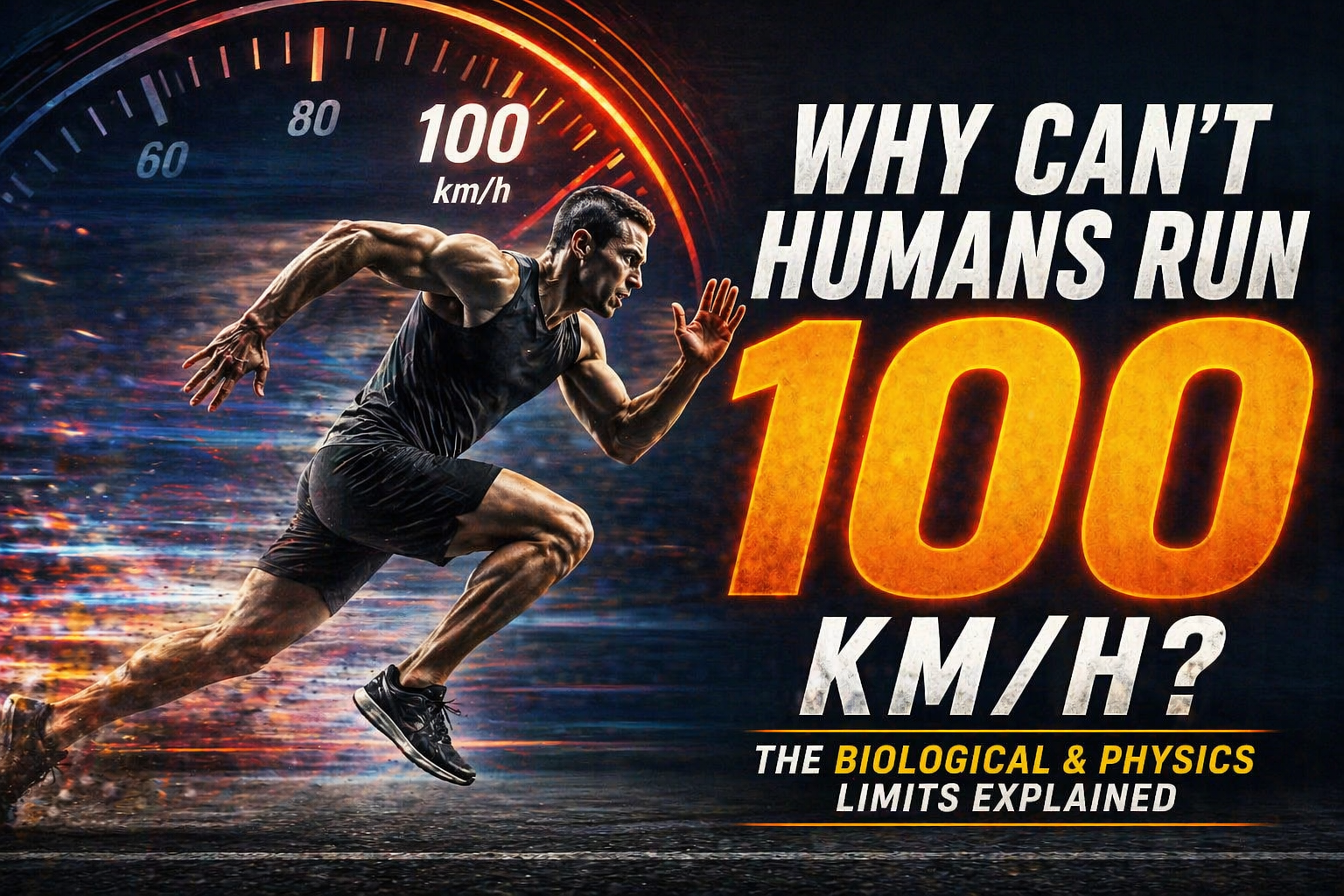
Could humans run 100 km/h if training, shoes and tracks kept improving? The numbers say no. At 100 km/h, 100 metres would be gone in 3.6 seconds. Usain Bolt’s 9.58-second world record is astonishing, but his top speed during that race was about 44.7 km/h. Reaching 100 would not mean finding another gear or trimming a little from the record. A runner would have to move more than twice as fast as the fastest human ever measured—and that is where the body starts to run out of options.
Where the Stride Starts to Fail
A sprinter can go faster in only two ways: take longer steps, take them more often, or find some balance between the two. The problem is that each improvement works against the other. A longer stride needs more time, while a quicker stride gives the foot less time to hit the track and push the body forward. At elite speed, that push already happens in a fraction of a second.
At 100 km/h, the foot would be gone almost as soon as it landed, leaving the muscles too little time to produce the force needed for the next stride. And the job is only half finished. The leg that has just left the ground still has to stop, reverse direction and swing forward again. Human legs are too heavy to repeat that cycle at the rate 100 km/h would demand.
Why More Strength Would Not Solve It
More muscle or stronger bones may sound like the obvious answer, but they create another problem: weight. Thicker bones, larger muscles and reinforced joints would make the legs harder to swing, not easier.
Animals built for extreme speed solve the problem differently. A cheetah runs on four limbs and uses a flexible spine to lengthen each stride. Humans run upright on two legs, with far less movement through the back. We can improve the system we have, but we cannot make it work like a cheetah’s without changing the body itself.
The Legs Reach Their Limit First
Air drag would add to the problem. At 100 km/h, a runner would face roughly five times the drag Bolt faced at his peak, and overcoming it would demand far more power. But the lungs would not be the first thing to fail.
A 100-metre sprint relies heavily on energy already stored in the muscles, so oxygen supply is not the main barrier. The decisive problem is mechanical: the feet cannot stay on the ground long enough, and the legs cannot cycle fast enough.
Could Humans Run 100 km/h Someday?
Humans will probably continue to get a little faster. Training methods improve, tracks become quicker and shoes return energy more efficiently, but those gains are measured in fractions of a second—not in a doubling of speed.
Biomechanist Peter Weyand has suggested that humans might theoretically reach somewhere around 56 to 64 km/h under ideal conditions. Even that estimate falls well short of 100. The remaining gap is not about motivation, coaching or equipment. Reaching 100 km/h would require lighter limbs, faster muscles, stronger tendons and a stride the human body does not have.
Final Takeaway
Records may fall, but 100 km/h is not simply a distant version of today’s sprinting. Training, equipment and better technique can push the human limit. They cannot remove the limits built into the way our legs produce force and move through each stride.
Reaching 100 km/h would mean changing the body itself, not merely improving the runner.
Related Reads
Why Usain Bolt’s 9.58 Seconds May Never Be Broken
Why a 300 km/h Tennis Serve Is Almost Impossible in Real Life
Why Can’t Humans Live for 200 Years? (Biological Limits of Lifespan)