Why AI Cannot Become Fully Human
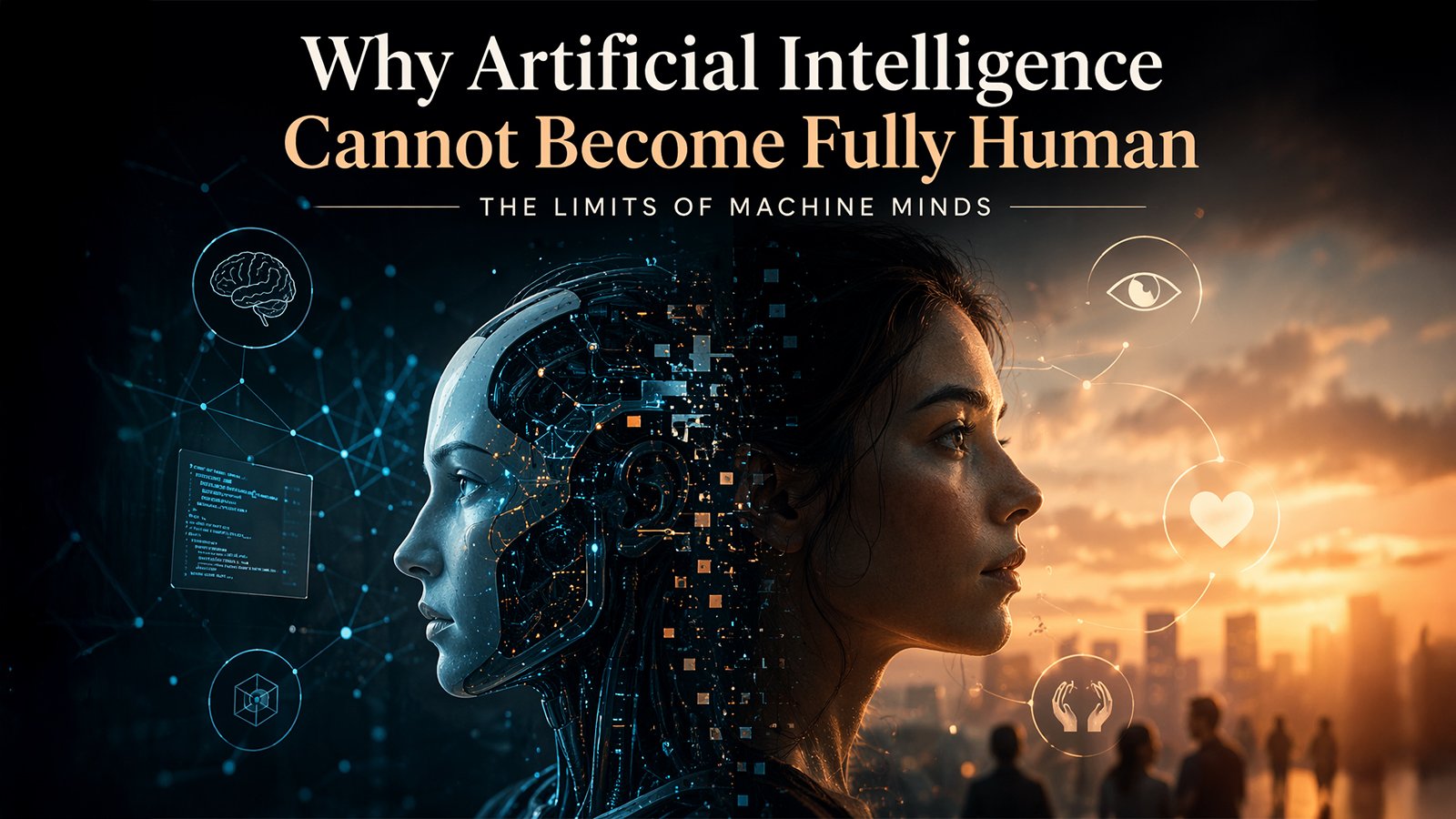
Artificial intelligence no longer behaves like ordinary software. It can write, translate, recognise images, make music, answer questions, and hold conversations that sound human. But AI cannot become fully human just because it can sound like us.
At times, its answers even sound more patient and confident than many human replies. So the question is no longer silly: if AI can sound human, can it ever become human? The answer depends on what we mean by human.
AI already beats humans in many narrow tasks. But being human is not only about giving better answers. A human being has a body, memories, emotions, fear, pain, and an inner life that cannot be reduced to output.
AI Cannot Become Fully Human Through Thinking Alone
People often say AI “thinks.” For normal conversation, that is fine. When a model writes code or answers a difficult question, it can look like thinking from the outside. But that is not human thinking. It is working with patterns learned from data.
A person does not just produce an answer. A person experiences the process of thinking. Confusion, doubt, memory, and sudden understanding are not just outputs. They are felt. Human thought is tied to attention, memory, tiredness, pain, desire, and the body.
AI has no known inner life behind its output. It can describe confusion without being confused, and grief without grieving.
The words may be accurate, even beautiful, but accuracy is not the same as experience. AI can imitate the shape of thought, but it has not shown the experience behind it.
Emotion Is More Than Language
AI can respond with warmth, concern, humour, or sympathy. In some cases, people may even feel emotionally supported by it. The comfort may be real for the person using it. But the machine is not feeling concern, comfort, or care.
Human emotion is not just choosing caring words. Fear, anger, love, shame, excitement, and sadness move through the body. They affect hormones, heart rate, breathing, muscles, memory, and instinct. When a person says, “I am afraid,” the body is already involved.
AI does not feel the tight chest before bad news, the exhaustion of worry, or the weight of grief in the body. It can recognise the language of these states, but it does not live inside them.
AI can speak the language of feeling, but it does not feel.
The Brain Is Not Just Hardware
The brain is often compared to a computer. That comparison works only up to a point. The human brain is not a processor sitting outside life. It is a living organ, shaped by the body around it and influenced by signals, hormones, sleep, senses, injury, age, and memory. It changes through experience because it belongs to a living organism.
AI systems are built very differently. They run on chips, electricity, code, and data centres. A model can be updated, fine-tuned, copied, paused, or deployed across servers. A human life cannot be treated that way. A person grows, suffers, heals, forgets, adapts, ages, and dies.
Human intelligence emerged inside bodies that needed to survive. Our minds are tied to hunger, touch, fear, pain, bonding, childhood, illness, and mortality. AI may model some of those things from data, but modelling a life is not the same as living one.
Memory Is Not the Same as Self
Identity creates another problem. Humans do not simply store information about themselves. They carry a sense of being the same person across time. A person remembers yesterday, anticipates tomorrow, and lives with the emotional weight of choices already made.
AI can be given memory. It can refer to earlier conversations and keep a consistent personality if designed that way. From the outside, that may look like identity. But memory alone does not create a self.
A database can store a biography. That does not make it a person. A chatbot can say “I remember,” but that does not mean it remembers the way a person does. For humans, memory is not just retrieval. It carries emotion, regret, pride, attachment, and personal history.
AI does not seem to own its memories in that way. It does not wake up with private awareness. It does not fear its non-existence. It does not form life goals in the way a person does. Its behaviour comes from training, design, prompts, and optimisation, not from a lived history.
The Unsolved Problem at the Centre
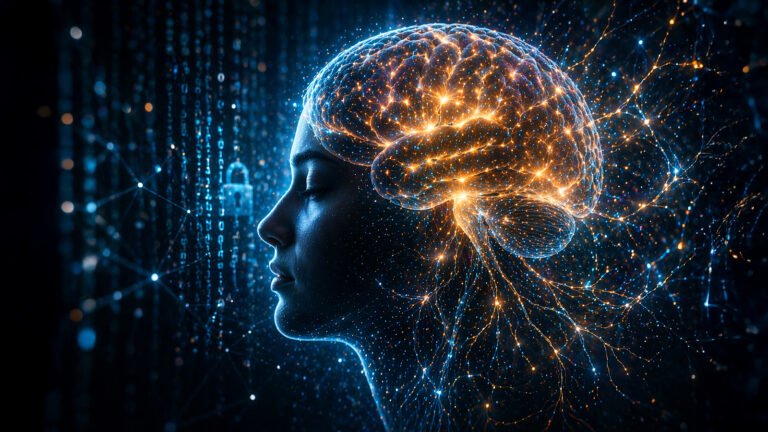
The deepest barrier is consciousness itself. Science has learned a lot about the brain. It can study neurons, scan brain activity, and connect brain regions with memory, emotion, attention, and decision-making. But it has not fully explained how physical processes become subjective experience.
Why does pain hurt? Why does a memory feel personal? Why is there a private point of view at all?
This is not a small technical gap waiting for a faster chip. It is one of the hardest questions in science and philosophy. Until we understand how subjective awareness arises, claims about recreating it in machines remain speculative.
Future AI may become far more capable than today’s systems. It may become better at reasoning, planning, speaking, and designing, and harder to distinguish from humans in conversation. But the real question would remain: is anyone inside the system experiencing the world, or is it only producing the signs of experience?
At present, we have no reliable evidence that AI has crossed that line.
Final Takeaway
AI may become one of the most powerful technologies we have ever built. It is already helping in science, medicine, education, software, design, and communication. In some narrow fields, it may outperform people completely. But becoming more capable is not the same as becoming human.
To be fully human is not just to calculate, speak, learn, or respond. It is to live inside a body, carry memory as experience, feel time passing, and know the world from a private point of view.
AI can imitate many of the outward signs of that life. It can sound thoughtful, emotional, creative, and self-aware. It may even become so convincing that people forget they are dealing with a machine. But imitation is not existence.
Until science can explain and reproduce subjective awareness, AI remains different from us: powerful, useful, astonishing at times, but not fully human.
Related Reads
Why Robot Doctors Can Never Fully Replace Human Doctors