Why Landing on the Sun Is Impossible
Landing on the Sun is impossible, but heat is only part of the reason. The Sun is about 150 million kilometres from Earth. We have sent spacecraft far beyond that, so getting there may not sound especially difficult. The plan sounds obvious: point a rocket at the Sun and let gravity pull it in. But a spacecraft leaving Earth is already racing sideways around the Sun. It cannot simply drop straight down. And even if it reached the Sun, there would be no surface waiting for it.
The Sun Has No Solid Ground
Earth, Mars and the Moon have solid surfaces. A spacecraft can slow down, touch the ground and remain there. The Sun is a huge ball of plasma. What looks like its surface is the photosphere, the bright layer we see from Earth. The photosphere is about 5,500°C, but it is not a crust. A spacecraft would keep sinking into hotter and denser plasma until it was destroyed.
Why a Spacecraft Cannot Fall Straight Into the Sun
Earth travels around the Sun at roughly 107,000 kilometres per hour. A spacecraft launched from Earth carries that speed with it. Unless it cancels most of it, the spacecraft will continue orbiting the Sun instead of falling into it. Cancelling that speed takes enormous energy. This is why reaching the Sun can be harder than sending a probe much farther into space.
Parker Solar Probe flew past Venus seven times. Each pass changed its orbit and brought it closer to the Sun. Even a powerful rocket could not take Parker there directly.
The Heat Would Destroy the Spacecraft
Above the photosphere lies the corona, the Sun’s outer atmosphere, where temperatures can reach around two million degrees Celsius. The corona is extremely thin, so its temperature alone does not tell us how much heat a spacecraft would absorb. The main danger comes from the intense sunlight. The closer a probe gets, the more heat its shield has to handle.
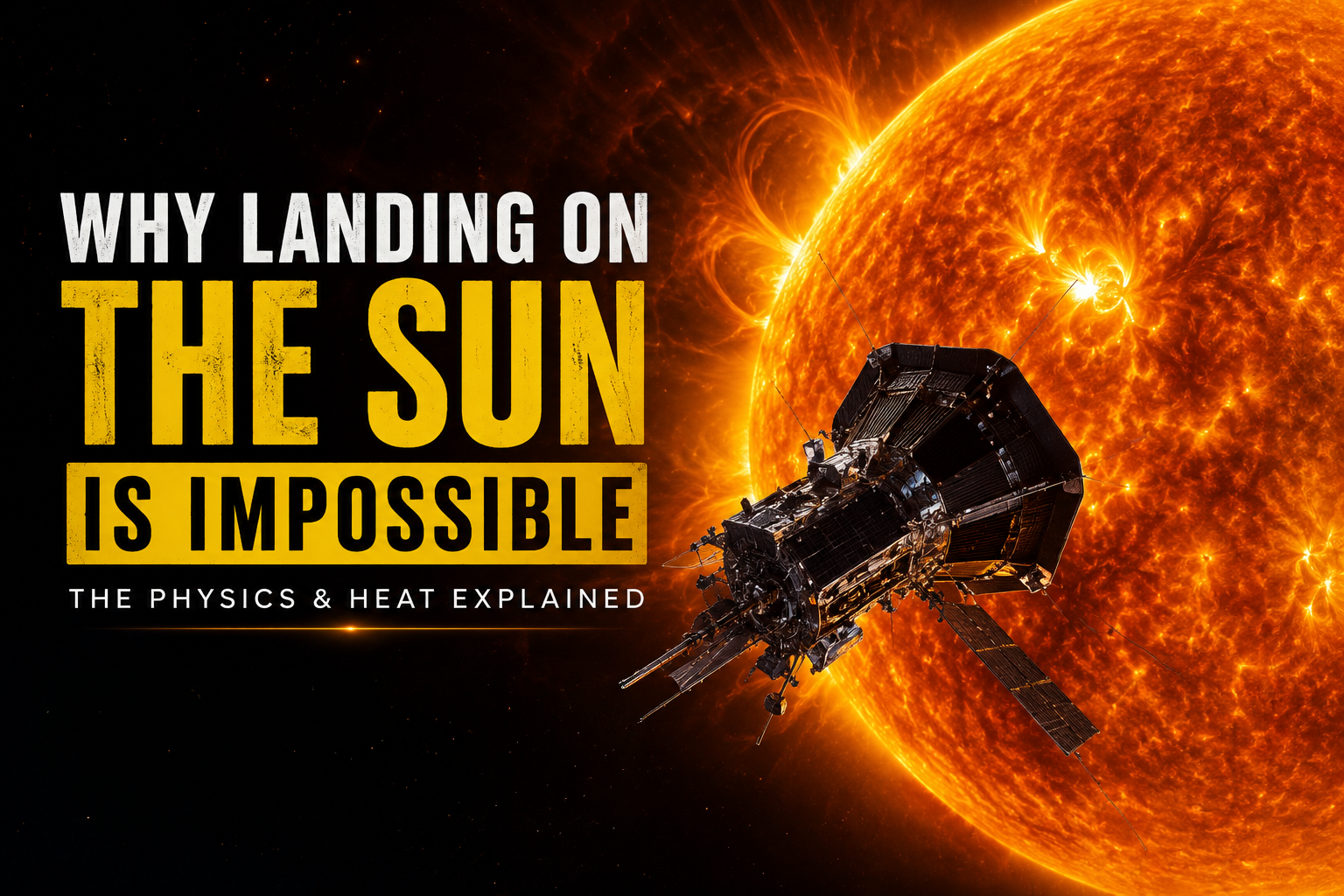
Parker Solar Probe uses a carbon-composite heat shield about 11.4 centimetres thick. Its Sun-facing side can reach nearly 1,377°C while the instruments remain protected behind it. Parker survives because the shield faces the Sun while the instruments remain in its shadow. Inside the photosphere, hot plasma would surround the spacecraft, and that protection would no longer work. No existing heat shield could keep a spacecraft alive there.
What Parker Solar Probe Actually Did
During its closest pass on December 24, 2024, Parker came within about 6.1 million kilometres of the Sun’s visible surface. It was travelling at roughly 692,000 kilometres per hour, faster than any other human-made object. The probe has also flown through the corona, an achievement often described as “touching the Sun.” But it did not land. It passed through the Sun’s outer atmosphere and continued around it.
Landing on the Sun Is Impossible. Could We Still Fly Into It?
A probe could be sent on a final path into the Sun and transmit data until its systems failed. But that would be a controlled plunge, not a landing. Once it entered the denser plasma, the probe would lose contact and be destroyed. It could not slow down and remain anywhere because there is nowhere solid to stop.
Better rockets and heat shields may take future probes deeper into the Sun. But they cannot create a surface where none exists. A spacecraft can orbit the Sun or plunge into it. It cannot land.
Related Reads
Why Solar Panels Can Never Convert 100% of Sunlight into Electricity