
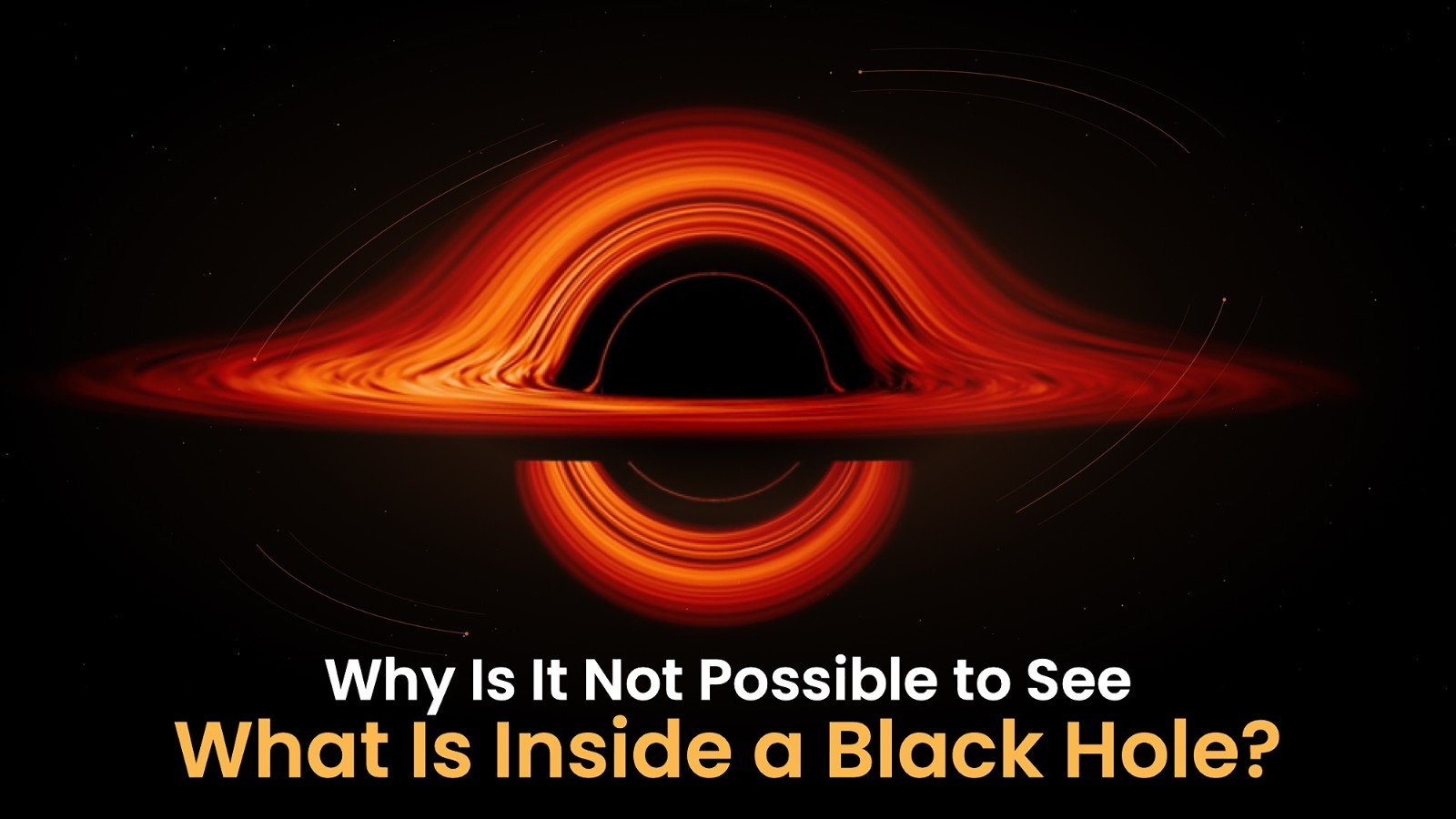
Why Is It Not Possible to See What Is Inside a Black Hole?
By Why Is It NOT Possible? Editorial·November 11, 2026·5 min read
Imagine sending a camera towards a black hole. A spacecraft stays far enough away to remain safe, receiving pictures as the camera falls. We could watch the surrounding stars change position as gravity bends their light. If there were hot gas nearby, we could see that too. Suppose the camera crosses the event horizon and keeps recording. Would we finally get a look inside?
According to general relativity, we would never receive those pictures. We could build a camera that survived the crossing and still have no way to recover what it recorded.
What Would Happen to the Camera?
We would have a better chance of keeping the camera intact around a supermassive black hole. Near a small black hole, gravity can pull much harder on one end of an object than the other, stretching it apart before it reaches the horizon. At the horizon of a supermassive black hole, that difference can be much smaller.
We would also choose a black hole with little surrounding gas. A hot accretion disk could destroy the camera before it reached the horizon. From the waiting spacecraft, its transmissions would become increasingly difficult to receive as it approached the horizon. Signals would arrive more slowly, with their wavelengths stretched and their energy reduced.
The camera would fade from view. We would not see it hanging there forever as a clear, frozen image. The camera itself could cross the horizon in a finite amount of time measured by its own clock. There would be no solid surface to hit, and it might keep recording after crossing. But anything it transmitted after crossing would remain inside.
The spacecraft could receive delayed signals sent earlier, while the camera was still outside. None would show what happened after it entered. Saving the footage on a memory card would not solve the problem either, because the camera could never return with it.
Why Can’t a Stronger Signal Get Out?
Normally, we could improve a weak radio link with a larger antenna or a more powerful transmitter. But a signal sent from inside the horizon has no path to the spacecraft, however powerful the equipment.
In general relativity, gravity changes the geometry of space and time, which determines where light and objects can travel. Inside the horizon, no future path available to a light beam leads back to the outside universe.
The simplest example is a black hole that does not rotate. Outside its horizon, an object can move towards or away from the centre. Inside, moving towards smaller radii becomes unavoidable as time passes. Remaining at the same radius is no longer an option, even with an engine running.
When we say that even light cannot escape, we do not mean that it slows to a halt. A nearby observer would still measure it travelling at the speed of light. Even a beam aimed outwards inside a non-rotating black hole moves towards smaller radii.
Switching from radio waves to X-rays would not help. Both are forms of light and face the same restriction. The X-rays astronomers observe near black holes come from hot material outside the horizon.
Gravitational waves give us another way to study black holes, including their masses and spins when they merge. Under general relativity, they cannot carry a signal from inside the horizon to an observer outside.
What the First Black Hole Image Actually Showed
The first image of a black hole, released in 2019, showed M87*, a supermassive black hole in another galaxy. The Event Horizon Telescope collected radio waves from hot material around it. Researchers combined the measurements to reconstruct the image and used colour to represent the radio emission.
The dark centre is the black hole’s shadow. Gravity bends the paths of nearby light, while light that crosses the horizon is captured. Those effects produce a dark region larger than the event horizon itself. A sharper image could reveal more about the surrounding gas and the effects of gravity. It would still contain no light sent from inside the horizon.
Do We Know What Is Inside?
Our imaginary camera might make observations after crossing. A person who survived the same fall could also see what was around them. But they could never tell anyone outside what they had seen. What happens deeper inside is harder to describe.
Familiar black hole models predict a singularity, where spacetime curvature grows without limit and the mathematical description breaks down. The dot drawn at the centre of a diagram is a simplified way of representing that prediction.
We have no observation confirming that a real black hole contains an infinitely dense point. Physicists expect quantum effects to matter in this region, but we do not yet have a tested account of what replaces the classical singularity. We can predict that signals stay trapped under general relativity, even though the theory cannot fully describe what happens deeper inside.
Could Hawking Radiation Reveal More?
Stephen Hawking calculated that quantum effects should make black holes emit radiation and gradually lose mass. For black holes formed from stars, the predicted radiation is extremely weak. It has yet to be observed from an astronomical black hole. This radiation is not a stream of ordinary light from objects inside, carrying their images back across the horizon.
If something falls into a black hole, could details about it eventually be recovered from the radiation? Calculations in theoretical models suggest that information can be preserved during evaporation. How that works in real astronomical black holes remains an active research problem.
Even if information survives in the radiation, decoding it would be very different from receiving the camera’s next picture.
Future theories may explain what the camera encounters inside. Under general relativity, none of the pictures it takes there can reach us.