
Why Exact Earthquake Prediction May Never Be Possible
Scientists can monitor a fault, but they still cannot tell when it will produce an earthquake
By Why Is It NOT Possible? Editorial·September 25, 2026·7 min read
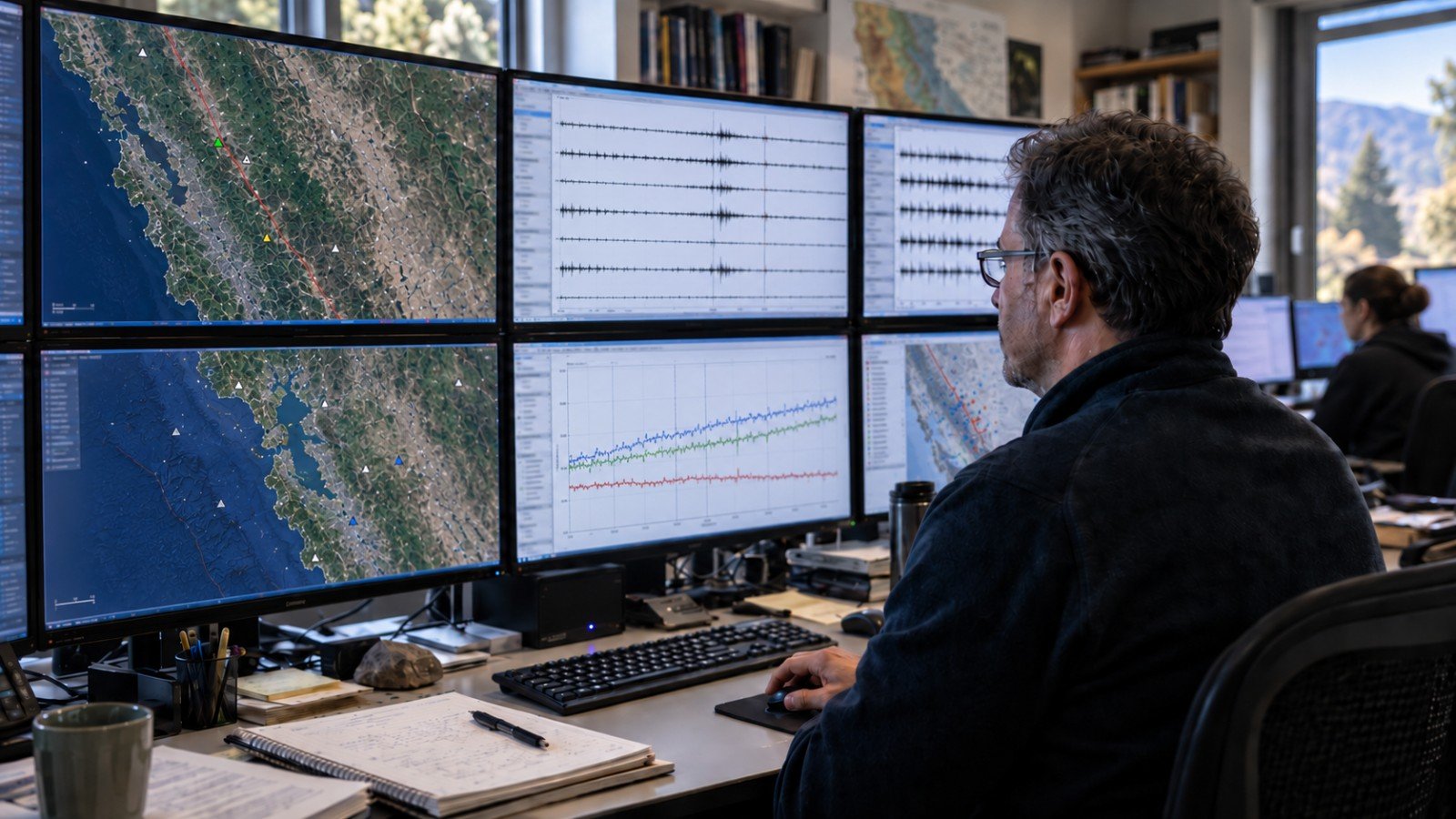
In the 1980s, Parkfield in California looked like the place where earthquake prediction might finally work. Moderate earthquakes had struck the same stretch of the San Andreas Fault at fairly regular intervals, so scientists expected the next one between 1988 and 1993. They covered the area with instruments and waited.
Nothing happened during the predicted period. A magnitude 6.0 earthquake finally struck on 28 September 2004, more than a decade outside the forecast window. The instruments recorded it in remarkable detail, but no clear short-term warning appeared.
This was not a vague prediction from a newspaper column. Parkfield was a serious scientific test on one of the most closely monitored fault sections in the world. Even there, scientists could not say when the earthquake would arrive.
What Counts as an Earthquake Prediction?
After almost every destructive earthquake, someone finds an old report or social-media post and says the event was predicted. Most of those claims are vague enough to fit many different earthquakes.
A warning that a major earthquake will strike somewhere along the Himalayas within the next few decades may be broadly correct. It still gives no date, city or magnitude. Nobody could order an evacuation from it.
The United States Geological Survey uses a stricter definition. A prediction must state the time, location and magnitude clearly enough to be tested. Seismologists cannot do that. They can estimate long-term risk and, after an earthquake, the chance of strong aftershocks. Those are forecasts, not exact predictions.
A Fault Does Not Follow a Timetable
Tectonic plates keep moving even when a fault is stuck. The rock around it slowly deforms and stores strain. Scientists can measure some of that movement, but not the condition of the whole fault.
A fault is not one smooth crack. It may run for hundreds of kilometres, split into branches underground and contain sections made from different rock. One patch may creep while the next remains locked. Fluids move through fractures, and earlier earthquakes leave stress unevenly spread along the fault.
GPS stations and satellites show how the surface is moving. They do not measure the exact stress or breaking strength of every section several kilometres below. Scientists can see that strain is building without knowing which patch will fail first or on what day.
A Small Rupture Can Still Become a Large One
An earthquake begins when a small part of a fault slips. Some ruptures stop within a few metres and produce a tremor that nobody feels. Others keep moving, break through stronger sections or jump onto a neighbouring fault. How far the rupture travels helps determine the final magnitude. At the beginning, however, a small earthquake and one that will grow much larger may not look very different.
Researchers still disagree on how much can be learned from the first few seconds. Some studies have found early clues to the final size. Under the cascade model, the difference between a small and large earthquake is whether the rupture stops or keeps spreading.
By the time those clues appear, the earthquake has already started. That information may help an early-warning system estimate the earthquake’s size. It still arrives too late to predict the event hours or days beforehand. A magnitude 8 earthquake may not look like one until the rupture has already crossed several fault sections.
The Problem with Warning Signs
Foreshocks appear before some large earthquakes, which makes them look like an obvious warning. The problem is that small earthquakes happen every day and most are followed by nothing larger. A quake is called a foreshock only after a bigger one occurs. At the time, it is simply another earthquake.
Worldwide, only about five per cent of earthquakes are followed by a larger nearby event within a week. Evacuating after every small quake would therefore be wrong most of the time.
Haicheng in China is the best-known apparent success. In February 1975, officials evacuated the city after a strong sequence of foreshocks and reports of ground and groundwater changes. A magnitude 7.3 earthquake followed, and the evacuation saved many lives. A year later, a magnitude 7.6 earthquake struck Tangshan without a comparable warning and killed hundreds of thousands. The signs seen at Haicheng were no help there.
Scientists have also investigated radon, groundwater changes, electromagnetic signals, slow fault movement and unusual animal behaviour. None has appeared consistently before large earthquakes.
In 2023, researchers combined 3,026 high-rate GPS records from 90 earthquakes of magnitude 7 or greater. They found a very small average movement during the final two hours before rupture. The findings were published in Science.
The signal became visible only after records from many past earthquakes were combined. Their times and locations were already known. It was far too weak to identify one approaching earthquake in real time.
Why Better Monitoring Has Not Solved It
More instruments will pick up movements that present networks miss, especially on the ocean floor and inside deep boreholes. They will improve forecasts and early-warning systems.
For exact prediction, researchers would need sensors close to the section that is about to fail. They would also need to know which small change matters and whether the first slip will stop or keep growing.
A fault may run for hundreds of kilometres and extend deep into the crust, so most of it cannot be monitored at close range. Measurements made at the surface are indirect. The weakest underground signals may never reach an instrument.
There is also a lot of noise to sort through. Rainfall, groundwater pumping, temperature changes and faulty equipment can all produce unusual readings. A real precursor must be separated from all of them.
Machine learning already helps seismologists find tiny earthquakes in noisy records and process large catalogues quickly. Laboratory experiments have even used algorithms to estimate when a repeatedly loaded block of rock will slip.
In laboratory experiments, researchers can repeat the same loading cycle hundreds of times under controlled conditions. Major earthquakes on natural faults may be centuries apart, while dense instrumental records cover only a few decades. Conditions also vary from one fault to another.
One physics-informed neural-network study used data equivalent to centuries of repeated fault motion. No well-monitored natural fault has produced a record of comparable length.
Early Warning Is Not Prediction
Japan, Mexico, Taiwan, China and parts of the United States already use earthquake early-warning systems. The name can be misleading because these systems act only after the earthquake has started.
Fast P-waves reach nearby sensors before the more damaging S-waves and surface waves. An electronic alert can travel faster than the shaking and warn places farther away. Depending on the distance, that may provide a few seconds or several tens of seconds. Trains can slow and gas valves can close automatically.
People close to the epicentre may receive nothing. The damaging waves can arrive before the system detects the earthquake, estimates its size and sends the alert. This blind zone often includes the places facing the strongest shaking.
Planning Without a Date
Since no exact date is available, preparation has to happen long before the earthquake. Fault maps and ground-shaking studies guide building codes and show which buildings, bridges and utility lines need strengthening. After an earthquake, seismologists also estimate the chance of further shocks.
Final Takeaway
No scientist can rule out a future breakthrough. A clear precursor may still be found. For it to work as a real prediction, that warning would need to appear before nearly every damaging earthquake, early enough for people to act, and rarely when no earthquake follows. Nothing known today does that.
A large earthquake may not reveal its final size when the first patch slips. The rupture can stop, keep moving or jump onto another fault. By the time its size becomes clear, the earthquake is already under way.
Scientists can identify dangerous regions and estimate probabilities. They cannot provide an exact date, location and magnitude because earthquakes do not produce the same clear warning every time. No method known today can reliably give the exact time, location and magnitude of a future earthquake.